Toyota opened its factory to its rival, and nothing was copied
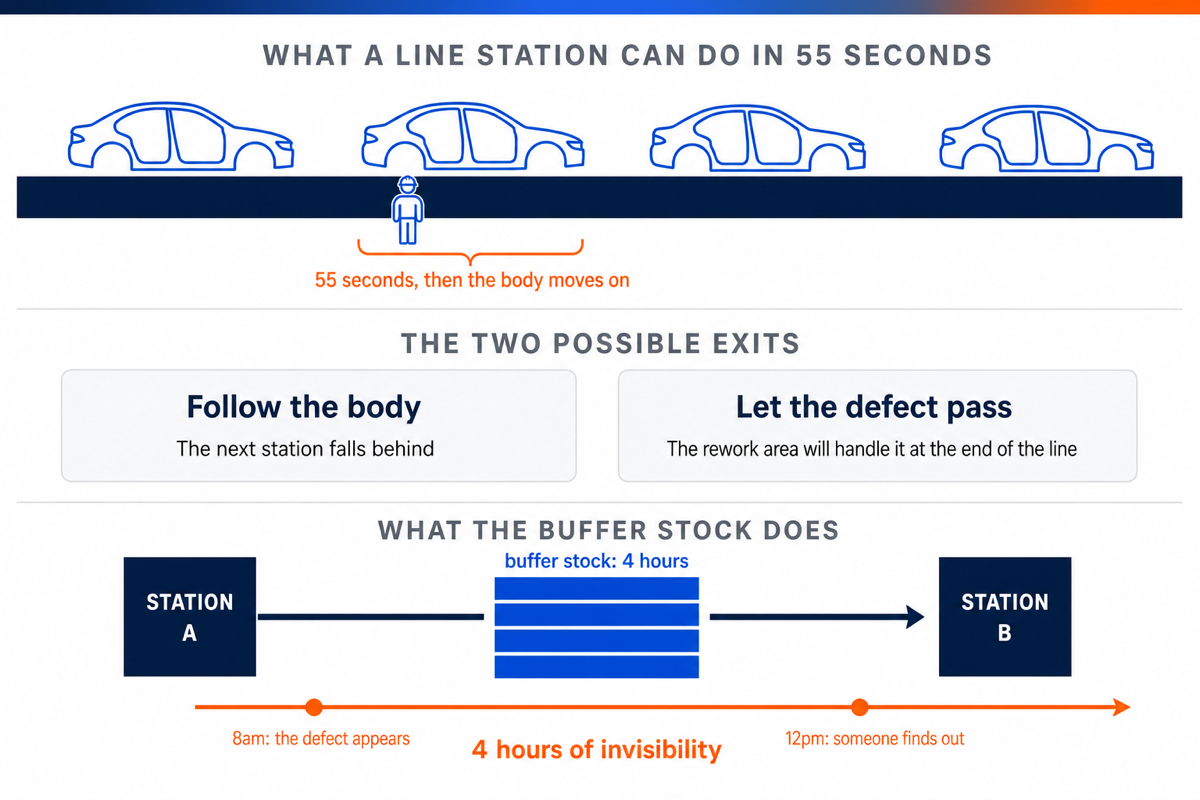
A car assembly line moves at constant speed. A body passes each station every fifty to sixty seconds, and the worker standing there has exactly that long to bolt, weld or fit the part they are responsible for. If they are not done when the body moves on, they have two options: follow the vehicle and abandon their station, or let the imperfect part go and rely on the rework area at the end of the line.
Every car plant knows this choice, and most settled it the same way for sixty years: the line does not stop. A stoppage idles several thousand people at once and reaches senior management immediately. To keep a local incident from spreading, buffer stocks are placed between stations so the downstream can keep going while the upstream is unblocked. The buffer is insurance, with a less discussed property: it makes the problem invisible for hours, sometimes days.
The vocabulary of the line
Cycle time : the number of seconds a station has before the next vehicle arrives.
Takt : a German word for musical meter, used at Toyota for the rhythm at which vehicles leave the line. It is derived from demand, not from machine capacity.
Buffer stock : a reserve of parts placed between two stations, allowing the downstream to continue if the upstream halts.
Rework area : the space at the end of the line where defects found at final inspection are repaired, often by dismantling what has just been assembled.
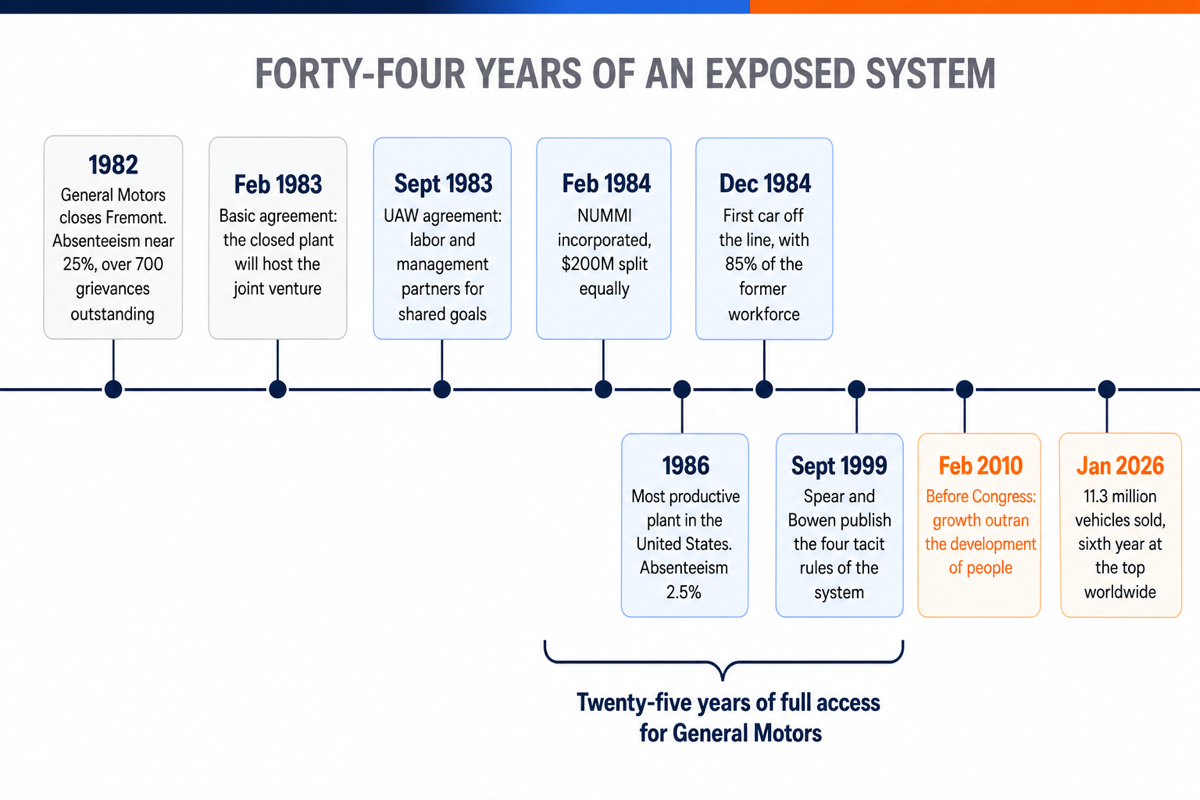
In 1982, General Motors closed an assembly plant in Fremont, California, reputed to be the worst in the group. Its productivity and quality ranked among the poorest in the entire General Motors system, absenteeism ran at roughly 20 to 25 % depending on the source, with the most detailed academic study putting it near 25 % at closure, and more than seven hundred union grievances were still outstanding the day the doors shut. Eighty-two industrial engineers defined how the work was to be done, and the collective agreement carried more than eighty job classifications.
Two years later the same plant reopened under another name, New United Motor Manufacturing, Inc., a joint venture between General Motors and Toyota. Eighty-five per cent of those hired were former employees of the closed plant, and the same union, the United Auto Workers, known by the initials UAW, still represented them. Within two years the plant became the most productive in the United States, and its main model ranked in the highest quality category with consumers and with General Motors internal audits alike.
This story is almost always told as a demonstration about people: same workers, different result, so the problem was never the workers. That is true and insufficient, because what makes the case useful is not what it proves but what it failed to produce.
For the twenty-five years of this shared plant, General Motors had complete, daily, contractual access to the most studied operating system of the twentieth century. It sent its managers there and brought back manuals. It never reproduced it anywhere else.
This extends what we looked at regarding what an incentive actually displaces: what travels inside a company is never what you believe you are transmitting.
What an assembly line forbids
The system installed at Fremont came from a financial constraint. After the war Toyota built a few thousand vehicles a year, in a home market too small to justify the long runs that made Detroit's economics work, and without the capital to hold inventory. Taiichi Ohno, an engineer and later a plant manager, spent thirty years building an organisation that draws its performance from the absence of reserves, described in his Toyota Production System: Beyond Large-Scale Production, published in 1978.
The idea holding it together is not just-in-time, which is only its logistical consequence. It comes from textiles. Sakichi Toyoda, founder of the company Toyota grew out of, had designed a loom that stopped itself the moment a thread broke, so that a single operator could watch several. Toyota named the principle jidoka and carried it over to stations held by people.
Jidoka, andon, fixed-position stop
Jidoka : the principle that a machine or a station halts as soon as an anomaly appears, rather than continuing to produce defects. Often rendered as automation with a human touch.
Andon : a cord or button within reach of every station, which flags a problem and summons a team leader. The light board displaying the location of the alert carries the same name.
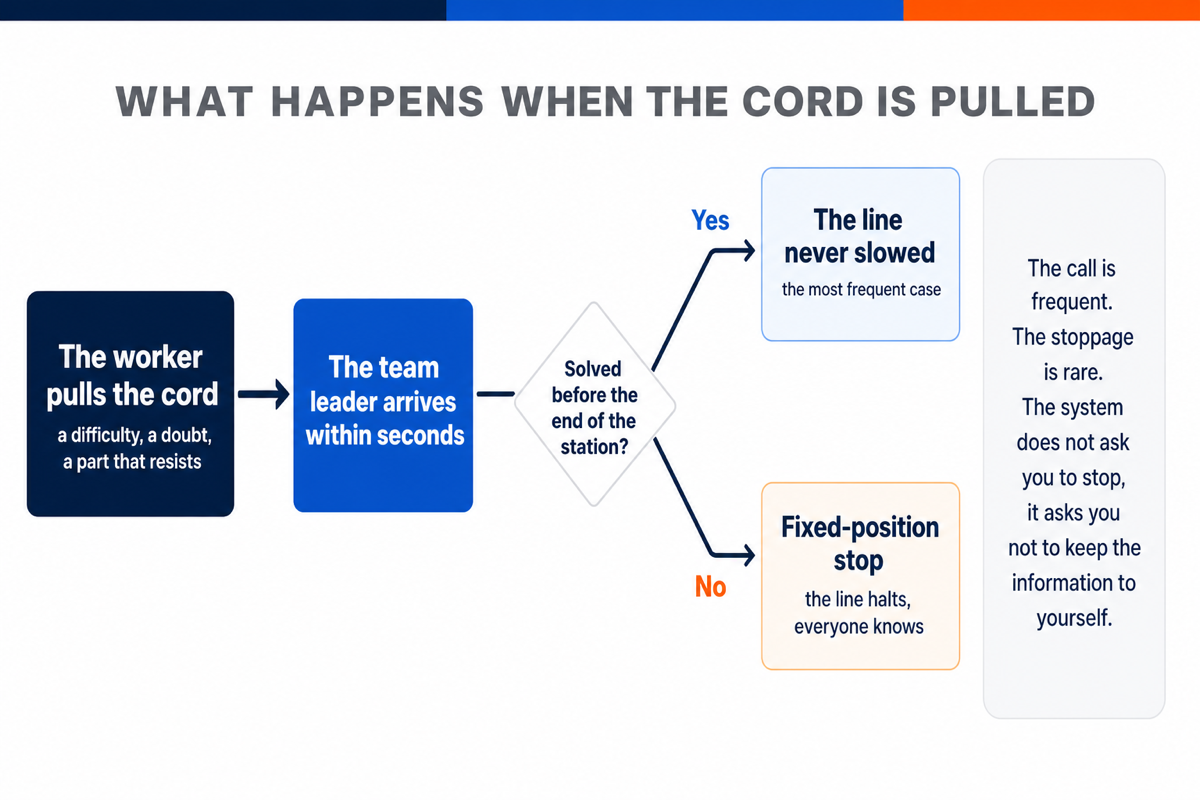
Fixed-position stop : the convention that an andon call halts the line only if the problem is unresolved by the time the vehicle reaches the end of the station. The call is therefore frequent, the stoppage far rarer.
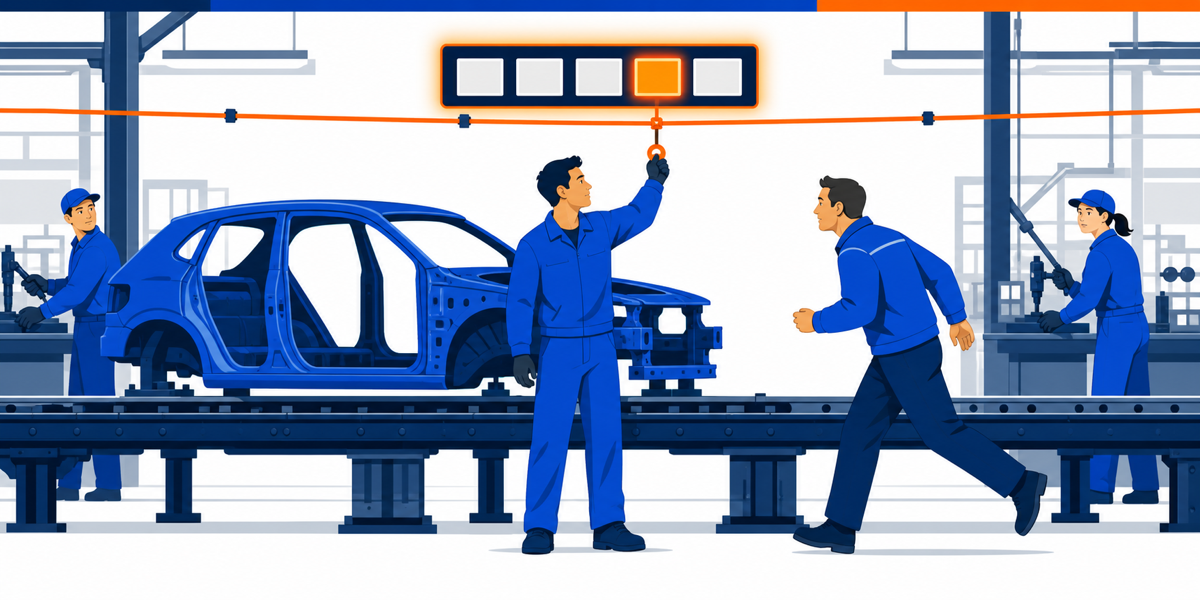
A worker who hits a difficulty, a doubt, a part that resists, pulls the cord, and a team leader arrives within seconds. If the problem is solved before the body reaches the end of the station, the line never slowed. Otherwise it stops. The convention is misread when it is reduced to "anyone can stop the factory": what is being asked for is not a stoppage, it is a call.
An organisation is not judged on the number of problems it runs into, which is roughly constant everywhere, but on the delay between a problem appearing and the moment someone whose job it is finds out. The rest follows.
Removing inventory then becomes a management decision rather than a saving. A four-hour buffer means a defect appearing at eight in the morning will be spotted at noon, on a batch already built, by someone who was not there and can no longer reconstruct the cause. Taking it out does not only free up cash, it brings detection and cause close enough together that they become one event.
That leaves the question this description opens up: why would a worker pull the cord? Whoever flags their own delay marks themselves as the slow link, and whoever proposes an improvement that removes half an hour of work a day is pointing at someone.
Toyota answered the objection with a contract rather than a speech. The collective agreement signed at Fremont in 1985 committed the company not to lay anyone off short of economic conditions threatening its viability, and required it first to cut executive pay and bring subcontracted work back in house. The commitment held: in 1988 the plant was running at under 60 % of capacity with no layoffs. Mark Hogan, then comptroller and general manager of general affairs at the venture, explained why the clause belonged to the production system rather than to social policy: team members know that contributing ideas for more effective operations puts nobody's job at risk.
What each party came for
An organisation of this kind is not explained by looking only at whoever designed it. Three parties signed, and each accepted something contrary to its apparent interest.
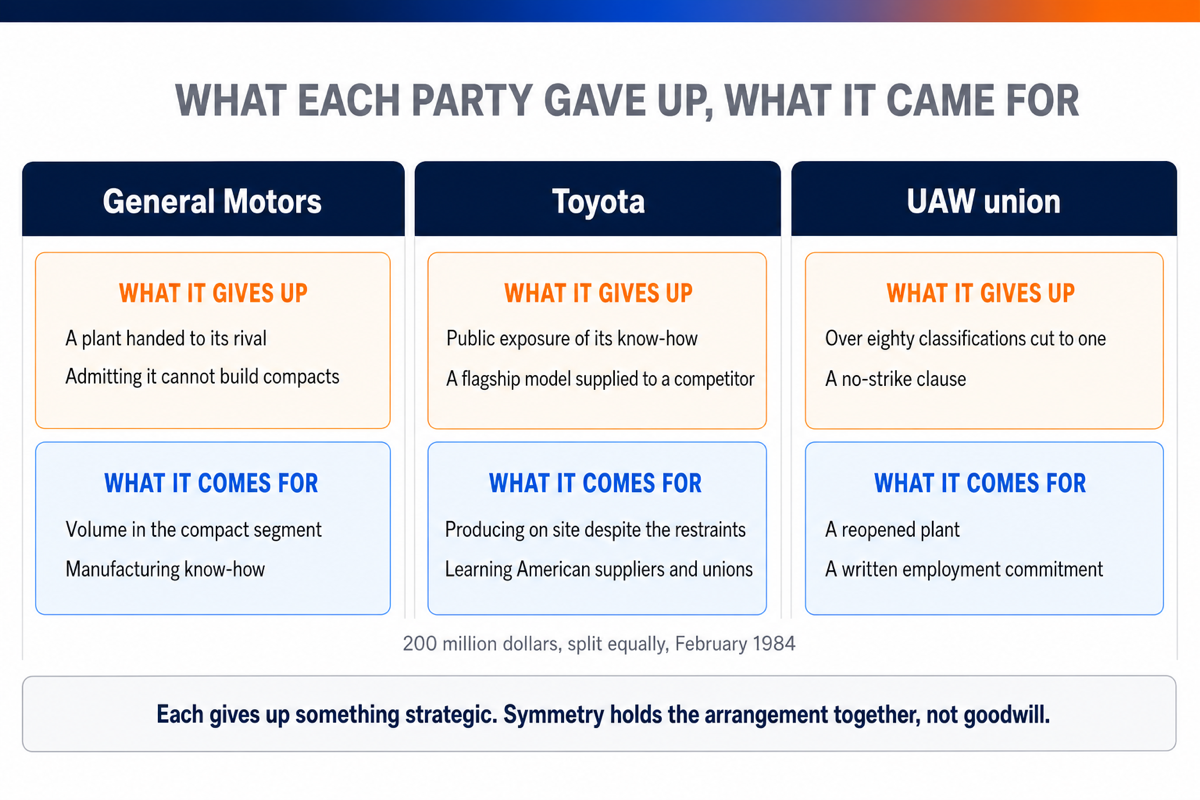
General Motors had failed to develop a profitable compact car in house and was being supplied insufficient volumes by Japanese partners. It was therefore after both volume and compact-car manufacturing know-how. Installing your competitor in one of your own plants in order to learn how to build is an uncomfortable position, and was owned as such.
Toyota, for its part, no longer exported freely: voluntary restraints had applied to passenger cars built in Japan since fiscal 1981, and Congress was examining local content bills. Producing on site was becoming less a choice than a deadline, and the venture allowed it with two hundred million dollars contributed equally, while learning American suppliers and a union it did not know. The calculation did not win unanimous internal support, and the company's official history says so plainly: the production divisions worried about disclosing their know-how, the sales divisions about supplying a flagship model to a rival. Both objections were set aside, and in April 1984, in Nagoya, Eiji Toyoda, chairman since 1982, presented the project by stating that "the spirit of competition and cooperation is the foundation that supports global economic development".
Toyota knew it was exposing its system and did it anyway. That is not generosity, it is a bet on the nature of what was being exposed: perfectly observable practices that observation does not suffice to acquire.
The union, finally, conceded what no local accepts gladly: the eighty job classifications of the old contract became a single one for production staff, the eighteen skilled trades classifications were cut to two, and the agreement carried a no-strike clause. In exchange its members got an open plant, a written employment commitment, and teams of five to seven people where the standards were written by those who worked to them. The text concluded in September 1983 with UAW national leadership held that "labor and management are partners for achieving shared goals", a formulation without precedent in the American car industry at the time.
The reversal: more rules, not fewer
The Fremont story circulates today in a form that suits everyone: Toyota supposedly freed the workers from a Taylorist straitjacket, and that restored trust explains the performance. The documented record says the opposite.
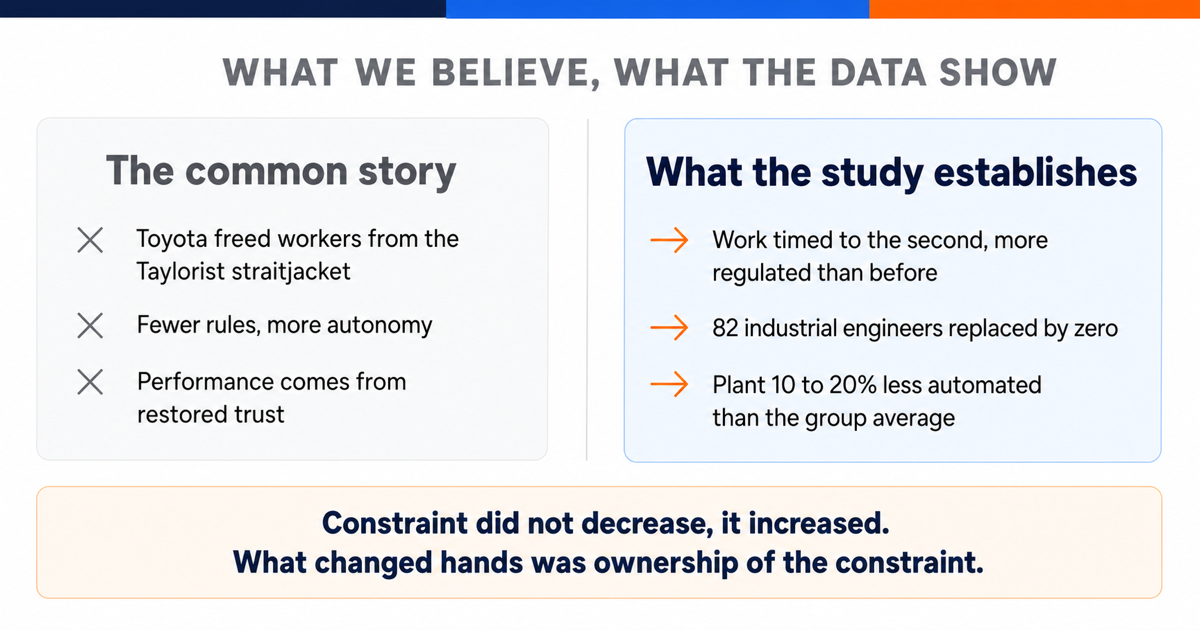
Paul Adler, a professor at the University of Southern California, spent several years in the plant interviewing managers, workers and union officials, and published a detailed study of it in 1993. The work there was standardised down to the gesture and timed to the second, far more so than under General Motors. One plant manager saw in it the intelligent interpretation and application of Taylor's time and motion studies. Standards had to be identical across shifts and negotiated with the stations upstream and downstream, and the procedure for changing them was itself standardised.
The difference came down to a single point, structural rather than moral: standards were no longer written by a dedicated department, but by the teams that worked to them. The old plant employed eighty-two industrial engineers for that task. The new one employed none.
Constraint had not decreased, it had increased. What changed hands was ownership of the constraint.
Standardised work, kaizen, kanban
Standardised work : a written description of the sequence of gestures at a station, the time allotted to each, and the minimum stock required. At Toyota this document is written and revised by the team holding the station.
Kaizen : continuous improvement through small changes tested locally, as opposed to a transformation programme decided centrally.
Kanban : a card travelling with a batch of parts, carrying the reference, the quantity and the receiving station. It forbids producing more than the downstream has consumed.
The second element sits even less comfortably: the plant was ten to twenty per cent less automated than the group average, according to the executive who ran it on the General Motors side. The performance came neither from higher investment, nor from proprietary technology, nor from a different workforce, but from an architecture of rules, free to state and expensive to hold.
The first four years read against the seven hundred grievances outstanding in 1982: around thirty grievances filed, three of them taken to arbitration, average absenteeism of 2.5 %, turnover between 6 and 8 %, and more than 70 % of employees taking part in the suggestion programme each year, at roughly six suggestions per person.
That leaves the central puzzle. General Motors owned half of this plant, under an agreement whose initial term ran twelve years, and rotated its managers through it for a quarter of a century. It had the written standards, the layouts, the numbers and staff trained on site. The results never spread through the rest of the group.
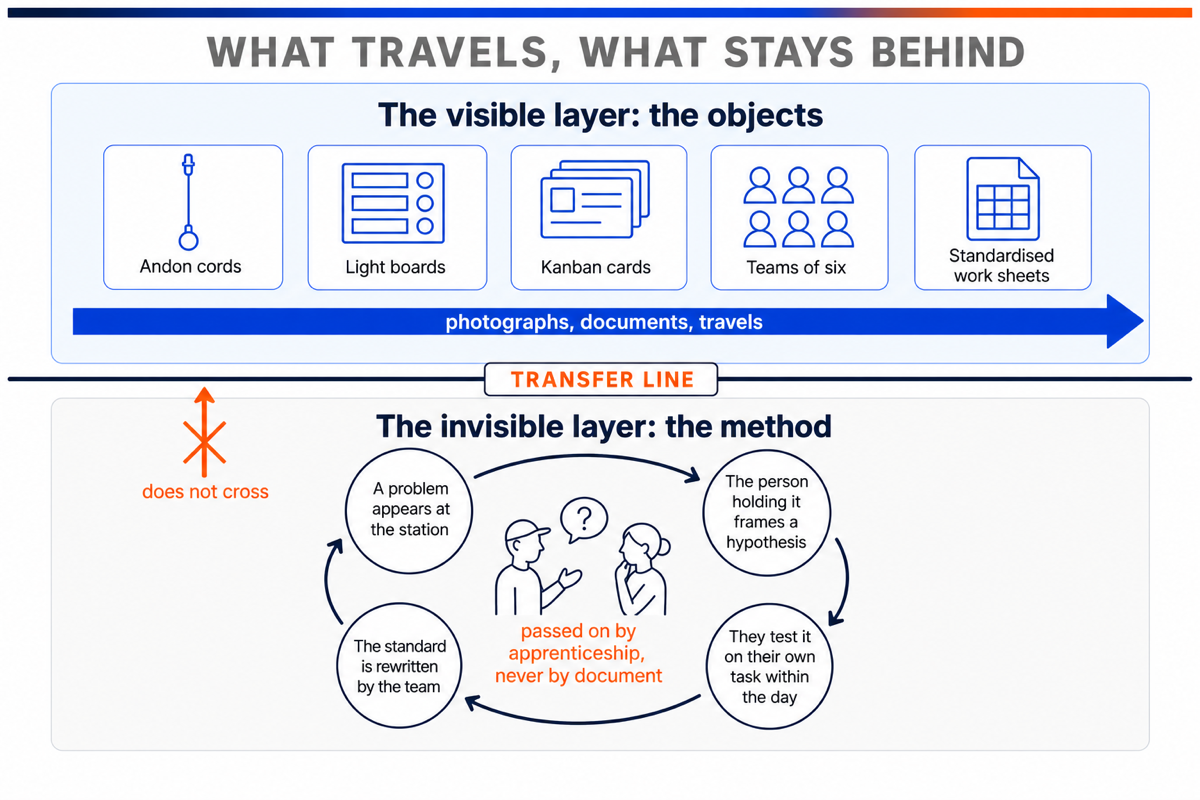
Steven Spear and H. Kent Bowen spent four years in more than forty plants answering that question, and their Decoding the DNA of the Toyota Production System, published in the September 1999 Harvard Business Review, gives a disconcerting answer. Toyota employees are not taught the rules of the system when they arrive. They discover them by solving problems, guided by a supervisor who asks questions rather than supplying answers. The rules are written down nowhere because they are not content. They are a method for producing content.
The four rules of Spear and Bowen
Rule 1 : all work is highly specified as to content, sequence, timing and outcome.
Rule 2 : every customer-supplier connection is direct, with an unambiguous way to send requests and receive yes-or-no responses.
Rule 3 : the pathway for every product and service is simple and direct, with no branching left to whoever happens to be free.
Rule 4 : any improvement is made according to the scientific method, under the guidance of a teacher, at the lowest possible level of the organisation.
The first three rules explain the rigidity Adler observed, and why it was not the enemy of flexibility: a task specified to the second is a refutable hypothesis, a vague instruction can be neither checked nor corrected. The fourth explains why the plant improved without anyone steering the improvement.
What you can copy from a Toyota plant are its outputs: the cords, the light boards, the kanban cards, the teams of six. They are the answers of thousands of local experiments. Installing them elsewhere means copying answers without the method, which holds exactly as long as the question stays the same.
What a leader can do with this tomorrow morning
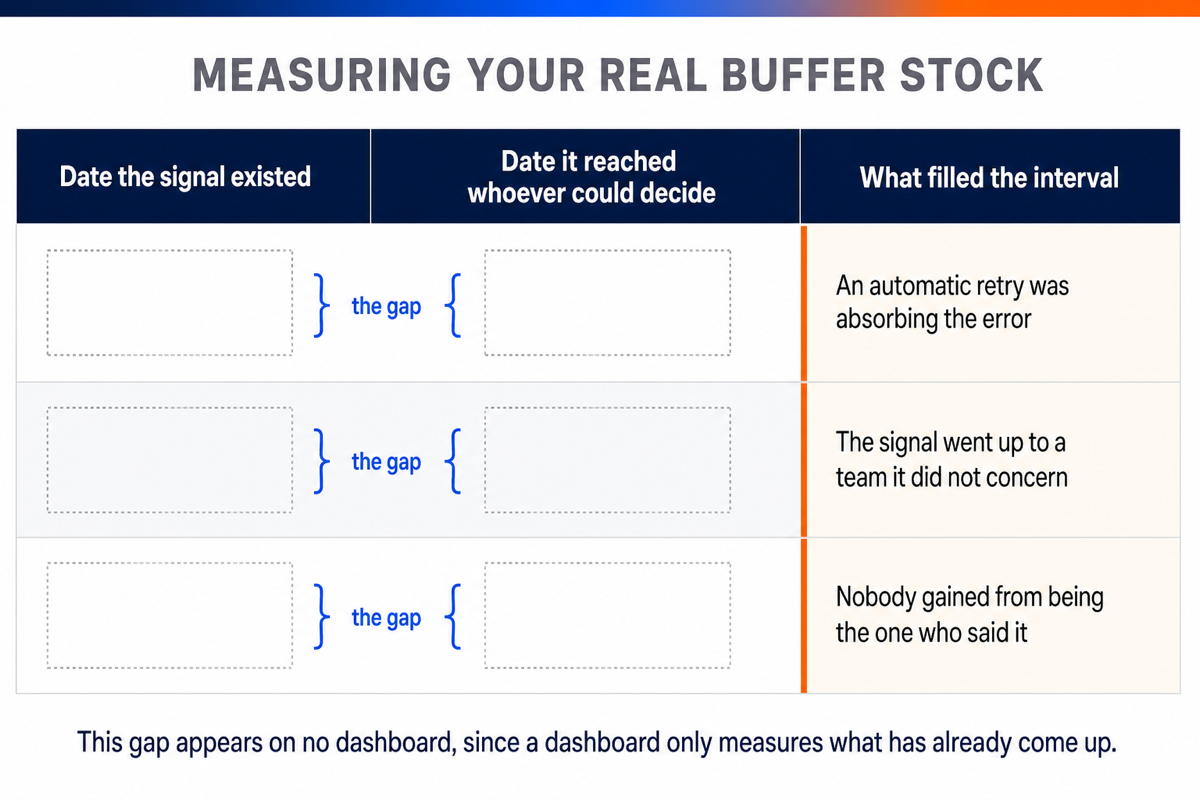
The useful exercise is not to install alert cords in any digital form. It is to measure, for each category of problem, the delay between its appearance and its arrival upstream, then to look for what in the organisation funds that delay.
Of those four rules, the fourth is the one that goes missing fastest in a transplant, and it contains the other three. An improvement decided in committee and rolled out by a project team teaches nobody anything. The same improvement framed as a hypothesis by the person holding the station, tested on their own task and settled within the day, produces a change to the process and someone able to produce another one next month.
The mechanism shows up far from industry. In several organisations, a technical team sets up automatic retries on calls failing between two services, so the user never sees an error. The visible incident rate drops to almost nothing and management concludes reliability has improved. What has been installed is a buffer stock: the retry absorbs the defect, nobody learns about it, and the cause degrades until the day volume exceeds what the retry can absorb. The outage then arrives all at once, on a root cause months old.
The question turns concrete as soon as decisions are delegated to software agents. An agent that silently retries, reframes its request until it gets an acceptable answer and works around the obstacle rather than flagging it behaves like a line with generous buffers: it holds the pace and deprives you of the information that would let you correct. What matters is not the number of retries allowed, it is what triggers a call rather than a workaround.
Toyota itself demonstrated that this capability is never permanently acquired. Between 2009 and 2010 the company recalled several million vehicles. On 24 February 2010, before the House Oversight and Government Reform Committee, Akio Toyoda, then president of Toyota Motor Corporation, gave an explanation that mentioned neither supplier nor component: the priorities, safety first, quality second, volume third, had become confused, and the company was no longer able to stop, think and improve as much as it had been before. Then this sentence from his written testimony: "We pursued growth over the speed at which we were able to develop our people and our organization, and we should sincerely be mindful of that."
That is not an anomaly, it is the nature of the system: a method transmitted through individual apprenticeship cannot grow faster than the capacity to train those who teach it. The recovery reads in the figures published on 29 January 2026: 11,322,575 vehicles sold worldwide in 2025 including Daihatsu and Hino, up 4.6 %, on production of 11,221,960 units. Two records, and a sixth consecutive year at the top of the global ranking.
That leaves the exercise. Take the last three serious incidents handled in your organisation and find, for each, the date the first signal was perceptible, and the date it reached whoever could decide. The gap is your real buffer stock. It appears on no dashboard, since a dashboard only measures what has already come up.
The builder's question
This inventory is not done in a management meeting, where the incidents will be recounted to you in their reconstructed version. It is done by asking those who saw the first signal why they did not raise it sooner, and listening to the answer without correcting it. It is almost always rational, and it always describes a rule of your organisation, never a character trait. Only then does the following question stop being rhetorical.
In your organisation, what does it cost the person who pulls it to pull the cord you say you want pulled?
Sources: As of February 2026
- [Primary] — NUMMI established, A 75-Year History through Text — Toyota Motor Corporation — 2012 — https://www.toyota-global.com/company/history_of_toyota/75years/text/leaping_forward_as_a_global_corporation/chapter1/section3/item2.html
- [Primary] — NUMMI starts production, A 75-Year History through Text — Toyota Motor Corporation — 2012 — https://www.toyota-global.com/company/history_of_toyota/75years/text/leaping_forward_as_a_global_corporation/chapter1/section3/item2_a.html
- [Primary] — Prepared Testimony of Akio Toyoda, President, Toyota Motor Corporation, Committee on Oversight and Government Reform — Toyota Motor Corporation — 24 February 2010 — https://global.toyota/en/detail/2364044
- [Primary] — Honorary Chairman Toyoda Enters U.S. Automotive Hall of Fame — Toyota Motor Corporation — 16 September 1994 — https://global.toyota/en/detail/7865933
- [Primary] — Sales, Production, and Export Results for 2025 (January-December) — Toyota Motor Corporation — 29 January 2026 — https://global.toyota/en/company/profile/production-sales-figures/202512.html
- [Primary] — The "Learning Bureaucracy": New United Motor Manufacturing, Inc., Research in Organizational Behavior — Paul S. Adler, University of Southern California — 1993 — http://faculty.marshall.usc.edu/Paul-Adler/research/NUMMI(ROB)-1.pdf
- [Primary] — Decoding the DNA of the Toyota Production System — Steven Spear and H. Kent Bowen, Harvard Business Review, vol. 77 no. 5, pp. 97-106 — September 1999 — https://hbr.org/1999/09/decoding-the-dna-of-the-toyota-production-system
- [Primary] — Decoding the DNA of the Toyota Production System, article record — Harvard Business School Faculty & Research — 1999 — https://www.hbs.edu/faculty/Pages/item.aspx?num=6524
- [Primary] — Four Rules in Use, statement of the Spear and Bowen rules — Durward K. Sobek II, Montana State University — undated — https://www.montana.edu/dsobek/a3/ioc-grant/status/four-rules.html
- [Secondary] — Decoding the DNA of the Toyota production system, article summary — Management And Accounting Web, University of South Florida — 2003 — https://maaw.info/ArticleSummaries/ArtSumSpearBowen99.htm
- [Secondary] — 2025 (Full Year) Global: Toyota Worldwide Car Sales by Country — Car Sales Statistics — 2 February 2026 — https://www.best-selling-cars.com/brands/2025-full-year-global-toyota-worldwide-car-sales-by-country/
- [Secondary] — NUMMI, historical record and joint venture timeline — Wikipedia — accessed August 2026 — https://en.wikipedia.org/wiki/NUMMI
- [Secondary] — Toyota Production System: Beyond Large-Scale Production, Taiichi Ohno — Productivity Press, English edition 1988, Japanese original 1978
- [Secondary] — The Toyota Way: 14 Management Principles from the World's Greatest Manufacturer, Jeffrey K. Liker — McGraw-Hill, 2004

Comments ()