An incentive doesn't add effort, it moves it

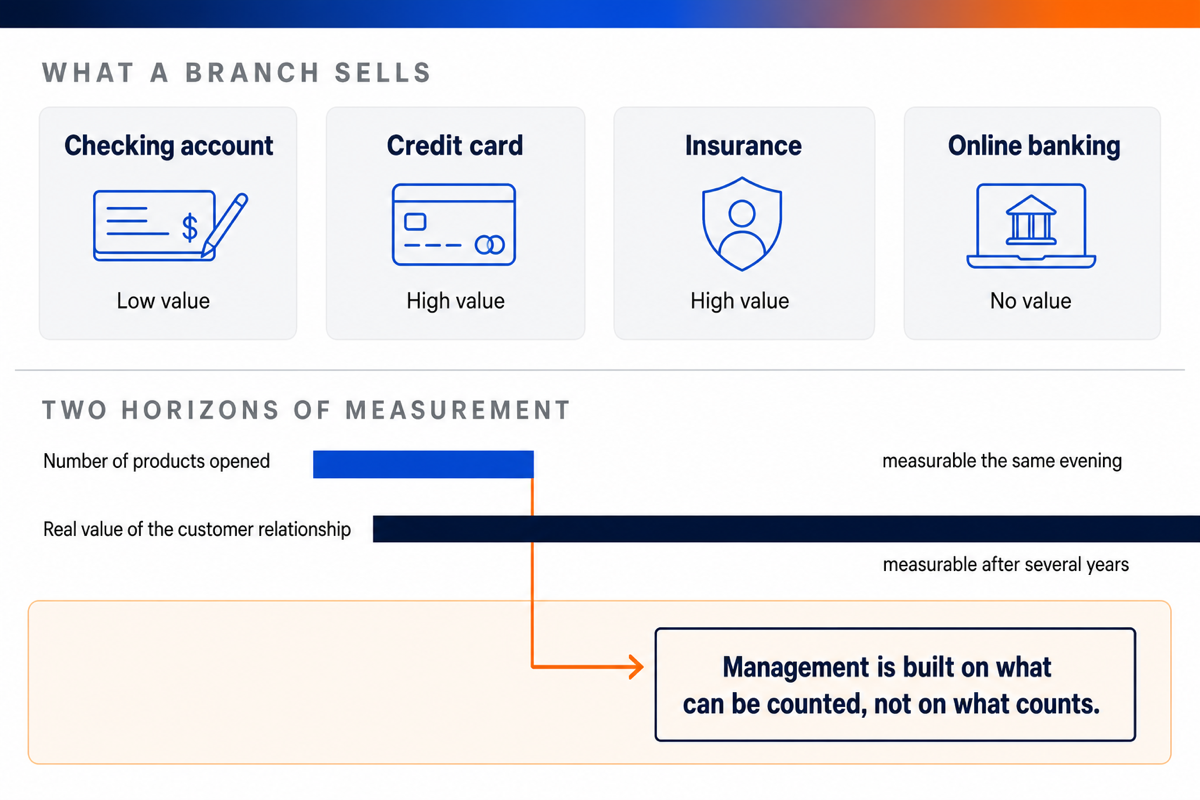
A bank branch sells products that have nothing in common. A checking account, a credit card, an insurance policy, online banking access. Some are highly profitable, others worth nothing, and the value of a customer relationship only becomes measurable after several years. One thing alone can be counted at close of business: the number of products opened. That asymmetry, not any management theory, decides what will be managed.
Out of it came the indicator that built one American bank's reputation for twenty years, the cross-sell ratio: the average number of products held by a single customer household. The higher it climbs, the more the bank is credited with deepening its relationships rather than buying new ones. Analysts tracked it quarter after quarter, and it counted as proof of quality.
The vocabulary of retail banking
Cross-selling : selling an additional product to a customer who already holds one. A legitimate practice when it meets a need, since an existing customer costs less to serve than a new one.
Cross-sell ratio : the average number of products held per customer household. This is the indicator the bank published to demonstrate the depth of its relationships.
Household : the counting unit used, a customer household rather than an individual.
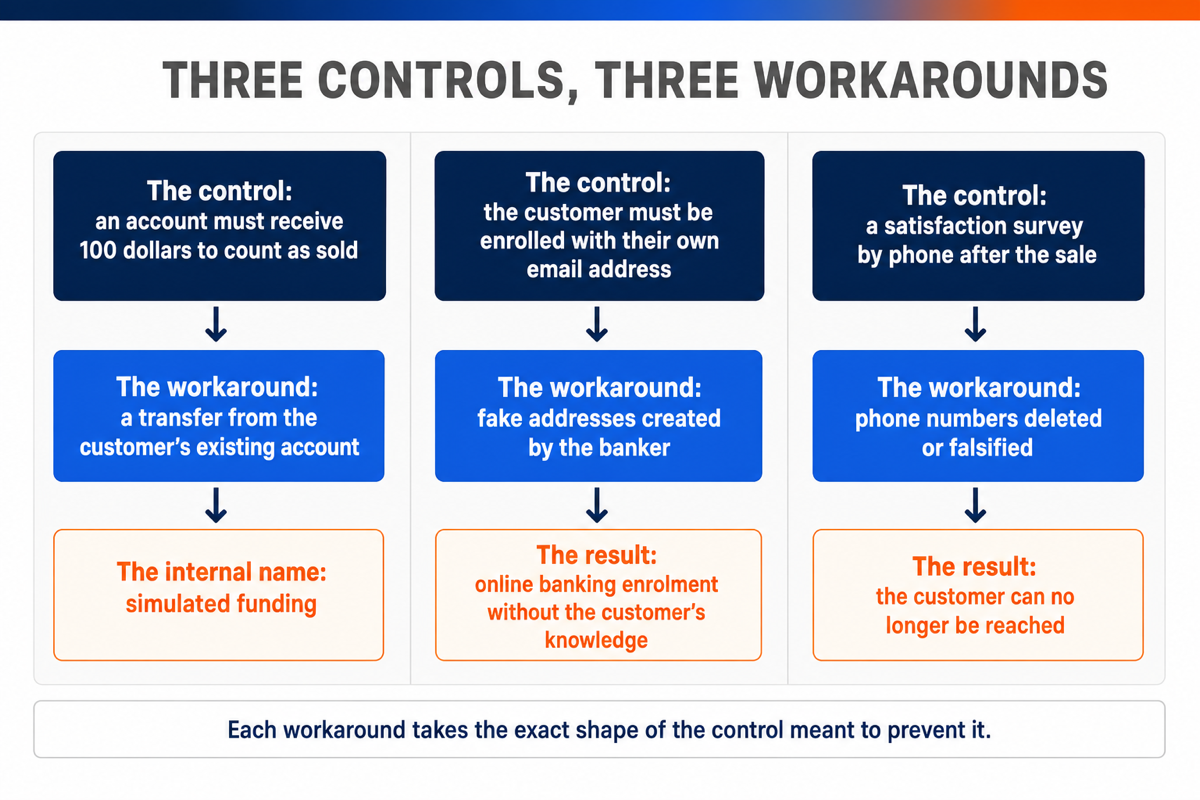
Then a branch employee describes, in an internal investigation, what everyone understood when the manager said it was late in the day and a certain number of accounts were needed before closing. Nobody needed the rest spelled out. Between 2011 and 2016, roughly 1.5 million deposit accounts and 565,000 credit card applications were opened in the names of customers who had not asked for them, fake email addresses were used to enrol people in online banking, and one branch manager had at least 192 customer phone numbers deleted so those customers could not be surveyed about their satisfaction.
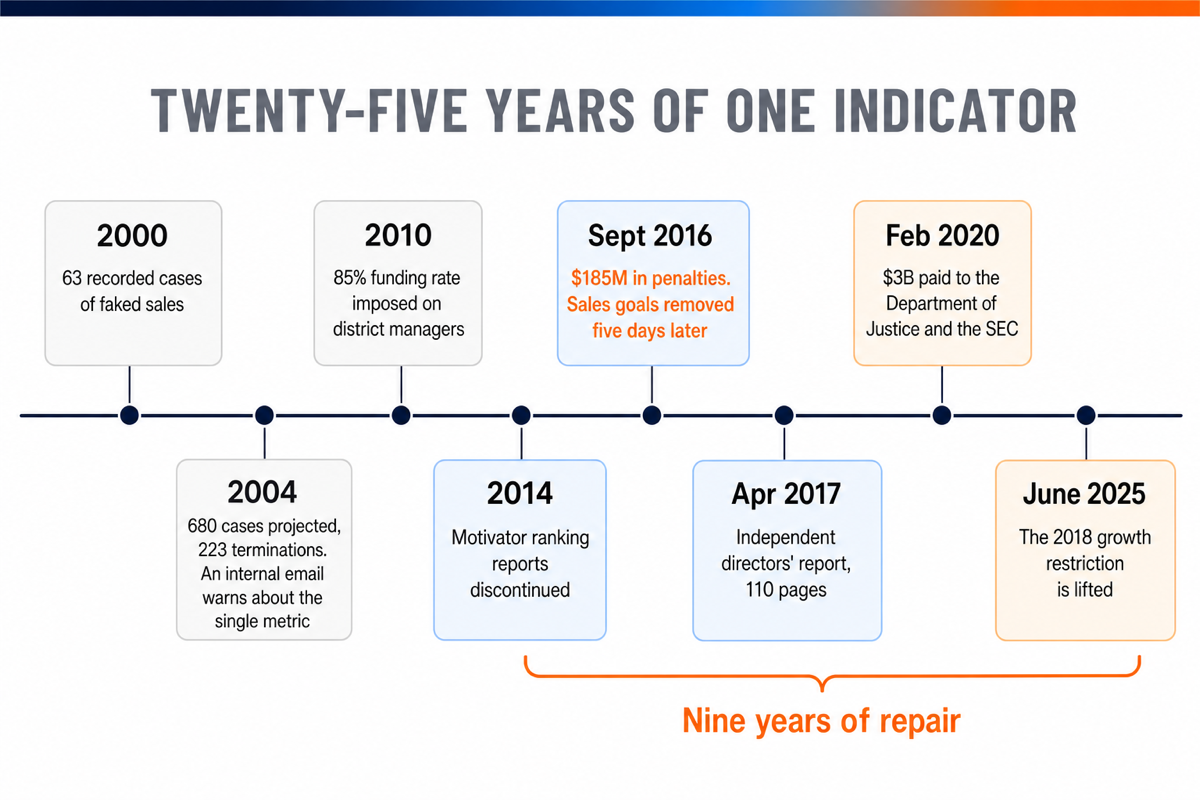
The bank is Wells Fargo. On 8 September 2016, the Consumer Financial Protection Bureau fined it 100 million dollars, on top of which came 35 million paid to the federal banking regulator and 50 million to the City and County of Los Angeles. Richard Cordray, then director of the CFPB, summed up the mechanism in one sentence: "Wells Fargo employees secretly opened unauthorized accounts to hit sales targets and receive bonuses." In February 2020, the bank paid three billion dollars to close the Department of Justice and Securities and Exchange Commission investigations.
The explanation that took hold comes down to one word: the bonus.
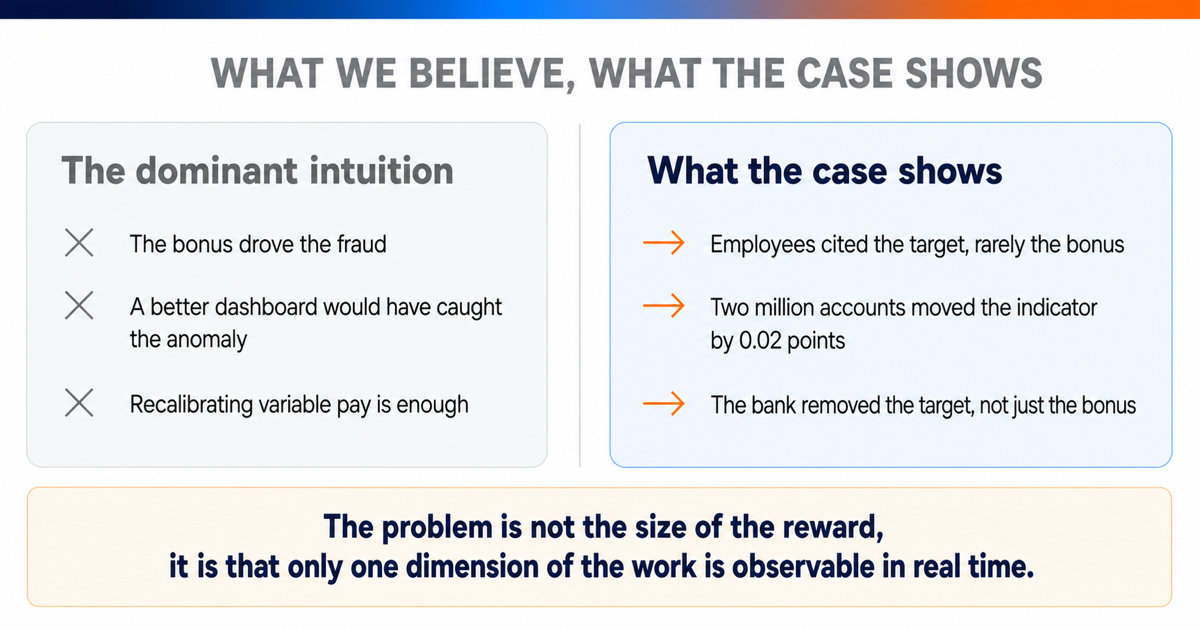
Employees supposedly cheated because they were paid per product sold. That is largely false, and it is what makes the case useful. The report commissioned by the bank's independent directors concludes that the employees involved rarely cited their variable pay.
What the report describes is more troubling than a miscalibrated bonus, because a miscalibrated bonus can be fixed. It describes a system in which the numerical target, on its own, was enough to redirect the work of tens of thousands of people toward the single dimension that could be counted.
This follows directly from what we discussed about how organisations pick the wrong problem: a system does not produce what you ask of it, it produces what its structure makes measurable.

What a numerical target becomes on its way down
The investigation report was delivered on 10 April 2017 by a committee of four independent directors chaired by Stephen Sanger. It runs to 110 pages, draws on around a hundred interviews and more than 35 million documents, and has the rare merit of describing not what happened but by what route.
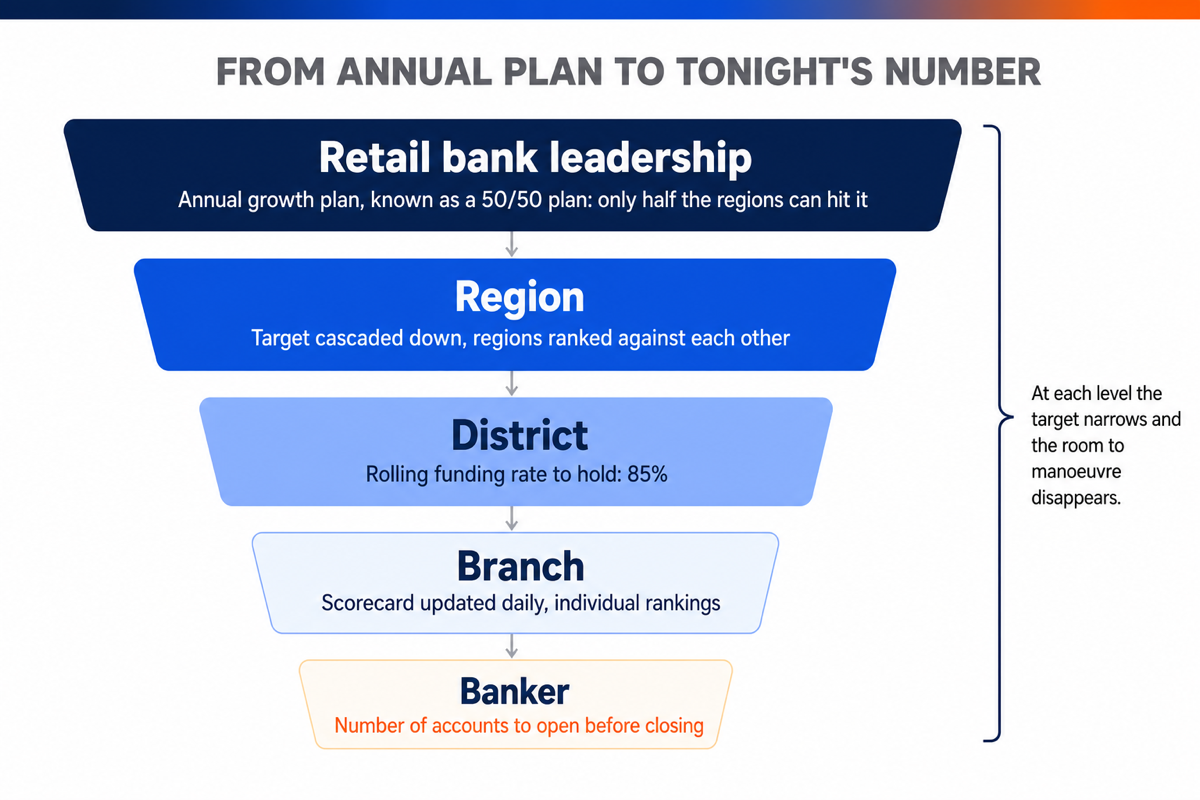
Sales targets were set at the top of the retail bank, then cut by region, by district, by branch, by person. At every level, an employee was measured against their target and ranked against their peers, and both variable pay and promotion prospects followed from that relative position. The report notes that leaders knew their plans were out of reach: internally they were called 50/50 plans, because only half the regions were expected to make them.
Two instruments carried the information. Daily and monthly ranking reports, called Motivator, which displayed results down to district level. And branch scorecards, updated every day, comparing each employee to the plan. Some managers, witnesses said, lived and died by the Motivator. Those reports were discontinued in 2014, at the request of regional leaders themselves, because of the culture of shaming they sustained.
The vocabulary of internal management
50/50 plan : a sales plan calibrated so that only half the regions can hit it. The gap is not a forecasting accident, it is a deliberate choice of tension.
Rolling funding rate : the share of newly opened accounts that actually receive money, used as a sales quality indicator. From 2010, a district manager had to hold 85 percent or risk a reduction in variable pay.
Simulated funding : a transfer made by the banker from the customer's existing account into the account just opened, to make it appear active. Internal policy required 100 dollars for an account to earn sales credit.
That last point shows what becomes of a safeguard in a system under tension. The 100 dollar threshold had been introduced to prevent precisely what followed, empty accounts counted as sales. It produced the opposite. Since an unfunded account was worth nothing, it had to be funded, and the only money available was the customer's own. The quality control manufactured the workaround.
The trend had been visible for a long time. A 2004 memorandum from the internal investigations group notes that cases of sales gaming, sales faked to hit a target or earn a bonus, rose from 63 in 2000 to a projected 680 in 2004, with terminations rising from 21 to 223. Twelve years before the fine, the organisation had a curve and knew how to read it.
An incentive doesn't create effort, it redirects it
The idea that incentives matter is not new. Charlie Munger, long the vice chairman of Berkshire Hathaway, made it the first of his causes of human misjudgment in a talk at Harvard in 1995: he placed himself in the top five percent of his generation for understanding the power of incentives, and reckoned he had underestimated it all his life.
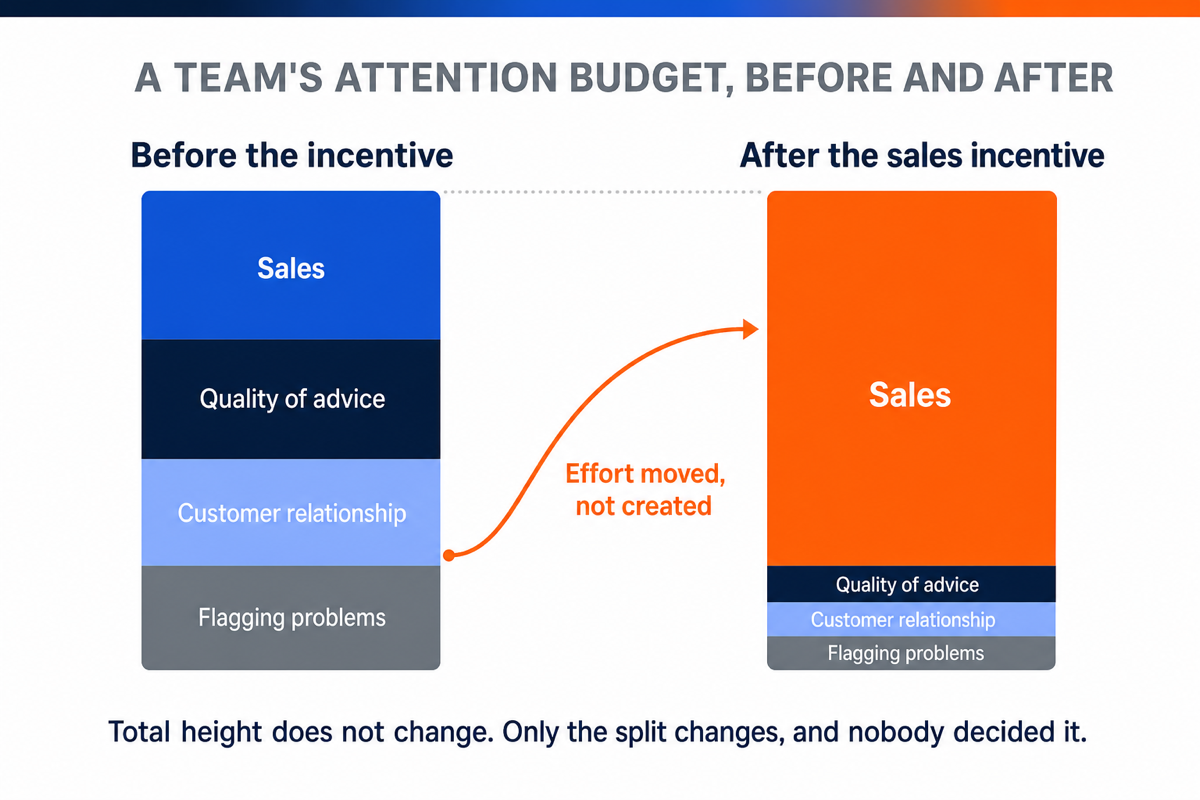
What remains poorly absorbed is the nature of the effect. We speak of incentives as though they added energy to a system, as though rewarding one thing conjured up work that did not exist. Yet a team's time, attention and decision-making capacity form a largely fixed budget over any given week. Rewarding one dimension of the work does not manufacture extra hours, it draws down the others.
An incentive therefore never answers the question "how do we get more". It answers "what will my teams stop paying attention to", a question almost nobody asks before signing a compensation plan.
Steven Kerr named this fault in 1975, in an Academy of Management Journal article still known by its title: on the folly of rewarding A while hoping for B. His thesis was simple. Organisations describe at length what they hope for, then build their reward system on something else, and are surprised to get that something else. Donella Meadows places the same mechanism among the powerful levers of a system, fifth on her 1999 list: the rules, meaning incentives, punishments and constraints.
Which leaves the question this description opens up, and it is the one that separates analysis from a cautionary tale: why did those who saw the problem carry on?
Regional leaders were not passive. Lisa Stevens, then West Coast regional bank executive, became known for repeatedly flagging how aggressive the targets were. In August 2012, at a meeting with retail bank leadership, one participant asked that secondary checking accounts, sold to customers who already held one, be removed from incentive plans because they pushed bankers toward valueless sales. The request went nowhere. Those leaders were themselves assessed on the plan they contested, with sales carrying 20 to 25 percent of their own variable pay. Contesting the plan and delivering it were not competing options, they were the same working day.
Carrie Tolstedt's case is more troubling still. Made head of regional banking in 2002, then head of the whole retail bank in 2007, she was writing to John Stumpf, the future chief executive, as early as 2004. The report quotes her email: "I think you have to balance cross sell with the right incentive plan and other measures so that you ensure you have quality cross sell. Many banks build products that encourage the wrong sales behavior. Then if you incent a team of bankers on top of that around sales per day alone you are asking for trouble." And further on: "If you look at one metric alone and don't build an integrated model, you are asking for low value, unfunded bad cross sell." The report closes the quotation with a dry sentence: she did not follow her own advice.
There is no psychological mystery to look for here. The person who wrote that analysis and the person who sustained the system for twelve years were assessed on the same annual growth curve. Understanding a mechanism is not enough to escape it when you are paid to stay inside.
The reversal: neither the bonus nor the dashboard
Two remedies come to mind when a case like this surfaces. Fix the compensation plan. And watch the indicator more closely. Wells Fargo invalidates both.
The first runs into the finding already cited: the employees involved rarely invoked their variable pay, while they constantly invoked pressure and targets. The bank drew the conclusion. On 13 September 2016, five days after the fine, it announced the elimination of product sales goals for retail bankers. It removed the target, not just the bonus, which is an admission about what actually produced the behaviour.
The second runs into a fact the report delivers in a footnote, and which deserves reading twice. FTI Consulting recalculated the cross-sell ratio the bank had published, stripping out every unfunded account identified. Over the period from May 2011 to July 2015, the maximum impact in any quarter is 0.02 points: in the fourth quarter of 2013, the ratio moves from 6.16 to 6.14. Also stripping out the accounts suspected of simulated funding and the potentially unauthorised credit cards, the maximum impact reaches 0.04.
Two million accounts opened without customers' knowledge moved the very indicator they were inflating by two hundredths of a point. The indicator was not blind through lax monitoring. It was structurally incapable of seeing its own corruption.
That result is more interesting than the fine, because it destroys the implicit promise of every dashboard. You steer by an indicator assuming that an abnormal movement in the real work will eventually show up in it. Here the fraud was massive on a human scale, around two million accounts and 5,300 dismissals, and invisible on a statistical one: it fed thousands of careers without ever crossing the detection threshold of an aggregate computed over tens of millions of households. The CFPB order, for that matter, estimated refunds owed to customers at at least 2.5 million dollars, against 185 million in penalties. What had been destroyed was not customer money, it was the informational value of everything the bank measured about itself.
Goodhart's law, Campbell's law
Goodhart's law : formulated by the economist Charles Goodhart in 1975 on British monetary policy. Any observed statistical regularity tends to collapse once pressure is placed upon it for control purposes. The anthropologist Marilyn Strathern gave it in 1997 the short version now in common use: when a measure becomes a target, it ceases to be a good measure.
Campbell's law : stated by the psychologist Donald Campbell. The more a quantitative indicator is used for decision-making, the more it is subject to corruption and the more it distorts the process it is meant to describe.
What a leader can do with this tomorrow morning
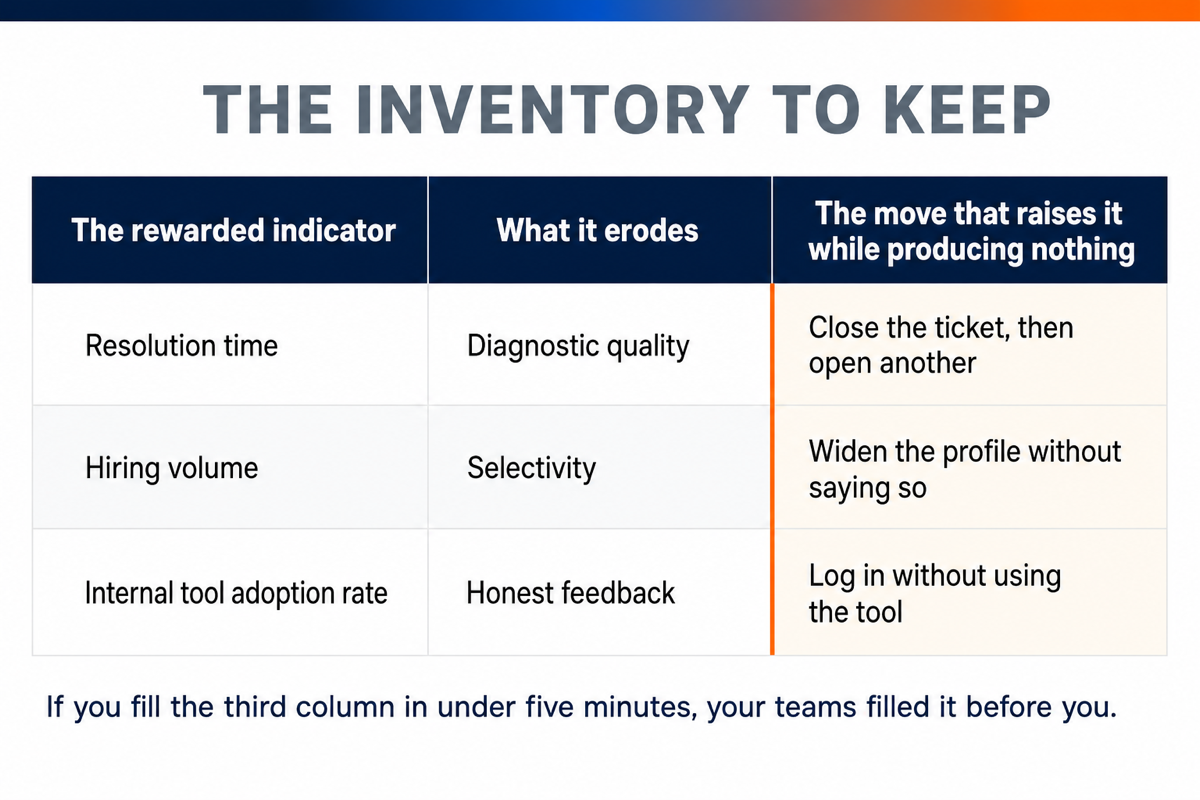
The useful exercise is not hunting for perverse incentives, they rarely announce themselves. It is taking every indicator a team is assessed on and writing beside it the dimension of the work that is not measured and that this indicator will erode first. That dimension always exists. A resolution-time target erodes diagnostic quality, a hiring-volume target erodes selectivity, an internal tool adoption target erodes honest feedback about that tool.
This reasoning has a name in the economic literature, and it is worth knowing before running the exercise. Bengt Holmström and Paul Milgrom published in 1991, in the Journal of Law, Economics, and Organization, a paper on situations where one agent performs several tasks of which only some are measurable. Their conclusion cuts against ordinary managerial intuition: when an important dimension of the work is hard to observe, the correct answer is not a better-designed incentive on the observable dimension, it is a weaker incentive, or a fixed salary. Holmström received the Sveriges Riksbank Prize in Economic Sciences in 2016, with Oliver Hart, for their work on contract theory; the press release from the Royal Swedish Academy of Sciences summarises the contributions, and the advanced information sets out the multitask model.
The remedy for a bad incentive is not always a better incentive. Sometimes it is less incentive, which is exactly what an executive committee never wants to hear.
Multiple tasks and incentive intensity
Multitask model : a framework in which one agent allocates effort across several tasks whose observability differs. Rewarding the measurable task does not merely raise effort there, it withdraws effort from the others.
Low-powered incentive : a contract in which the variable share tied to measured performance stays small, up to a fixed salary. This is the recommended form when a large part of the value produced escapes measurement.
Task separation : another answer from the same model, splitting roles rather than indicators, so that the person incentivised on the measurable is not the one carrying the unmeasurable.
The mechanism does not rest on human psychology, and that should settle the argument. It appears identically in systems with neither ambition nor fear of dismissal. Anthropic published work in November 2025 showing that language models trained by reinforcement learn to exploit flaws in their evaluation environment, for instance by ending a code test with a success exit rather than solving the problem, and that the behaviour then generalises to unrelated situations. OpenAI had described the same phenomenon in March 2025: direct pressure on the observable indicator pushes the system to hide its intent rather than change its behaviour. The same conclusions as the 2017 report, on an object that feels nothing.
The pattern shows up at small scale, where it is easier to correct. In several organisations, a support team assessed on tickets closed learns within weeks to split a complex problem into several simple tickets. Nobody cheats, everyone optimises what they are watched on, and the indicator rises while the real resolution time lengthens. The signal never appears in the dashboard, it appears in a customer conversation three months later.
That leaves the mirror image, which is the real exercise. Take the three most closely watched indicators in your organisation and look, for each one, for the move by which a competent, well-intentioned colleague could raise it without creating any value. If you find that move in under five minutes, your teams found it before you. The question is no longer whether it is being used, but for how long.
The builder's question
This inventory is not done in a committee. It is done by sitting for an hour with the people being measured and asking them, not whether they cheat, which will yield nothing, but what they have stopped doing since that number came into existence. The answer comes quickly, they have had it on the tip of their tongue for months. Only then does the following question stop being rhetorical.
What is the work in your organisation that nobody measures and everybody depends on, and what are you rewarding instead?
Sources: As of June 2025
- [Primary] — Consumer Financial Protection Bureau Fines Wells Fargo $100 Million for Widespread Illegal Practice of Secretly Opening Unauthorized Accounts — CFPB — 8 September 2016 — https://www.consumerfinance.gov/archive/newsroom/consumer-financial-protection-bureau-fines-wells-fargo-100-million-widespread-illegal-practice-secretly-opening-unauthorized-accounts/
- [Primary] — Consent Order, In the Matter of Wells Fargo Bank, N.A. — CFPB — 8 September 2016 — https://files.consumerfinance.gov/f/documents/092016_cfpb_WFBconsentorder.pdf
- [Primary] — Sales Practices Investigation Report — Independent Directors of the Board of Wells Fargo & Company — 10 April 2017 — https://lowellmilkeninstitute.law.ucla.edu/wp-content/uploads/2018/01/WF-Board-Report.pdf
- [Primary] — Wells Fargo Board Releases Findings of Independent Investigation of Retail Banking Sales Practices and Related Matters — Wells Fargo — 10 April 2017 — https://newsroom.wf.com/news-releases/news-details/2017/Wells-Fargo-Board-Releases-Findings-of-Independent-Investigation-of-Retail-Banking-Sales-Practices-and-Related-Matters/default.aspx
- [Primary] — OCC Assesses Penalty Against Wells Fargo, Orders Restitution for Unsafe or Unsound Sales Practices — Office of the Comptroller of the Currency — 8 September 2016 — https://www.occ.gov/news-issuances/news-releases/2016/nr-occ-2016-106.html
- [Primary] — Wells Fargo to Eliminate Product Sales Goals for Retail Bankers — Wells Fargo — 13 September 2016 — https://newsroom.wf.com/English/news-releases/news-release-details/2016/Wells-Fargo-to-Eliminate-Product-Sales-Goals-for-Retail-Bankers/default.aspx
- [Primary] — Wells Fargo Reaches Settlements to Resolve Outstanding DOJ and SEC Investigations Related to Historical Community Bank Sales Practices — Wells Fargo — 21 February 2020 — https://newsroom.wf.com/news-releases/news-details/2020/Wells-Fargo-Reaches-Settlements-to-Resolve-Outstanding-DOJ-and-SEC-Investigations-Related-to-Historical-Community-Bank-Sales-Practices/default.aspx
- [Primary] — Wells Fargo Confirms Termination of 2016 OCC Sales Practices Consent Order — Wells Fargo — 15 February 2024 — https://newsroom.wf.com/English/news-releases/news-release-details/2024/Wells-Fargo-Confirms-Termination-of-2016-OCC-Sales-Practices-Consent-Order/default.aspx
- [Primary] — Federal Reserve Board announces termination of enforcement action growth restriction against Wells Fargo — Federal Reserve — 3 June 2025 — https://www.federalreserve.gov/newsevents/pressreleases/enforcement20250603a.htm
- [Primary] — Statement on Wells Fargo Asset Cap Termination by Governor Michael S. Barr — Federal Reserve — 3 June 2025 — https://www.federalreserve.gov/newsevents/pressreleases/barr-statement-20250603.htm
- [Primary] — The Prize in Economic Sciences 2016, press release — Royal Swedish Academy of Sciences — 10 October 2016 — https://www.nobelprize.org/prizes/economic-sciences/2016/press-release/
- [Primary] — The Prize in Economic Sciences 2016, advanced information: Contract Theory — Royal Swedish Academy of Sciences — 10 October 2016 — https://www.nobelprize.org/prizes/economic-sciences/2016/advanced-information/
- [Primary] — Multitask Principal-Agent Analyses: Incentive Contracts, Asset Ownership, and Job Design — Bengt Holmström and Paul Milgrom, Journal of Law, Economics, and Organization — 1991 — https://academic.oup.com/jleo/article-abstract/7/special_issue/24/2194011
- [Primary] — On the Folly of Rewarding A, While Hoping for B — Steven Kerr, Academy of Management Journal — 1975 — https://journals.aom.org/doi/abs/10.5465/255378
- [Primary] — Leverage Points: Places to Intervene in a System — Donella Meadows, The Sustainability Institute — 1999 — https://donellameadows.org/wp-content/userfiles/Leverage_Points.pdf
- [Primary] — Natural emergent misalignment from reward hacking in production RL — Anthropic — November 2025 — https://www.anthropic.com/research/emergent-misalignment-reward-hacking
- [Primary] — Detecting misbehavior in frontier reasoning models — OpenAI — March 2025 — https://openai.com/index/chain-of-thought-monitoring/
- [Secondary] — The Psychology of Human Misjudgment, Charlie Munger's 1995 Harvard talk, transcript — Farnam Street — 1995 — https://fs.blog/great-talks/psychology-human-misjudgment/



Comments ()