Andy Grove: the decision that saved Intel had already been made without him

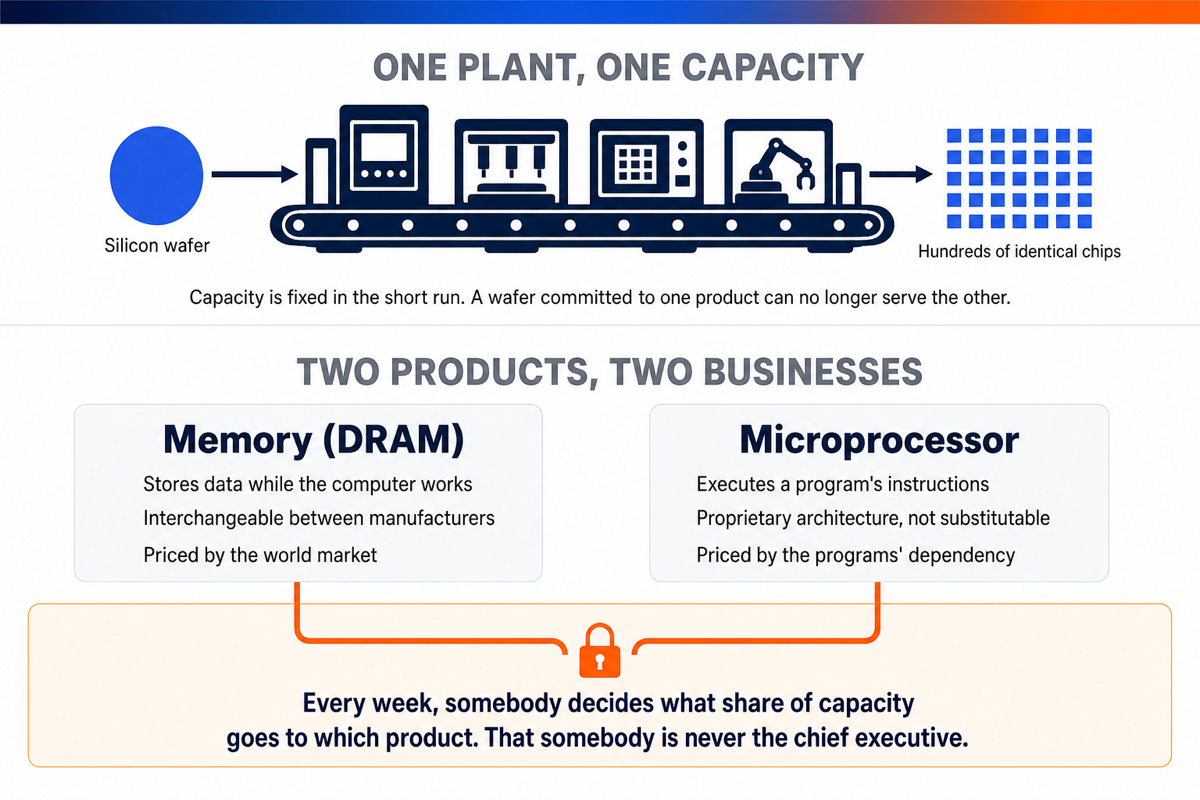
A semiconductor plant does not make products, it makes wafers. A polished silicon disc enters the line and comes out weeks later covered in identical circuits, then gets cut into hundreds of chips. The constraint that governs the whole business is this: the line costs billions, its capacity is fixed in the short run, and a wafer committed to one product can no longer serve another. So every week, somebody has to decide what share of that capacity goes where. That somebody is never the chief executive.
The vocabulary of manufacturing
Wafer : a polished silicon disc on which circuits are printed and then cut into individual chips. It is the real unit of account inside a semiconductor plant.
Dynamic random access memory, or DRAM : a chip that temporarily stores data while a computer works. A standardized product, interchangeable between manufacturers, and therefore sold at whatever the world price happens to be.
Microprocessor : the chip that executes a program's instructions. Unlike memory, its architecture is proprietary, programs written for it do not run on a competitor's, and its price reflects that dependency rather than a world commodity rate.
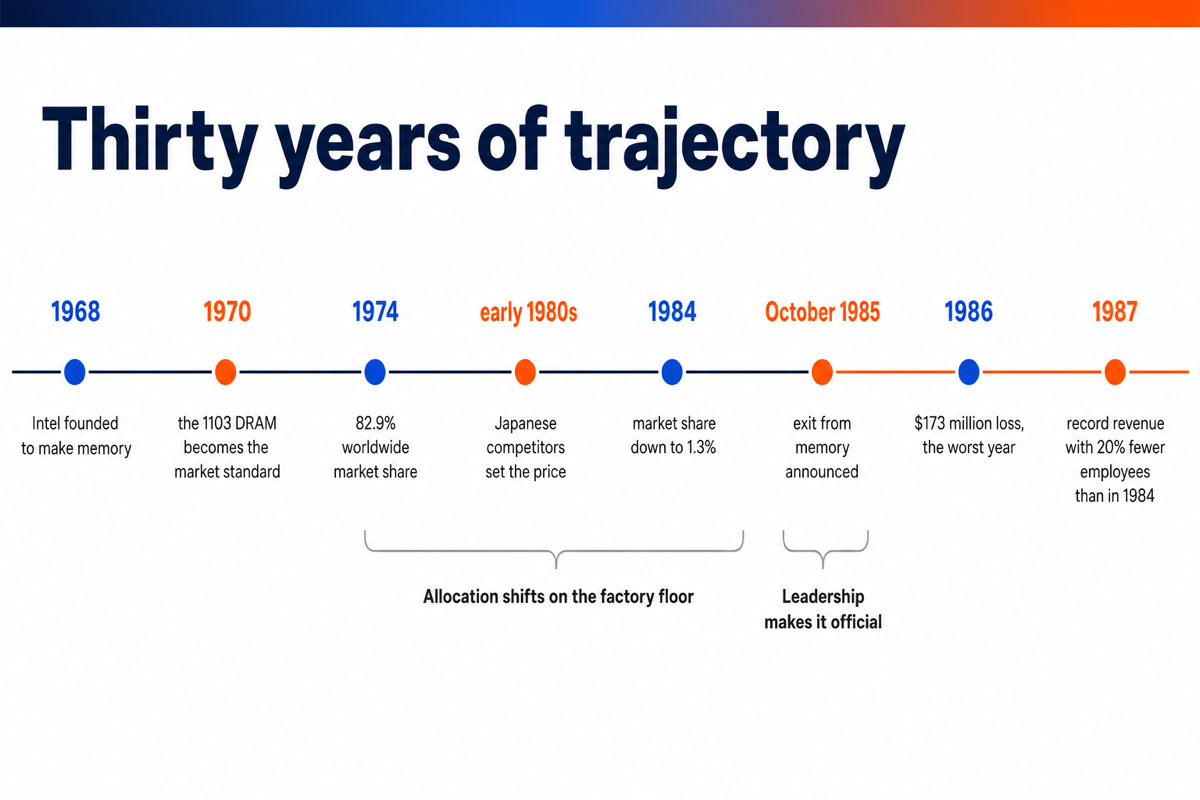
In 1985, at a Californian company founded seventeen years earlier to build precisely that kind of memory, the capacity question had become unanswerable. Revenue fell to $1,365 million, down 16% from the previous year's record. Net income shrank to $2 million, one cent per share, with operating losses in the last three quarters. The company was Intel, and its founding product was killing it.
On October 10, 1985, it announced its withdrawal from dynamic random access memory. The decision passed into legend through a scene its chief executive would later recount. Andy Grove looks out of his Santa Clara office window at the Ferris wheel of the nearby amusement park, turns to Gordon Moore and asks what a new chief executive would do if the board threw them both out. Moore answers that he would get Intel out of memory. Grove follows up: why shouldn't we walk out the door, come back, and do it ourselves?
In Intel's own archives, Grove puts it this way: "It was an emotional decision. We had been the first to introduce the product and build the business ... In retrospect, getting out of DRAMs when we did was the best business decision we ever made."
The scene has become a set piece of strategic management. It is told as the story of a clear-sighted leader who sees before everyone else and forces a turn.
The academic work conducted inside Intel tells something else. By the time Grove and Moore have that conversation, the company has already left memory. Not in its statements, in its factories.
As in the hierarchy of leverage points described by Donella Meadows, the place where a decision is really made is almost never the place being watched.

What an inflection point actually does to an organization
Grove named these moments in Only the Paranoid Survive, published in 1996: the strategic inflection point, the time in the life of a business when its fundamentals are about to change. His test is simple to state. There is an inflection when one of the forces acting on the business becomes roughly ten times stronger than what the organization is built to absorb.
Inflection point and 10X force
Strategic inflection point : the moment when the fundamentals of a business change, so that the old way of winning stops working and a new one takes over. It can only be identified with certainty after the fact.
10X force : Grove's test for telling a cyclical swing apart from a genuine inflection. He lists six forces acting on any business, including competitors, customers, suppliers and substitute technologies, and considers there is an inflection when one of them becomes roughly ten times more intense than what the organization can absorb.
At Intel, that force had a name, the rise of Japanese memory manufacturers in the early 1980s. It acted not on technology but on price. Since memory is interchangeable, a competitor able to produce more cheaply does not take market share, it sets the price for everyone, including those whose cost structure cannot survive it.
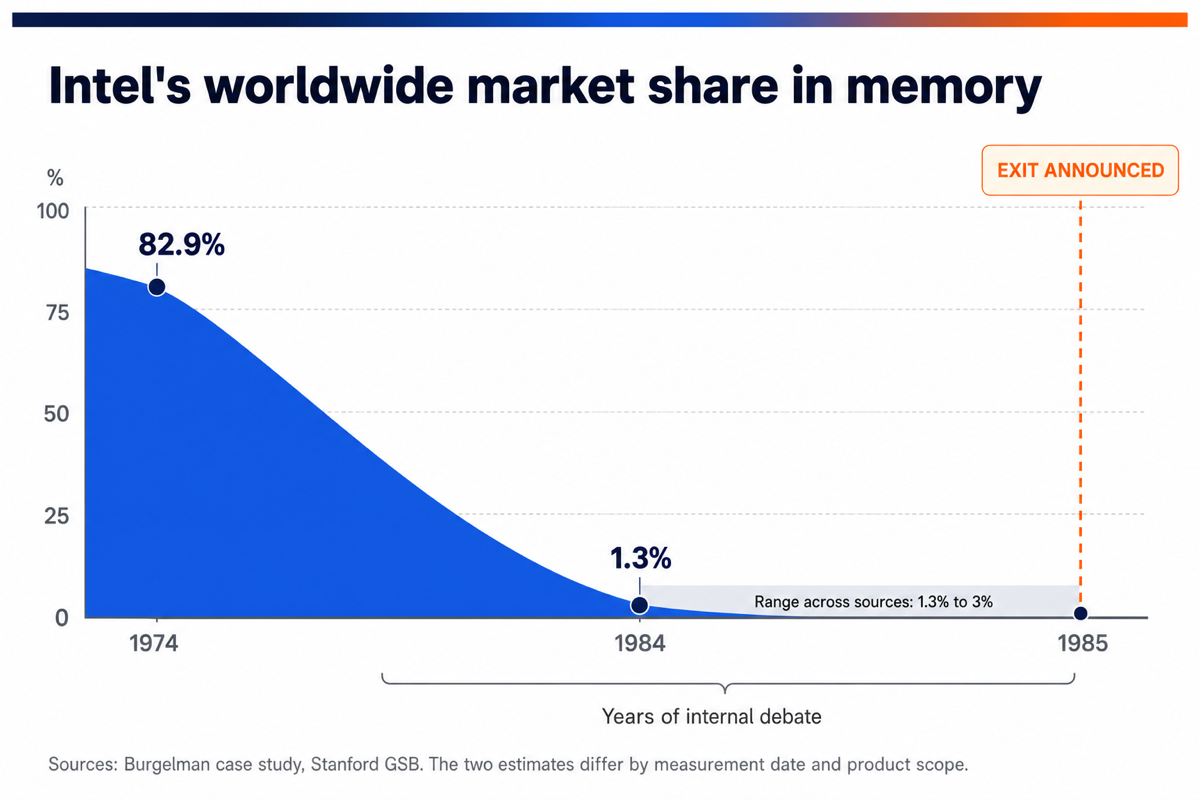
The trap is therefore not missing the signal. It is that the signal arrives long before the proof, and that the internal debate settles in for years. Robert Burgelman, the Stanford professor who studied Intel from the inside for two decades and taught alongside Grove, documents a continuous erosion: from an 82.9% worldwide share in 1974 to 1.3% in 1984 in his case study, while Stanford Graduate School of Business reporting puts it at 2 to 3% during the period when the debate was raging. The gap reflects the measurement date and the product scope retained, but the order of magnitude is not in dispute: Intel had stopped being a memory player long before it agreed to say so.
Which leaves the question of why an intelligent leadership clings to a business that no longer amounts to anything. The answer is not commercial, it is doctrinal. Burgelman's case study is explicit: inside Intel, memory was regarded as the technology driver on which the company's entire learning curve depended. A simple, repetitive product, it served to refine manufacturing processes that then benefited everything else. Abandoning memory, under that belief, was not dropping a product line, it was giving up knowing how to manufacture.
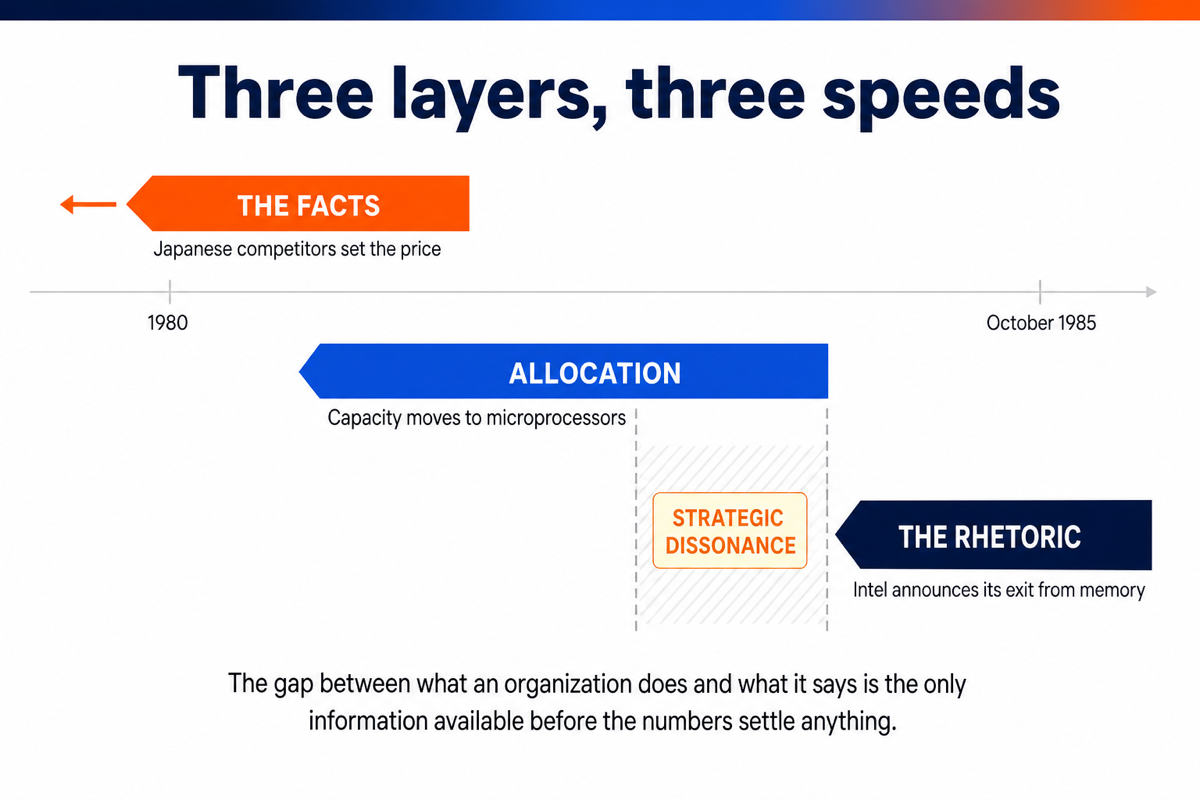
The belief had been true. It had stopped being true without anyone organizing its update. Burgelman and Grove gave that state a name: strategic dissonance.
Strategic dissonance and recognition
Strategic dissonance : the gap between what a company says it does and what it actually does, or between its distinctive competencies and the real basis of competition. It shows up as conflicting voices inside the organization, and it is the only available indicator as long as the data refuses to settle anything.
Strategic recognition : leadership's capacity to admit an inflection point has been reached, and to back a redirection before external signals are complete. It is an act of acceptance, not an act of vision.
The factories had already decided
Here is the fact that changes the reading of the whole story. In a study published in 1994 in Administrative Science Quarterly, Burgelman documents that Intel's internal selection environment had shifted the allocation of scarce manufacturing capacity away from memory and toward the emerging microprocessor business before corporate strategy was officially changed. Grove tells it himself in his book: it was the production planners who redirected capacity, on profitability grounds.
The mechanism is unremarkable, which is precisely what makes it interesting. Manufacturing capacity was allocated on a profitability-per-wafer criterion. Memory was collapsing in price, microprocessors were rising. Quarter after quarter, middle managers applied the rule and redirected the company's scarcest resource toward whatever paid best.
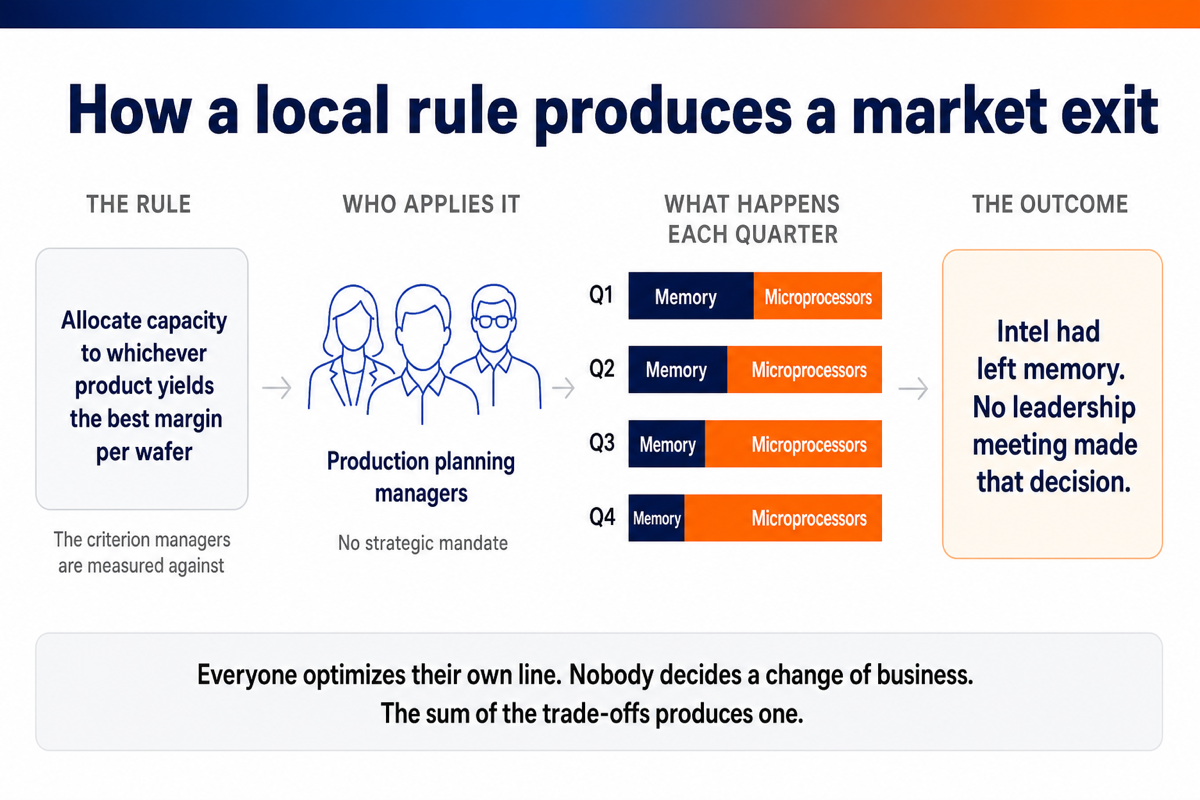
None of those managers had a mandate to decide a change of business. None of them thought that was what they were doing. Each was optimizing a production line against a criterion handed to them, and against which their own performance was measured. The sum of their trade-offs produced exactly that.
When Grove and Moore conclude that Intel must leave memory, they are not making a breakaway decision. They are recognizing, and making official, a movement already completed on the factory floor.
What leadership brings, then, is not the choice but what comes after, and that part is considerable. The official exit made it possible to stop memory research spending, close sites and restructure, none of which a production planner could ever have triggered. Intel booked a $173 million loss in 1986, the worst year in its history to that point. Then, in 1987, the company returned to record revenue, achieved with roughly 20% fewer employees than in 1984, a direct result of the restructuring carried out in 1985 and 1986.
Leadership's role in this sequence is neither to see nor to choose. It is to publicly own, and to pay the social and financial cost of, what the organization had already done quietly.
It is worth measuring what this reading takes away from the heroic account, and what it gives back. It takes away the foresight: nobody at the top saw earlier than anyone else, and the debate dragged on for years precisely because leadership was resisting what its own factory floor was showing it. What it gives back is rarer and much harder to imitate, the acceptance of being publicly wrong. Leaving memory meant, for Grove and Moore, admitting in front of their teams, their customers and their shareholders that the identity they had defended for a decade was obsolete, and that production planners had worked it out before they did.
Paranoia is not a mood, it is a listening architecture
The book's title produced a stubborn misreading. "Only the paranoid survive" is commonly read as a call for permanent executive anxiety, a constant vigilance exercised from the top. That is the opposite of what the Intel case demonstrates.
Burgelman and Grove are explicit about where the signals come from. The voices, they write, usually rise from the middle management ranks or the sales organization, from people who know more because they spend time outdoors where the storm clouds of creative destruction gather force and start blowing into their face. At Intel, the earliest hints came from managers returning from Japan who reported feeling like objects of derision.
That is not board-level information. It is a feeling, reported by someone with no authority to decide anything, appearing on no dashboard.
The top of an organization is structurally the last to know. It receives aggregated, smoothed, delayed data, presented by people whose credibility often depends on the current strategy.
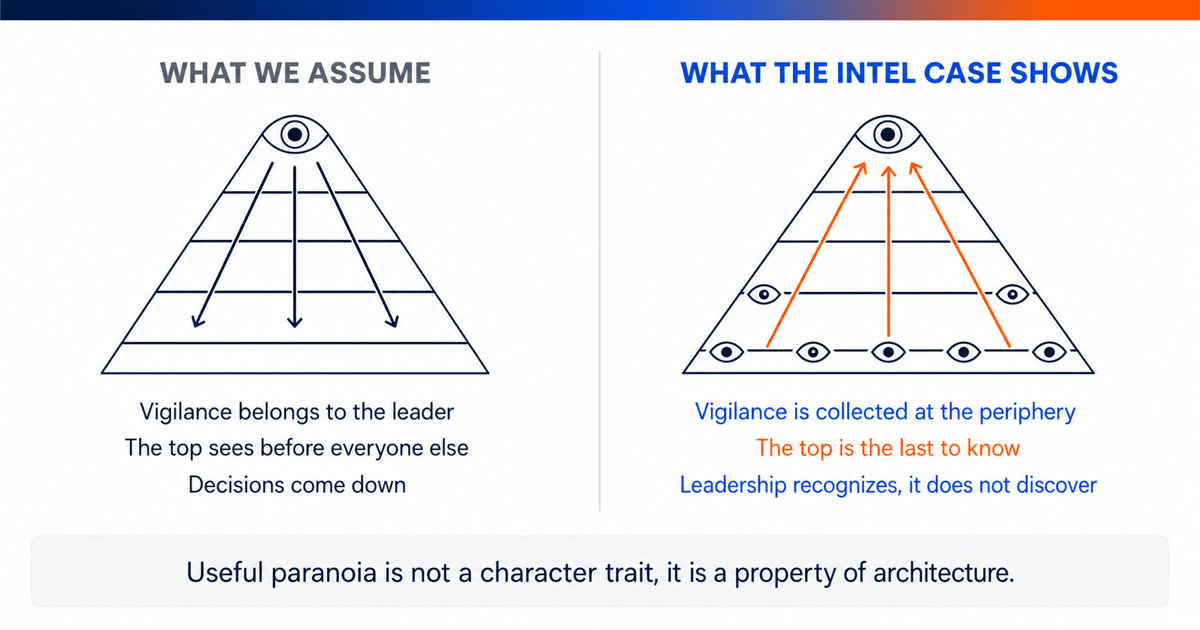
Useful paranoia therefore does not mean worrying more. It means building the channels through which discomfort felt at the periphery can travel upward unfiltered, and accepting to act on that discomfort before the numbers confirm it. It is a property of organizational architecture, not a trait of the leader's character.
Burgelman adds a caveat that prevents this from becoming a comfortable method. There are two symmetrical traps. The first is the absence of debate, where everyone pursues their own agenda and nobody challenges anyone. The second is endless debate, where arguing continues and nothing gets decided. A leader's work sits in the gap between the two: encourage contradiction, then know when to close it.
What a leader can do with this tomorrow morning
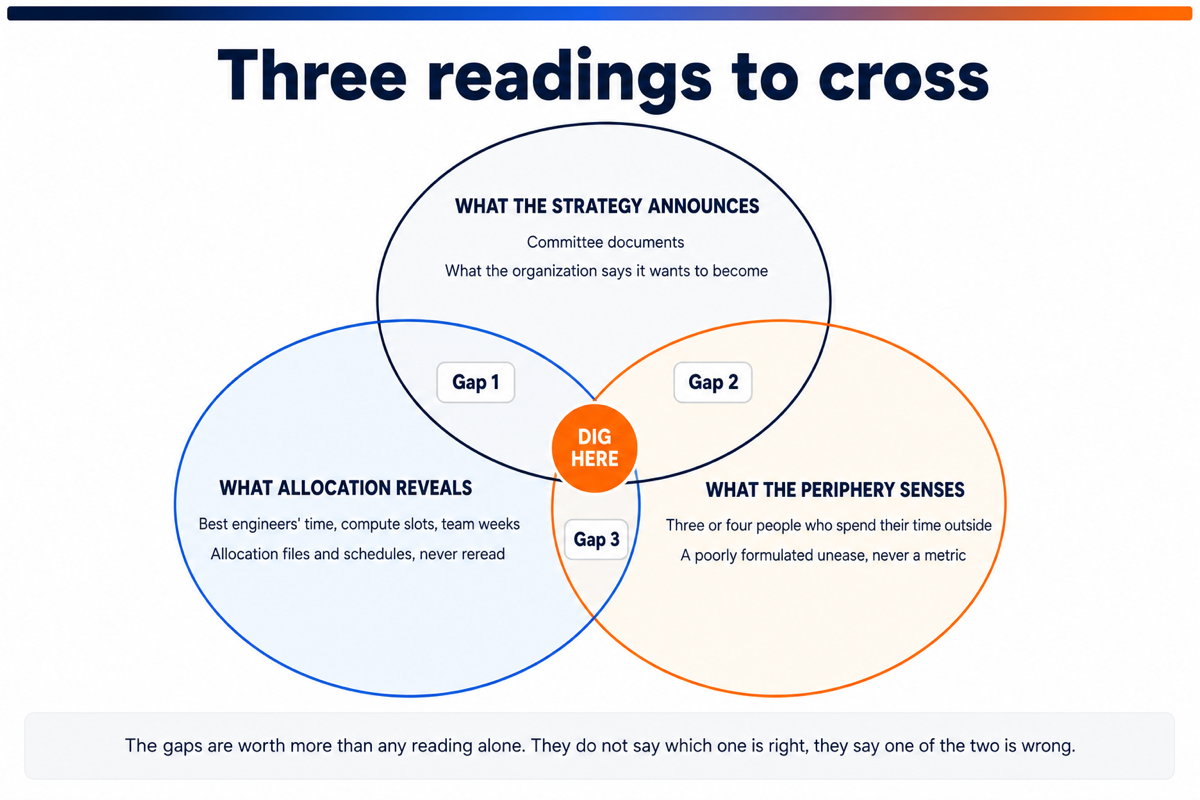
The most direct exercise is to compare two things most organizations never place side by side: the stated strategy, and the actual allocation of the scarcest resource. Not the overall budget, which is negotiated once a year and says nothing. The scarce resource: the time of the best engineers, compute slots, the weeks of the team that knows how to do the hard thing.
Wherever the two diverge, the organization has already voted, and its vote is more reliable than the strategy committee deck. Which leaves the question of which side holds the truth, and the answer is not always the same. At Intel, allocation was right against the rhetoric. Sometimes the reverse holds, and a local rule destroys a position the strategy was rightly protecting. What the gap signals for certain is that one of the two is wrong.
The exercise has a theoretical foundation worth knowing before running it. Herbert Simon received the Sveriges Riksbank Prize in Economic Sciences in 1978 for his research into the decision-making process within economic organizations. His break, as the Royal Swedish Academy of Sciences summarizes it in its press release, was to reject the classical assumption of an omniscient, profit-maximizing entrepreneur and replace it with a set of cooperating decision-makers whose capacity for rational action is limited. In Administrative Behavior, published in 1947, he describes the firm as an adaptive system held together by a network of intercommunications and by its members' willingness to cooperate.
Bounded rationality
Bounded rationality : Simon's term for the fact that individuals and organizations decide with incomplete information, finite processing time and simplified rules. He sums it up by saying behavior is intendedly rational, but only limitedly so.
Practical consequence : if nobody in the organization holds a complete view, then the collective outcome is not produced by a central decision but by the aggregation of local rules. Those rules therefore deserve as much attention as the strategy itself.
The second exercise concerns inherited rules. Intel went through a second inflection point in 1994 with the Pentium floating-point calculation flaw. The company first responded as a component supplier to industrial customers, refusing blanket replacement, even though its own Intel Inside campaign, launched in April 1991, had turned it into a consumer brand three years earlier. The public reacted as it would to a consumer brand. Weeks later Intel announced it would replace every flawed chip, no questions asked, and on January 17, 1995 booked a $475 million charge.
The crisis did not come from the flaw, which was marginal and documented. It came from a behavioral rule inherited from a version of the company that no longer existed. The internal question is that one: which of our rules were written for an organization we no longer are?
The third exercise is the simplest and the most rarely done. Name the three or four people in your organization who spend the most time outside, with customers, competitors or suppliers, and who hold no decision-making power. Give them a channel that does not pass through the full reporting line.
The pattern shows up at small scale too. In several organizations, what comes back through that kind of channel in the early months is almost never an analysis. It is a poorly formulated unease, of the "customers aren't asking us the same questions anymore" variety. That is exactly the material Grove describes, and it is the material reporting processes destroy best, because they require an impression to become a metric before it can travel.
The builder's question
That comparison is not made in a meeting, and certainly not from the documents presented there. It is made by opening the allocation files, the team schedules and the waiting lists, the ones nobody ever rereads because they count as logistics. Only then does the following question stop being rhetorical.
If you compared what your organization says it wants to become with how it actually spends its scarcest time, which decision would you discover it has already made without you?
Sources: As of August 2026
- [Primary] — Farewell to DRAM, October 10, 1985 — Intel, official timeline — 1985 — https://timeline.intel.com/1985/farewell-to-dram
- [Primary] — Intel Corporation 1985 Annual Report — Intel — 1986 — https://archive.org/details/intel-history-1985-annual-report-pdf
- [Primary] — Intel Corporation Annual Report 1986 — Intel — 1987 — https://www.intel.com/content/dam/www/central-libraries/us/en/documents/2025-05/history-1986-annual-report.pdf
- [Primary] — Intel Corporation Annual Report 1987 — Intel — 1988 — https://www.intel.com/content/dam/www/central-libraries/us/en/documents/2025-05/history-1987-annual-report.pdf
- [Primary] — Fading Memories: A Process Theory of Strategic Business Exit in Dynamic Environments — Robert A. Burgelman, Administrative Science Quarterly, vol. 39 no. 1, pp. 24-56 — March 1994 — https://www.gsb.stanford.edu/faculty-research/publications/fading-memories-process-theory-strategic-business-exit-dynamic
- [Primary] — Intel Corporation (A): The DRAM Decision, case study BP256A — Robert A. Burgelman, Stanford Graduate School of Business — 2005 — https://www.gsb.stanford.edu/faculty-research/case-studies/intel-corporation-dram-decision
- [Primary] — Strategic Dissonance (working paper) — Robert A. Burgelman and Andrew S. Grove, Stanford Graduate School of Business — 1996 — https://www.gsb.stanford.edu/faculty-research/working-papers/strategic-dissonance
- [Primary] — The Prize in Economics 1978, press release — Royal Swedish Academy of Sciences — October 16, 1978 — https://www.nobelprize.org/prizes/economic-sciences/1978/press-release/
- [Primary] — Rational Decision-Making in Business Organizations, Nobel lecture — Herbert A. Simon — December 8, 1978 — https://www.nobelprize.org/uploads/2018/06/simon-lecture.pdf
- [Secondary] — What do you do when industry dynamics fundamentally change? — Stanford Graduate School of Business Insights — June 1, 1996 — https://www.gsb.stanford.edu/insights/what-do-you-do-when-industry-dynamics-fundamentally-change
- [Secondary] — Only the Paranoid Survive, Andrew S. Grove — Currency Doubleday, 1996 — https://www.penguinrandomhouse.com/books/72469/only-the-paranoid-survive-by-andrew-grove/
- [Secondary] — Pentium FDIV bug, history of the recall and the $475 million charge — Wikipedia — 2026 — https://en.wikipedia.org/wiki/Pentium_FDIV_bug

Comments ()