ASML: the world's chokepoint belongs to the most dependent company in the chain
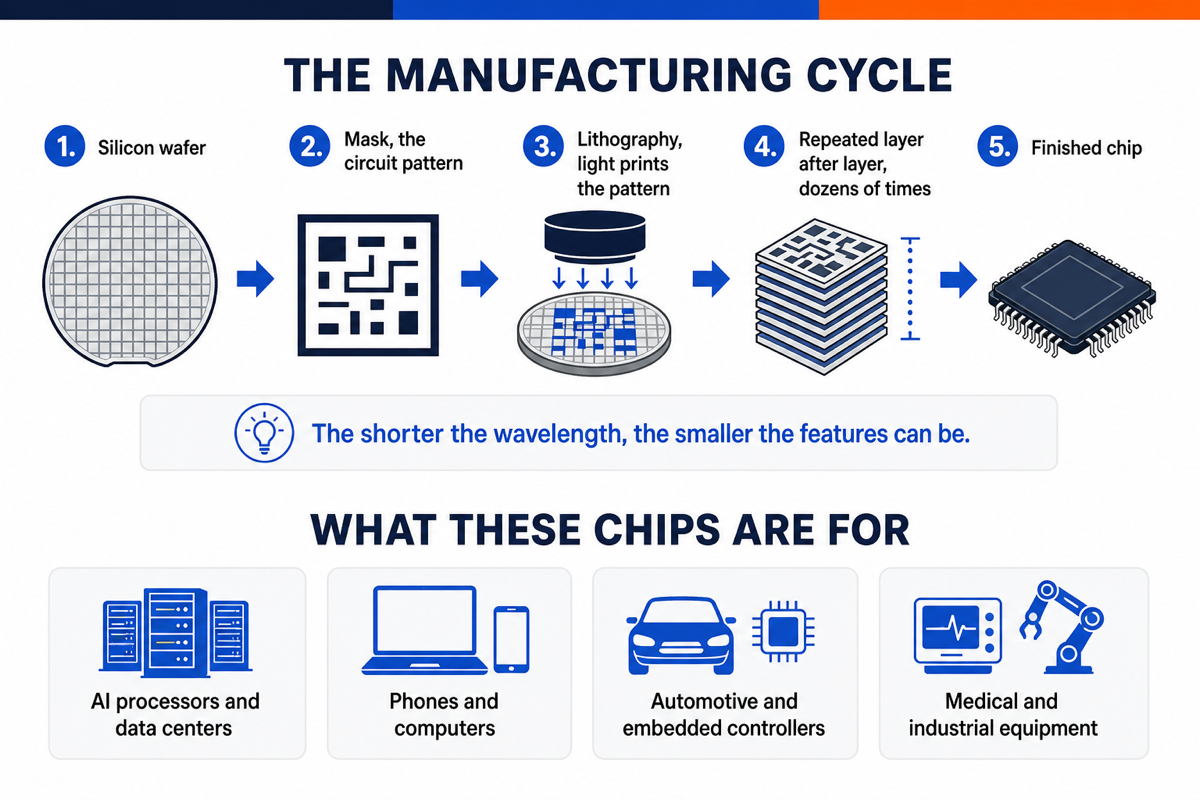
In 1988, in Veldhoven, in the Netherlands, a company of a few hundred people was close to disappearing. It built lithography machines, the equipment that prints a circuit pattern onto a silicon wafer by projecting light through a mask, layer after layer. That step decides how fine a chip can be, and it follows a simple rule: the shorter the wavelength of the light, the smaller the printed features can be.
Its industrial shareholder, ASM International, could no longer sustain investments that returned nothing and pulled out. Its other shareholder, Philips, had just announced a sweeping cost-cutting program. The company was burning cash, had few customers, and nobody in the industry was betting on it. Its executives went to see a Philips board member, Henk Bodt, who persuaded his colleagues to extend one final lifeline. That account comes from the company's own history page.
The company is ASML. Thirty-eight years later, it reported €32.7 billion in net sales for 2025, €9.6 billion in net income, and closed the year with a €38.8 billion backlog. More to the point, it is the only company in the world building the machines that print with extreme ultraviolet light, known across the industry by its acronym EUV, a wavelength of 13.5 nanometers, more than fourteen times shorter than the light used by the previous generation of machines. Without them, no leading-edge processor, for AI or anything else, can be patterned. No state, no consortium, no competitor has managed to produce a second one.
The explanation you hear most often comes down to one word: secrecy.
ASML supposedly holds knowledge nobody else has. That is wrong, and it is what makes the case interesting. The lock is not in what ASML hides, it is in what ASML does not do itself.
The principle has been public since the 1990s, and it fits in one sentence: produce that 13.5 nanometer light, carry it to the wafer without losing it on the way, and repeat the operation fast enough for industrial production. The founding patents have expired or can be read, and the company publishes its work in scientific journals.
This extends directly what we discussed about what builders see: the durable position rarely sits where the eye lands first.
What a chokepoint is, and where it actually comes from
In an industrial chain, a chokepoint is a link whose failure stops everything else. The instinct is to assume it grows from a protected technological lead: a patent, a process, a team. That reading is comforting, because it implies that a competitor with enough money and time will eventually catch up.
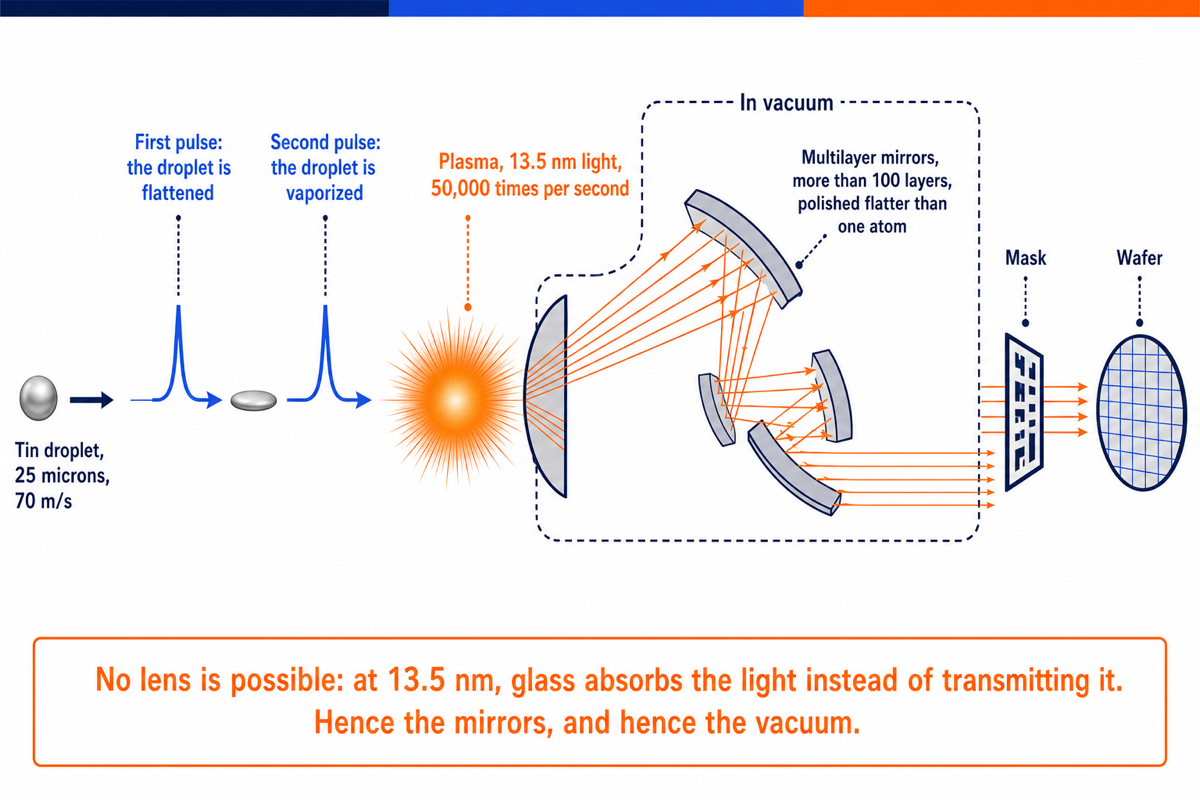
ASML's history says something else, and you have to step inside the machine for a minute to see it. Start with the light, which ASML does not produce. Tin droplets 25 microns across are ejected at 70 meters per second, flattened by a first laser pulse, then vaporized by a second into a plasma that emits extreme ultraviolet light, fifty thousand times a second. The laser comes from Germany's Trumpf, and the source around it was developed over two decades by Cymer, a Californian company ASML eventually acquired in 2013.
Then the optics. At 13.5 nanometers, that light is absorbed by almost every material it passes through, glass included: a conventional lens would extinguish it rather than transmit it. Lenses had to give way to mirrors, each stacking more than a hundred layers, polished flat to less than the thickness of an atom, and operating in a vacuum. Those mirrors come from Carl Zeiss SMT, ASML's optics partner since 1986, two years after it was founded.
Forty years on, ASML still has not brought that capability in-house, and did the opposite. In November 2016, it bought 24.9% of Carl Zeiss SMT for one billion euros in cash and committed roughly €760 million over six years to fund its R&D and capital expenditure, to prepare the next generation of machines. A supplier had become too critical to remain merely a supplier, and was secured by being funded rather than replaced.
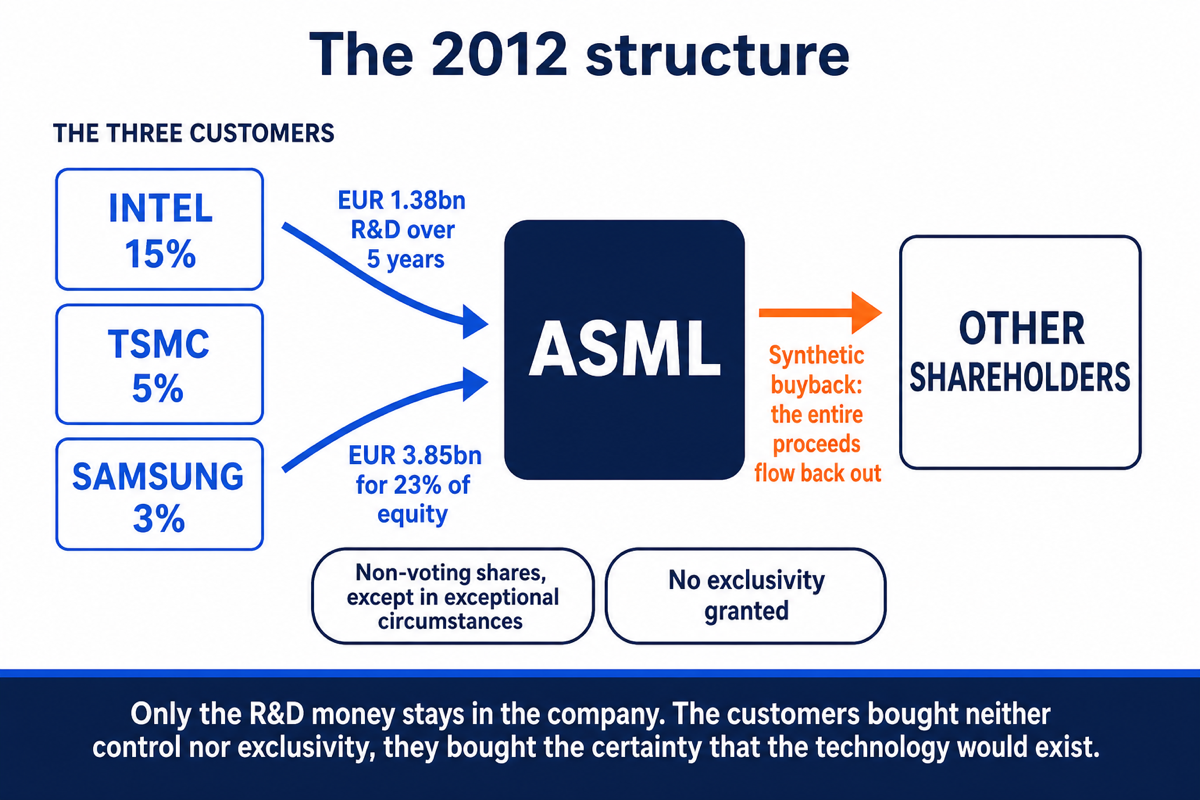
The same move happened one level up the chain, this time driven by the customers. In the early 2010s, only three companies were still investing to pattern ever finer features, Intel, TSMC and Samsung, and all three were already buying ASML machines. Their problem was not technical but economic: without extreme ultraviolet, the cost of manufacturing a wafer would make further miniaturization unprofitable before it made it impossible. Shang-yi Chiang, then TSMC's co-chief operating officer, put it plainly in the press release announcing its participation: the point was to control escalating wafer manufacturing cost, and thereby protect the economic viability of Moore's law (the trajectory set out by Gordon Moore in 1965 and revised in 1975, of roughly a doubling of transistors per chip every two years, which became the industry's implicit roadmap).
So in 2012, the three committed €1.38 billion in R&D over five years and together subscribed to a 23% equity stake for €3.85 billion, TSMC for 5%, Samsung for 3%, Intel for the balance.
Two clauses in that structure say more than the amounts. The shares issued were non-voting except in exceptional circumstances, so nobody was buying control of ASML. And the proceeds of the issuance did not stay in the company, they were returned to the other shareholders through a synthetic buyback.
Those three customers did not recapitalize their supplier and bought no exclusivity, with ASML stating that the funded technologies would benefit the entire industry. They paid to be certain those technologies would exist.
Dependence as architecture
What those arrangements describe is not a self-sufficient company. It is a company structurally incapable of operating alone, which turned that incapacity into a position.
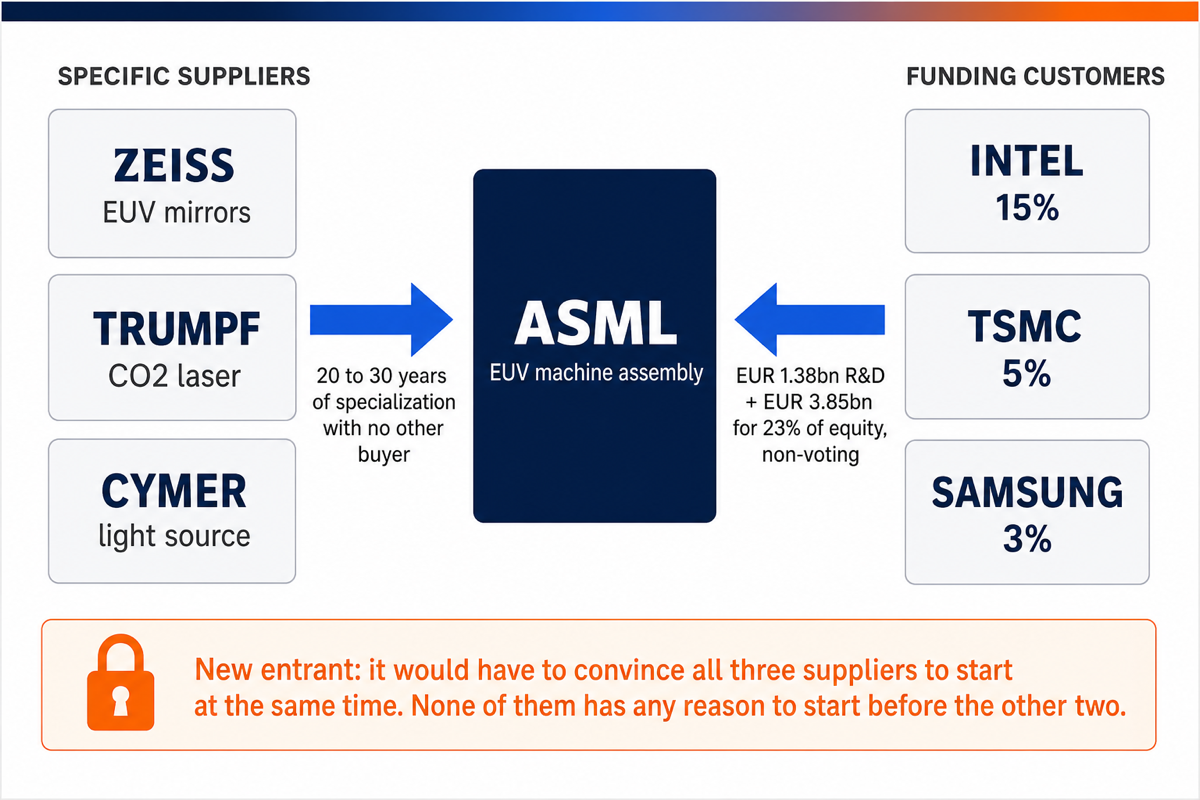
Each of its critical partners has invested for decades in capabilities that have no use anywhere but at ASML. Zeiss sells extreme ultraviolet optics to nobody else. Trumpf designed a laser whose market consists of a single buyer. These investments are specific in the strict sense: their value collapses if the counterparty changes. Symmetrically, ASML cannot replace any of them on a reasonable horizon, because what they hold is not a blueprint but knowledge accumulated through successive attempts, inside a machine of hundreds of thousands of parts where every generation required relearning.
That leaves the question this description opens up: what interest do Zeiss and Trumpf have in making themselves captive to a single customer? The answer starts with the amounts. ASML's purchases from Zeiss SMT and its subsidiaries reached €4.41 billion in 2025, against €3.33 billion in 2023. Over a nearly equivalent period, Zeiss SMT reported €5.055 billion in revenue, up 23%, making it the largest of the Zeiss Group's four segments. The two periods do not overlap exactly, but the order of magnitude leaves little doubt: ASML is not an important customer of Zeiss SMT, it is very nearly all of its business. Trumpf, for its part, runs an EUV division with its own chief executive and publicly describes its relationship with ASML as an exclusive partnership. The laser it has just redeveloped for the next generation has more than 450,000 parts, weighs over 20 tons, and enters series production in 2026. As for Cymer, the question no longer arises: ASML bought it.
On production rhythm and inventory, the answer is more counterintuitive still. There is no inventory. Every optical column is built to order, and ASML states in its 2025 annual report that the number of machines it can produce is capped by Zeiss SMT's capacity, not by its own assembly line. The same document describes Zeiss SMT as its sole supplier of lenses, mirrors, illuminators and collectors, and acknowledges that a prolonged interruption at that supplier would leave ASML unable to conduct its business. The balance of power you would instinctively assume is therefore reversed: the buyer funds its supplier to loosen the constraint, with €1.91 billion in loans extended to Zeiss SMT at the end of 2025 and €1.19 billion in advance payments to secure deliveries.
A new entrant trying to reproduce the whole thing therefore does not run into a secret. It runs into a simultaneity problem. It would need to convince the equivalent of a Zeiss, a Trumpf and a Cymer to each commit twenty or thirty years of specialization to a machine that does not exist yet, whose first customer would come later. None of the three has any reason to start before the other two. That bootstrapping deadlock, not technical difficulty taken alone, is what protects the position.
The lock is not owned, it is co-built
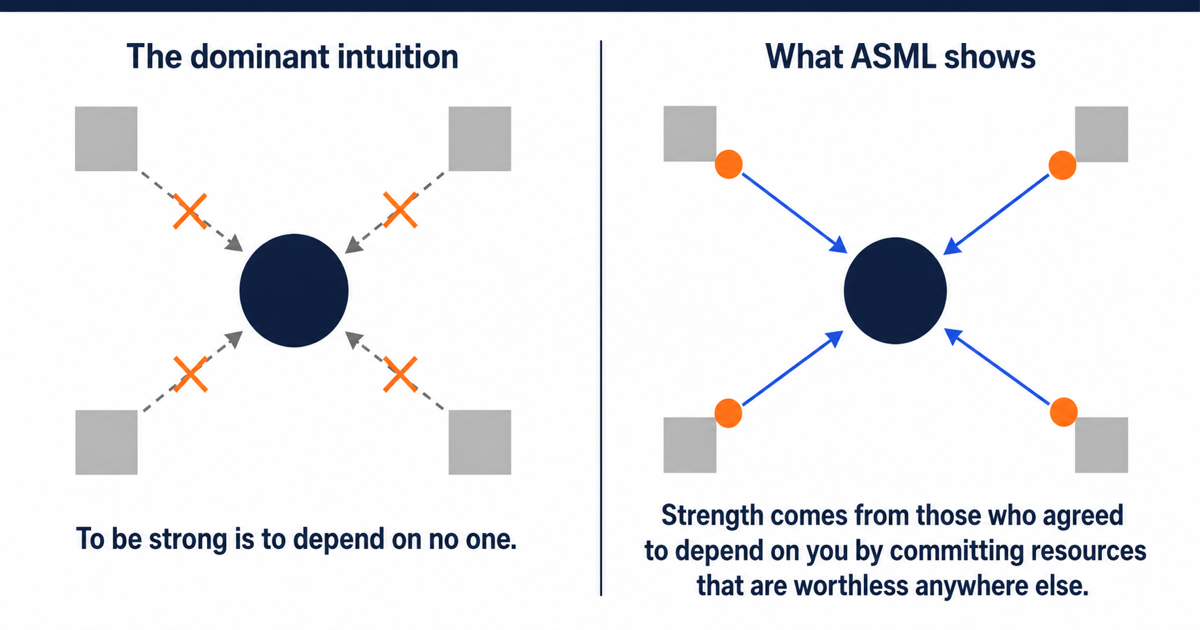
Here is the reversal. We instinctively equate power with autonomy, and dependence with vulnerability. Technological sovereignty policies rest almost entirely on that equation: to be strong is to depend on no one. ASML shows the opposite. Its strength does not come from depending on little. It comes from the fact that a large number of players agreed to depend on it by committing resources that are worthless anywhere else.
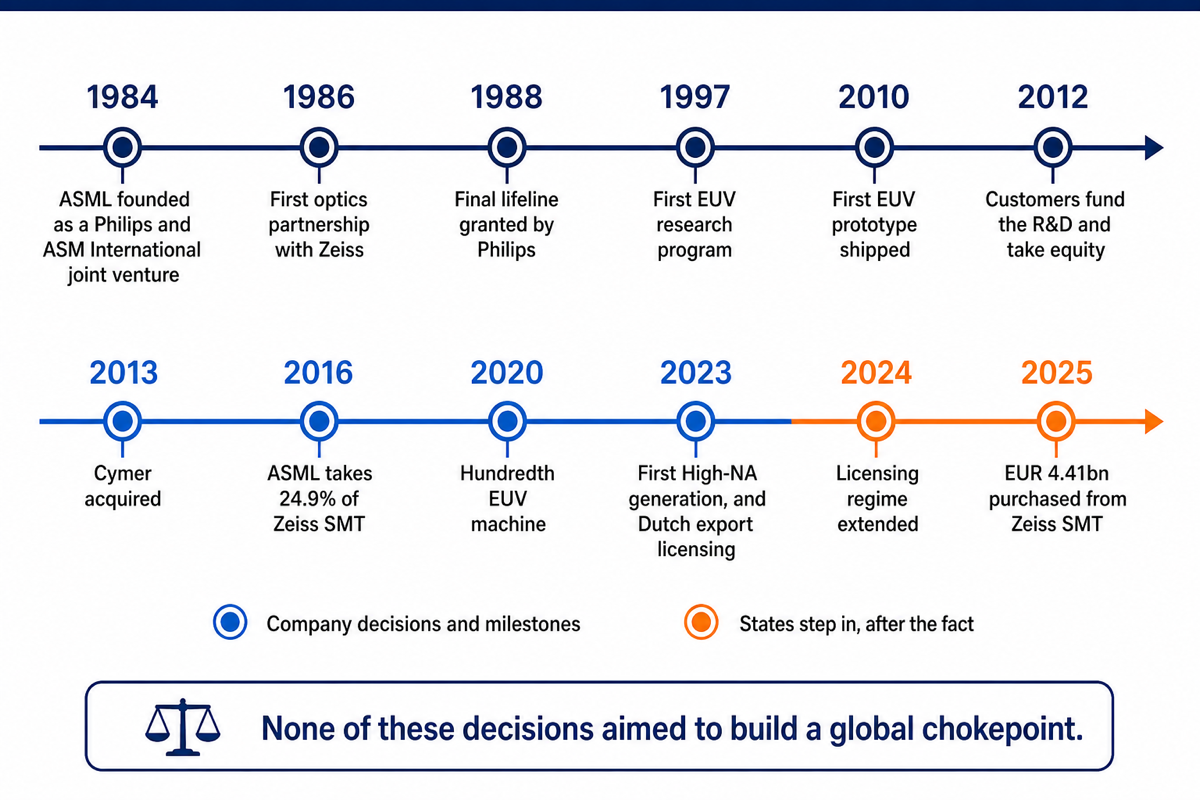
The corollary is unwelcome for anyone looking for a recipe. Nobody planned this position, not ASML, and not the governments now interested in it. It emerged from a sequence of decisions taken for local, short-term reasons, the optics partnership of 1986, the lifeline of 1988, the funding program accepted in 2012 because customers feared the technology would never arrive. Only afterwards did states discover the lock and start legislating around it. The Netherlands has required licences for exports of its most advanced immersion machines since September 2023, and extended that regime to further equipment in September 2024.
There is a second asymmetry, less visible. A position of this kind takes decades to form and can only be judged in decades. ASML shipped its first extreme ultraviolet prototype in 2010, its hundredth machine ten years later, its first high numerical aperture generation in 2023. More than twenty years separated the 1997 research program from the first system accepted into volume production, funded in part by those who would go on to buy it. Not one of those milestones would have cleared an investment committee reasoning over five years.
What a leader can do with this tomorrow morning
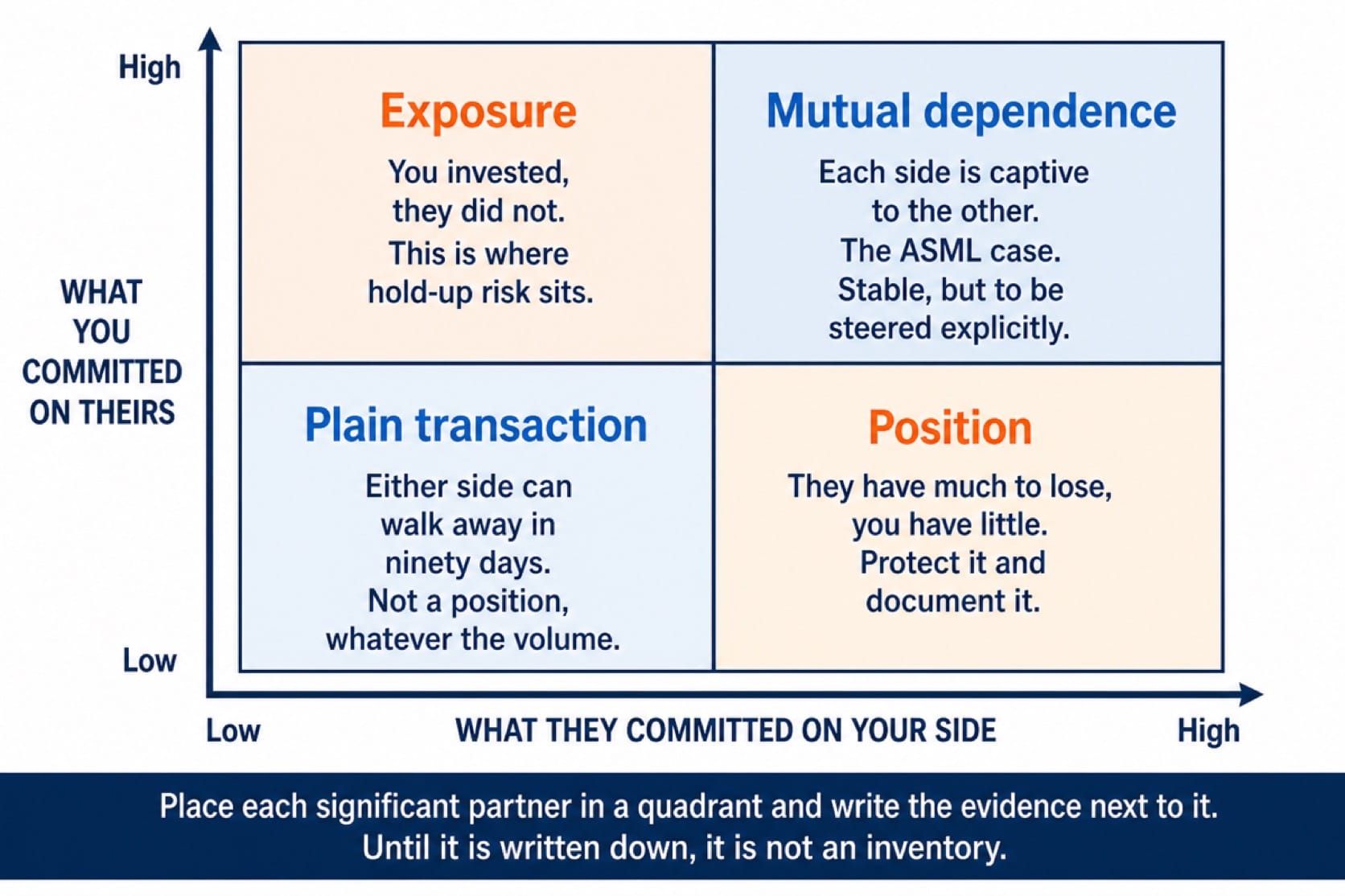
The useful question is not "who do we depend on?". It is too easy to ask and invariably produces dependency-reduction plans that cost a lot and change little. The useful question is the reverse: who, among our partners, has committed resources that are only worth something because of us?
That is a far more reliable measure of position than market share. A supplier who adapted its processes to your constraints, a partner who trained a team on your standard, a customer who built their own tooling on top of your interface, all of them made a specific investment. What you represent to them does not vanish because a competitor quotes 15% less. Conversely, a relationship where either side can walk away in ninety days losing nothing is not a position, whatever its volume.
That exercise has a name in the economics literature, and it is worth knowing before running it. Oliver Williamson received the Sveriges Riksbank Prize in Economic Sciences in 2009 for his analysis of economic governance, and of the boundaries of the firm in particular. The central prediction of his theory, as the Royal Swedish Academy of Sciences summarizes it in its press release, is that the propensity of economic agents to conduct transactions inside the boundaries of a firm increases along with the relationship-specific features of their assets. Asset specificity is the concept, and the risk it creates carries another name, hold-up: whoever invested in a relationship becomes exploitable by whoever did not. ASML is the limit case where that risk neutralized itself, because each side is captive to the other. To go further, the advanced information published by the Academy sets out the mechanics and the empirical literature that tested them.
The pattern shows up at small scale too. In several organizations, the teams that actually shape trade-offs are not the ones with the largest budget. They are the ones around which everyone else built their own tools, their own formats, their own routines. Nobody decided to grant them that power. It accumulated while attention was elsewhere.
Then comes the mirror image, which is the real exercise. Take inventory of what your organization has built that only has value with a single partner. That is not necessarily a problem, deep specialization is often the source of the advantage. But until that inventory is written down, dependence is not a strategy, it is a blind spot.
The builder's question
That inventory is not built in a meeting. It is built by looking at what your partners actually constructed around you, and what it would cost them to undo it. Only at that point does the following question stop being rhetorical.
If your main partner decided tomorrow to replace you, how much of what they built in order to work with you would they lose, and do you know the answer precisely?
Glossary
The technical terms used in this article are collected here. Every underlined term in the text links to its definition, and every definition links back to the exact passage you came from.
Lithography: the manufacturing step that prints a circuit pattern onto a silicon wafer by projecting light through a mask. It is repeated for every layer of the chip, dozens of times, and it sets how fine the features can be. Back to the text
Wafer: a polished silicon disc on which circuits are printed and then cut into individual chips.
Mask: the plate carrying the pattern for one layer of the circuit. Light passes through it and projects that pattern, reduced in scale, onto the wafer. It is the photographic negative of the chip.
Extreme ultraviolet, or EUV: light with a wavelength of 13.5 nanometers, more than fourteen times shorter than the 193 nanometers of the previous generation, known as DUV for deep ultraviolet. That wavelength is what makes finer features printable, and it is also what rules out lenses, since almost every material absorbs this light instead of transmitting it. Back to the text
Plasma: a state of matter in which atoms are ionized, produced here by vaporizing a tin droplet with a laser pulse. It is that plasma, not a lamp or a direct laser, that emits the EUV light. Back to the text
Numerical aperture, and High-NA: a measure of how much light a machine's optics can collect and focus. The higher it is, the smaller the printed features can be. The generation known as High-NA raises that value from 0.33 to 0.55. Back to the text
Asset specificity: the property of an investment whose value collapses if the counterparty changes. A machine designed for a single customer, a team trained on one standard, a process adapted to one partner's constraints. It is the central concept of Oliver Williamson's analysis of the boundaries of the firm. Back to the text
Hold-up: within that framework, the situation where the party that made a specific investment is left at the mercy of the other, who can renegotiate on favorable terms because the first party can no longer go elsewhere without losing everything. Back to the text
Synthetic buyback: an operation through which a company returns capital to its shareholders by repurchasing their shares. In the 2012 structure, it was used to push the proceeds of the issuance subscribed by the three customers straight back out to the existing shareholders.
Sources: As of August 2026
- [Primary] — Our history — ASML — 2026 — https://www.asml.com/en/company/about-asml/history
- [Primary] — ASML reports €32.7 billion total net sales and €9.6 billion net income in 2025 — ASML — January 28, 2026 — https://www.asml.com/en/news/press-releases/2026/q4-2025-financial-results
- [Primary] — ZEISS and ASML strengthen partnership for next generation of EUV lithography — ASML — November 3, 2016 — https://www.asml.com/en/news/press-releases/2016/zeiss-and-asml-strengthen-partnership-for-next-generation-of-euv-lithography
- [Primary] — Samsung joins ASML's Customer Co-Investment Program for Innovation, completing the program — ASML — August 27, 2012 — https://www.asml.com/en/news/press-releases/2012/samsung-joins-asmls-customer-co-investment-program-for-innovation-completing-the-program
- [Primary] — TSMC joins ASML's Customer Co-Investment Program for Innovation — ASML — August 5, 2012 — https://www.asml.com/en/news/press-releases/2012/tsmc-joins-asmls-customer-co-investment-program-for-innovation
- [Primary] — Light & lasers, Lithography principles — ASML — 2026 — https://www.asml.com/en/technology/lithography-principles/light-and-lasers
- [Primary] — Lenses & mirrors, Lithography principles — ASML — 2026 — https://www.asml.com/en/technology/lithography-principles/lenses-and-mirrors
- [Primary] — ASML honors TRUMPF for new EUV laser — TRUMPF — October 24, 2025 — https://www.trumpf.com/filestorage/TRUMPF_Master/Corporate/Newsroom/Press_releases/2025_26/Corporate/20251024-PM-TRUMPF-Supplier-Award/20251024-PR-TRUMPF-Supplier-Award-EN.pdf
- [Primary] — The Prize in Economic Sciences 2009, press release — Royal Swedish Academy of Sciences — October 12, 2009 — https://www.nobelprize.org/prizes/economic-sciences/2009/press-release/
- [Primary] — The Prize in Economic Sciences 2009, advanced information — Royal Swedish Academy of Sciences — 2009 — https://www.nobelprize.org/prizes/economic-sciences/2009/advanced-information/
- [Primary] — The Netherlands expands export control measure for advanced semiconductor manufacturing equipment — Government of the Netherlands — September 6, 2024 — https://www.government.nl/latest/news/2024/09/06/the-netherlands-expands-export-control-measure-advanced-semiconductor-manufacturing-equipment
- [Secondary] — Zeiss expands German site that caps ASML's EUV scanner output — Tom's Hardware — July 26, 2026 — https://www.tomshardware.com/tech-industry/zeiss-expands-german-site-that-caps-asmls-euv-scanner-output
- [Secondary] — Tracing the emergence of extreme ultraviolet lithography — Center for Security and Emerging Technology, Georgetown University — July 2024 — https://cset.georgetown.edu/publication/tracing-the-emergence-of-extreme-ultraviolet-lithography/
Comments ()