Stripe buys OpenRouter: your model gateway just became a critical vendor
Stripe confirmed on 19 August 2026, in a statement published on its own newsroom, that it had agreed to acquire OpenRouter, the gateway and routing platform that provides access to more than 400 models from over 80 providers. Neither company disclosed the price. Bloomberg reported more than $7 billion on 16 August, and the New York Times put the figure at $7.5 billion on 19 August, of which $1.5 billion goes to the founders. For scale, OpenRouter had raised $113 million in May 2026 at a $1.3 billion valuation, in a round led by CapitalG. Three months separate the two events.
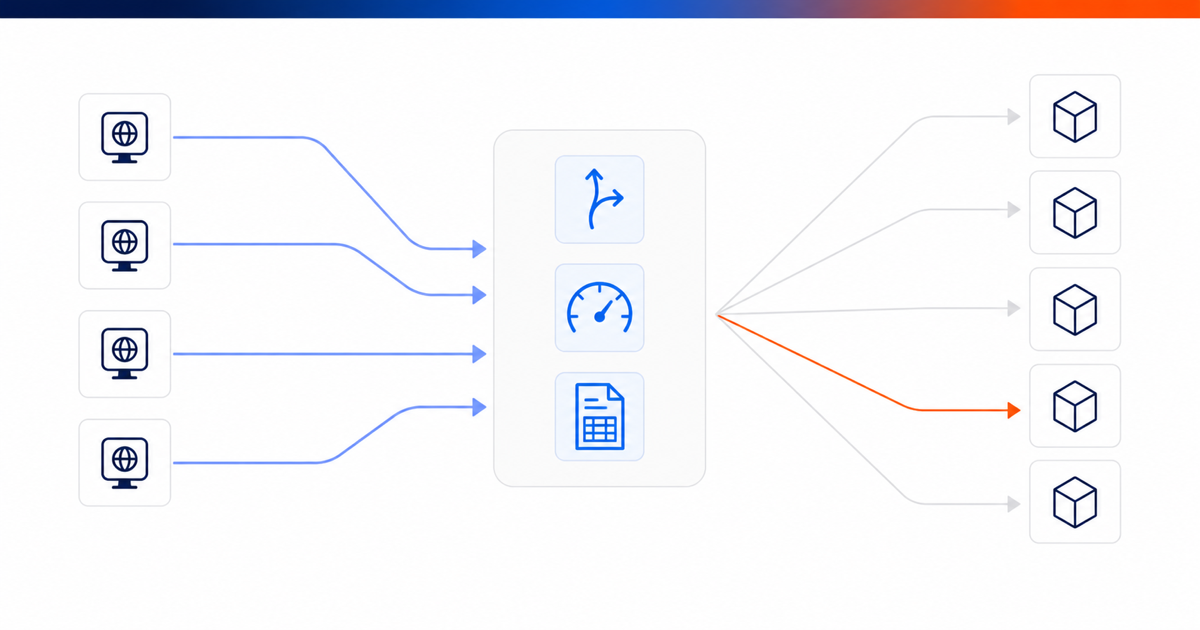
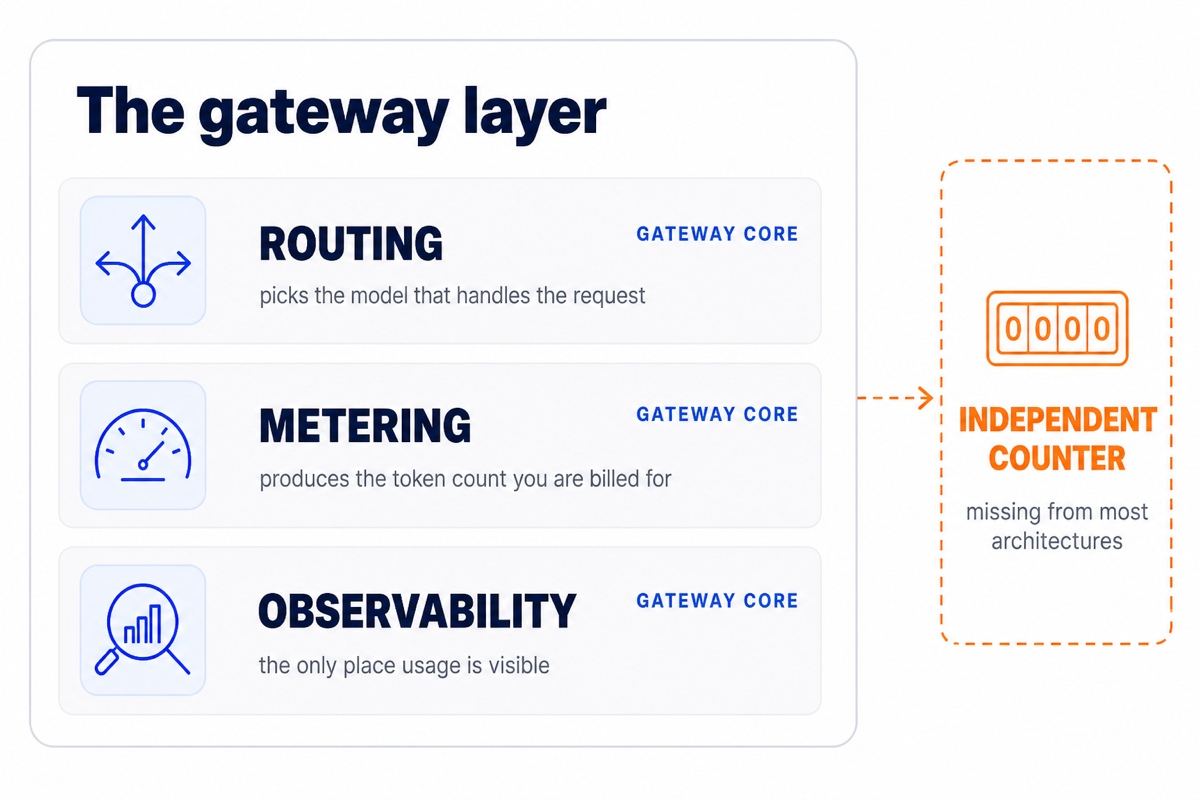
The first reflex on hearing this kind of news is to ask whether prices will go up. That is the wrong question, and it arrives too late anyway. The useful question is what this layer actually does inside your architecture, because in most teams it has quietly accumulated three distinct functions that nobody ever decided to combine: it picks which model handles each request, it produces the token count that becomes the basis of what you pay, and it is the only place where real usage is observable. A layer that decides, measures and certifies at the same time is not a technical commodity. It is a critical vendor, and it is rarely registered as one.
The 25 July article on Gemini 3.5 Pro's delay framed the problem on the model side: the risk is not picking the wrong one, it is running an architecture that makes switching expensive. The gateway is the same problem moved up one layer, with the twist that it was adopted precisely to solve the first one. What follows covers what has accumulated in that layer, why its neutrality cannot be verified from the outside, and the four questions worth settling before the transaction closes.
What the gateway accumulated without anyone deciding
The figures OpenRouter published on announcement day give the scale: more than 10 trillion tokens processed per day, more than 400 models, a claimed community of over 10 million developers and companies, and inference volume growing at least tenfold every year since the company was founded in early 2023. It employed 90 people at the time of the deal. These numbers move fast and contradict each other across sources depending on the measurement window: the press reported 25 trillion weekly tokens in May 2026, while the August statement returns to a daily rate of more than 10 trillion. Both can be true three months apart at that growth rate, but they are not directly comparable, and none of them is audited by a third party.
What matters to a decision maker is not the size of the volume, it is how it got there. A gateway arrived in most architectures during the prototype phase, for a perfectly sound reason: one key, one API, access to the whole catalogue, and the ability to compare one model against another without rewriting the integration. The pattern that keeps showing up in the field is that this prototype decision was never revisited when the system went to production. A team wired the gateway in on a Tuesday to test three models, and two years later the company's entire inference traffic runs through it, without any architecture review ever having to approve anything, since technically nothing changed.
The consequence is that your token count lives at a third party. You receive an invoice backed by a log you do not keep, for requests routed to a model you did not choose, under an arbitration policy between price, latency and availability that is the very core of the product. None of that is abnormal, it is exactly what the gateway promises to do. But the 3 July article on inference costs assumed you were measuring your own consumption. If the only measurement you have is the one produced by the vendor billing you, you are not measuring, you are acknowledging.
Neutrality cannot be verified from the outside
OpenRouter made the clearest possible commitment in its announcement post: same product, same roadmap, and routing decisions that remain driven by the user's interest alone, bending to no model, no provider and no parent company. Alex Atallah, cofounder and CEO, argues the same case in Stripe's statement, describing intelligence as multi-model and in need of a neutral layer to orchestrate everything. There is no reason to doubt the sincerity of that commitment, and OpenRouter's market position was built on it.
The problem is not good faith, it is verifiability. A routing decision leaves no counterfactual trace. When a request goes to one model rather than another, you see the result and the cost, never the comparison you did not run. No customer can establish from the outside that a given arbitration was the best available, for the same reason no advertiser can audit an ad auction from their dashboard. The only protection is to keep an independent counter and periodically retest the direct alternative, which almost nobody does as long as the invoice stays within expectations.
This question reaches well beyond the 19 August deal, because a market category is forming around it. Databricks has made its own AI gateway generally available, Rippling launched a tool in early August to track AI spend per employee, and Ramp has entered the same territory. Stripe, for its part, had already bought Metronome, whose usage metering engine is used by several major labs, in a deal completed on 15 January 2026. The OpenRouter acquisition therefore places the engine that counts consumption and the layer that decides where it happens under the same roof. Franco Granda, an analyst at PitchBook, reads it as a deliberate attempt by Stripe to embed itself in the middle of capital flows in the AI era, and argues the deal gives the acquirer some degree of power over its own suppliers, frontier labs and hyperscalers included. Patrick Collison puts it differently in the statement: tokens are the central currency for companies building with AI.
Four questions to settle before the deal closes
The transaction is not closed. OpenRouter's post specifies that it remains subject to customary closing conditions and that closing is expected in the coming weeks. That window is the right moment to ask four questions, not because anyone should be running for the exit, but because a dependency documented in calm conditions is far easier to renegotiate than one discovered the day terms change.
Where is the count that becomes the basis of your invoice logged, and do you have an independent counter? If the answer is that you read the same numbers the vendor does, you have no negotiating position in a dispute, and more importantly no way to detect slow drift. An application-side counter, even an approximate one, changes the nature of that conversation.
What is your actual switching time to direct provider calls? Not the estimate given in a meeting, the measurement. If your code calls the gateway through an interface compatible with provider APIs, switching is a matter of hours. If it relies on gateway-specific features, automatic arbitration, provider fallback, unified response format, it runs into weeks and nobody on the team can say so precisely. The answer is a number, obtained by trying.
What prompt data transits, and under what retention policy? A gateway sees every piece of content sent to the models. The question is not specific to this acquisition, it should have been asked at integration time, and a change of control is a legitimate occasion to ask it again, including with your legal team.
What do you do if pricing terms change after integration? This is the mechanism described in the 27 July article on agentic arbitrage, turned back on you: the value captured by an intermediation layer grows as the cost of leaving it grows. Writing down in advance the threshold that would trigger a change, in margin points or as a share of the invoice, beats discovering it in a board meeting.
What to put in motion this week
Add the gateway to your critical vendor register, with the same treatment as your hosting provider or your identity provider. If it is not on that list, none of the review processes you already run will apply to it, and that is precisely what has happened so far.
Add an application-side token counter, per service and per use case, independent of the gateway's. A few hours of work buys you a basis of comparison against the invoice, plus a dataset you keep if you ever change vendor.
Measure the switching time instead of estimating it. Take a secondary service, have it call a provider directly for a day, and time it. The result will tell you whether your reversibility is real or theoretical.
Pull up the change-of-control clause in your contract, if you have one, along with the prompt retention policy. Both take an hour to read and renegotiate far better before a closing than after.
Finally, write down the threshold that would trigger a reassessment, quantified and dated, and file it with the rest of your dependency criteria. A threshold written in cold blood is the only kind that survives the meeting where everyone has good reasons to wait one more quarter.
Conclusion
The story of this layer is one of a minor technical decision that became a major dependency without any intermediate step alerting anyone. Neither OpenRouter's neutrality pledge, which is probably sincere, nor Stripe's reputation changes that, because the problem is not who owns the vendor but the absence of a fallback position at the customer's end. The coming weeks offer an unusual window: a deal announced, not yet closed, involving a vendor you depend on without ever having formalised it. Windows like that do not reopen.
Sources: As of August 2026
- [Primary] Stripe agrees to acquire OpenRouter to help businesses optimize token routing and usage — Stripe — 19 August 2026 — https://stripe.com/newsroom/news/stripe-agrees-to-acquire-openrouter
- [Primary] OpenRouter is Joining Stripe — OpenRouter — 19 August 2026 — https://openrouter.ai/blog/announcements/openrouter-is-joining-stripe/
- [Primary] Stripe completes Metronome acquisition — Stripe — 15 January 2026 — https://stripe.com/newsroom/news/stripe-completes-metronome-acquisition
- [Secondary] Stripe didn't really buy OpenRouter because of the 'singularity' — Julie Bort, TechCrunch — 19 August 2026 — https://techcrunch.com/2026/08/19/stripe-didnt-really-buy-openrouter-because-of-the-singularity/
- [Secondary] Stripe Finalizes Deal to Acquire AI Startup OpenRouter for Over $7 Billion — Bloomberg — 16 August 2026 — https://www.bloomberg.com/news/articles/2026-08-16/stripe-nears-deal-to-buy-ai-firm-openrouter-for-over-7-billion
- [Secondary] OpenRouter more than doubles valuation to $1.3B in a year — TechCrunch — 26 May 2026 — https://techcrunch.com/2026/05/26/openrouter-more-than-doubles-valuation-to-1-3b-in-a-year/
- [Secondary] Stripe to buy OpenRouter as fintech expands deeper into AI — CNBC — 19 August 2026 — https://www.cnbc.com/2026/08/19/stripe-openrouter-fintech-ai-model-marketplace-.html
- [Secondary] Stripe to Acquire OpenRouter: Why Everyone Is Obsessed With Model Routing — Menlo Ventures — August 2026 — https://menlovc.com/perspective/stripe-to-acquire-openrouter-why-everyone-is-obsessed-with-model-routing/
Comments ()