Agentic arbitrage: $234 billion in SaaS spending at risk from your own AI agents
On 1 July 2026, Gartner published an estimate that moves the agentic AI debate from engineering to budget: up to $234 billion of enterprise application software spending is exposed to what the firm calls agentic arbitrage between now and 2030, roughly 20% of enterprise SaaS spending by that date. The mechanism is stated plainly: when AI agents complete tasks across multiple systems, the need to open each of those software interfaces disappears.
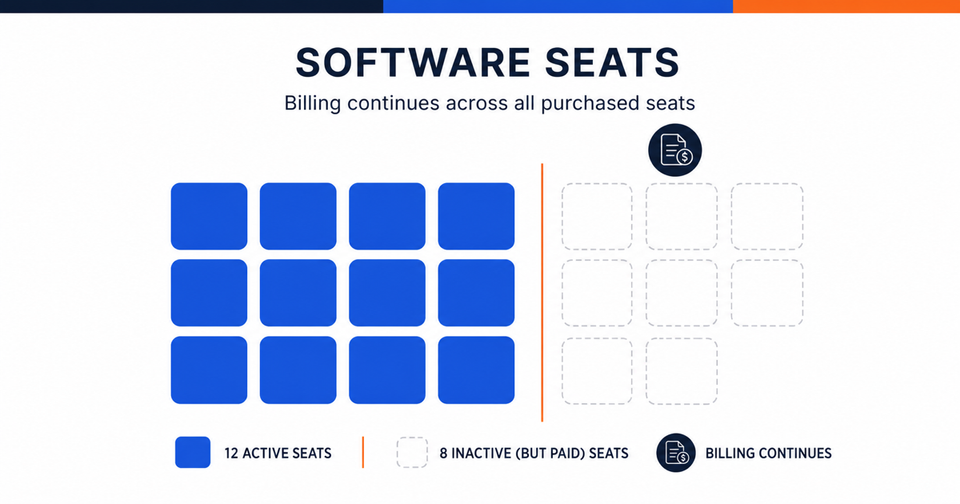
The instinctive reading treats this as a vendor problem, a threat to Salesforce or ServiceNow that buyers can watch from the sidelines. The opposite is true. For a technology or finance leader, agentic arbitrage is not primarily a market risk. It is an accounting anomaly forming inside their own portfolio: seat-based licences tied to interfaces that agents progressively stop using, on multi-year contracts signed well before the shift becomes visible.
The technical trigger for that arbitrage was covered in the article on A2A and MCP in production: once an agent talks natively to multiple systems through standard protocols, it no longer needs the graphical interface those systems charge for. The budget consequence of that interoperability is arriving now, and it gets handled at contract renewal, not at agent deployment.
What agentic arbitrage breaks in the SaaS model
George Brocklehurst, Managing Vice President at Gartner, frames the problem from the vendor side: agentic systems deliver outcomes directly, bypass user-experience-heavy applications and make the software invisible, which breaks the link between user growth and revenue growth for many enterprise software vendors. That broken link is the whole story. Seat-based licensing rests on a simple assumption, that a productive employee is an employee who opens the application. The assumption stops holding the moment an agent traverses five systems to produce an outcome nobody needs to look up in any of them.
Gartner also reframes the term Saaspocalypse, describing it as less an apocalypse than a metamorphosis: SaaS is not destroyed, it re-emerges in a different form, carrying threats and opportunities for incumbents and new entrants alike. The nuance matters to a buyer, because it rules out the convenient scenario of a price collapse you simply wait to benefit from. What is happening is a redistribution: the share of value carried by the interface erodes, the share carried by institutional memory and accumulated customer context strengthens.
The firm is explicit here: adding AI features to an existing tool often creates more cost without producing better outcomes, because outcomes require systems that can retain deep institutional memory and customer context over time. A vendor stacking AI buttons onto an existing dashboard is not defending its position, it is raising your invoice. A buyer paying that premium is purchasing features while believing they are purchasing results.
The signal is already visible in pricing sheets
This shift is not a distant projection. It already shows in the pricing changes vendors are making themselves. In June 2026, GitHub dropped its flat rate for premium requests in favour of usage-based billing on tokens, covering input, output and cached tokens at published per-model rates. Zendesk introduced outcome-based pricing. Workday launched a flexible credit system for access to its AI capabilities.
Three vendors, three pricing architectures, one direction: the seat is no longer the natural billing unit. For a finance function, that means year-over-year budget comparison loses its baseline. A line item that cost a predictable amount per user per month becomes variable, tied to a processing volume nobody was steering until now.
The pattern settling into mature portfolios is quieter than the pricing question, and more expensive. When an agent automates a workflow spanning several systems, licence consumption does not fall mechanically, because seats are attached to teams and contractual scopes rather than actual usage. The gap between seats paid for and seats genuinely active builds without an alert, and only surfaces at renewal, usually past the renegotiation window.
Sorting your portfolio before the next renewal
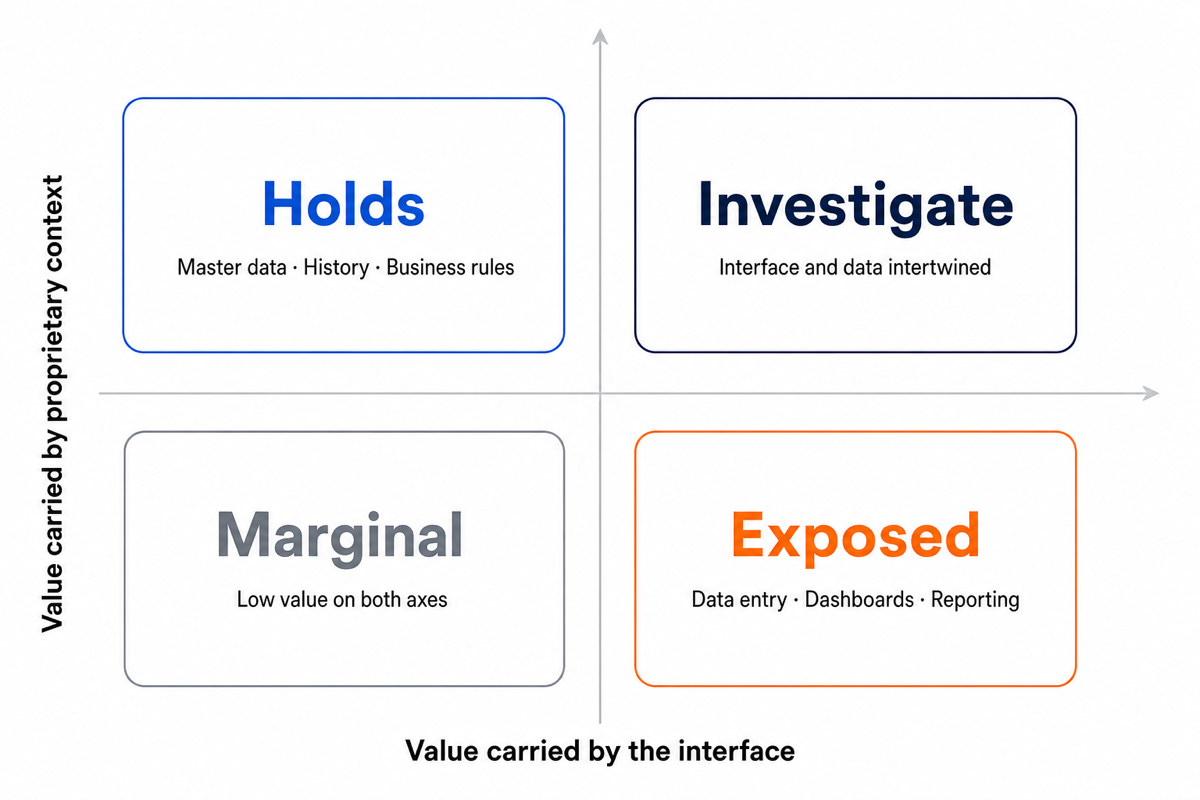
A tool whose value rests mainly on its interface is exposed. That covers data-entry applications, consultation dashboards, reporting tools and light workflow layers whose function amounts to presenting data that lives elsewhere. An agent with access to the source produces the same outcome without opening the screen, and the perceived value of the licence falls faster than the contract ends.
A tool whose value rests on proprietary data, a network effect or accumulated memory holds up. The system that owns transaction history, the master reference data, business rules codified over a decade or the customer relationship graph does not become less valuable because an agent queries it instead of a human. It becomes more strategic, since it now feeds the agents themselves. That is precisely the criterion Gartner highlights when it advises vendors to capture and retain customer-specific knowledge, not just data.
Between the two sits the zone to investigate first: tools whose value blends interface and proprietary data, where the call depends on how deep the lock-in really goes. The question to put to the application owner is not how many people use it, but what would remain irreplaceable if the interface disappeared tomorrow. A hesitant answer is information in itself, and it is worth far more twelve months before expiry than three weeks before signature.
What to set in motion this week
Pull the list of software contracts expiring in the next twenty-four months and classify each line by the nature of its value, interface or proprietary context. On a mid-sized portfolio this takes half a day and determines where negotiating effort belongs.
For the three largest contracts, ask for the gap between billed seats and active seats over the past six months. If the vendor cannot supply that data, or supplies it reluctantly, you already have your answer.
Add a usage-linked review clause to upcoming renewals, or failing that, shorten the commitment period on tools classified as interface-dependent. Signing a five-year deal on that segment today means committing across exactly the window Gartner identifies for the shift.
For every AI surcharge billed by an existing vendor, check whether it delivers a measurable outcome or merely an additional feature. The measurement method was set out in the article on AI ROI, and it applies to imposed spending as much as to internal projects.
Conclusion
The $234 billion Gartner points to is not a saving that lands automatically in buyers' budgets, but a mass of spending whose justification is about to move. Organisations that sort their portfolio before the next contractual deadlines will negotiate on facts, separating what they pay for an interface from what they pay for an information asset. Those that roll their contracts over as they come will find the gap once it has become structural, with agents in production and licences sized for human usage that no longer exists.
Sources: As of July 2026
- [Primary] Gartner Says $234 Billion in Enterprise Application Software Spend Is at Risk from Agentic AI — Gartner — 1 July 2026 — https://www.gartner.com/en/newsroom/press-releases/2026-07-01-gartner-says-us-dollars-234-billion-in-enterprise-application-software-spend-is-at-risk-from-agentic-artificial-intelligence
- [Secondary] Agentic AI to disrupt $234B in SaaS spending: Gartner — CIO Dive — 6 July 2026 — https://www.ciodive.com/news/agentic-ai-disrupt-234-billion-saas-spending/824530/
- [Secondary] Agentic AI puts $234B in enterprise SaaS spending at risk, Gartner says — CIO — July 2026 — https://www.cio.com/article/4192242/agentic-ai-puts-234b-in-enterprise-saas-spending-at-risk-gartner-says.html
- [Primary] GitHub Copilot is moving to usage-based billing — GitHub — June 2026 — https://github.blog/news-insights/company-news/github-copilot-is-moving-to-usage-based-billing/
- [Primary] Zendesk introduces outcome-based pricing — Zendesk — 2026 — https://www.zendesk.com/newsroom/articles/zendesk-outcome-based-pricing/
- [Primary] Introducing Workday Flex Credits — Workday — 2026 — https://blog.workday.com/en-us/introducing-workday-flex-credits-smarter-more-flexible-way-access-ai-innovation.html
Comments ()