Why Your Inference Costs Are Exploding (and How to Cut Them by 60%)
The bill arrives and it always surprises.
68% of enterprise teams underestimate their first-year LLM API spend by more than 3x [The True Cost of Running Enterprise LLMs in Production, 2026], an order of magnitude confirmed by a February 2026 DoiT survey in which 79% of enterprises reported an AI budget overrun over the prior twelve months. Not a 20% variance, three times the planned budget. Enterprise LLM spending doubled in six months, from $3.5B in late 2024 to $8.4B by mid-2025, with Menlo Ventures projecting $15B for 2026.
This is not an adoption problem. It is an operational naivety problem.
Most teams deploy their first agent or RAG pipeline with a frontier model in route-all mode, bill every token as if it were irreplaceable, and discover six months later that LLM infrastructure has become their second largest cloud cost center. The problem is not model pricing, it has dropped 80% over two years. The problem is call architecture.
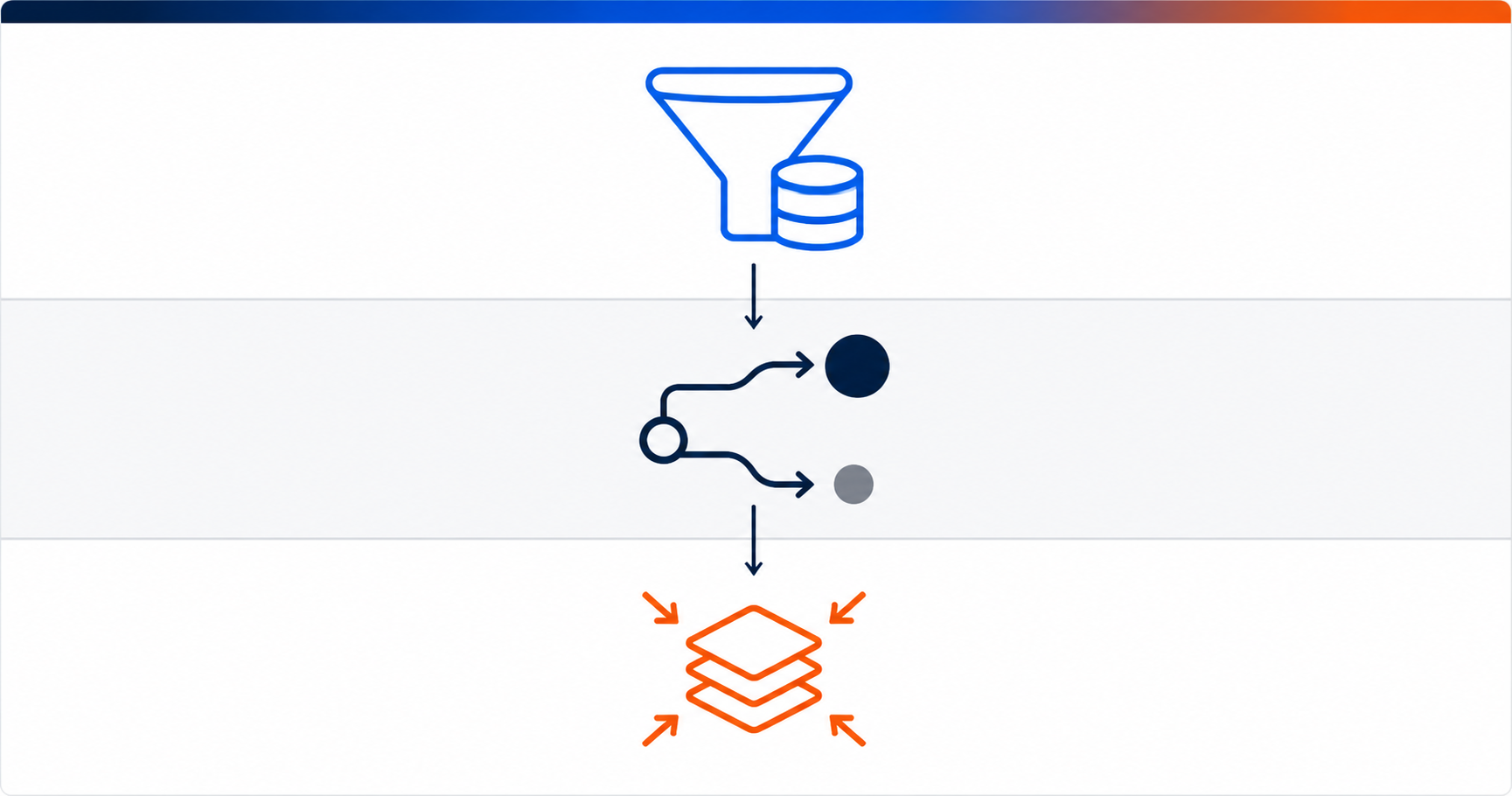
Three levers combined, semantic caching, intelligent routing to lighter models, and quantization, deliver documented 60% reductions in enterprise environments. Each can be implemented independently. Together, they form the foundation of serious LLMOps.
The instinct that blocks most teams is the counterintuitive part to fix: they assume cutting costs means sacrificing answer quality, systematically downgrading to a cheaper model. Production data shows the opposite. Enterprises that cut costs by 60% do so without degrading acceptance rates, because the gain comes from call architecture, caching and routing, not from compromising on the model used for tasks that genuinely need it. For long-running agents specifically, the optimization patterns differ meaningfully from a one-off LLM call: we cover them in the dedicated article on token budgeting for production AI agents.
What is actually driving the bill
Before optimizing, you need to understand exactly what you are paying for.
An LLM call breaks down into two token types: input tokens (the prompt, context, injected documents) and output tokens (the generated response). With Anthropic, Claude 3.7 Sonnet input tokens cost $3.00 per million and output tokens $15.00 per million. This asymmetric ratio is the first thing most teams overlook: reducing output tokens is far more profitable than reducing input tokens.
Second factor: invisible repetition. 31% of LLM queries in production share semantic similarity with queries already processed [LeanLLM, 2025]. For a customer support pipeline or an internal copilot, this figure rises to 50-70%. Every repeated query is unnecessary spend if no caching mechanism exists.
Third factor: systematic oversizing. Teams select the most powerful available model, apply it to 100% of their requests, and charge their internal FAQ at the same rate as their contract analysis. RouteLLM research (ICLR 2025) showed that 50 to 70% of enterprise LLM requests can be handled by the cheapest model tier, with only 5 to 15% genuinely requiring the premium tier.
The three levers that work
Lever 1: semantic caching
Exact caching is trivial and low-impact. Semantic caching compares incoming requests by vector similarity and returns the cached response when the score exceeds a configurable threshold.
GPTSemCache reports hit rates between 61.6% and 68.8% across varied workloads [arxiv, 2026]. ProjectDiscovery took their hit rate from 7% to 84% through explicit breakpoint placement and deliberate TTL management, making complex security audits "economically viable at scale" by their own account [ProjectDiscovery Blog, 2025].
Thomson Reuters Labs documented a 60% cost reduction through prompt caching alone across their LLM applications [Medium / TR Labs, 2025].
Production-ready tools today: GPTCache (open-source, Python, two-line integration), Redis Vector Cache (for multi-pod deployments), and gateway-level solutions that apply caching across the entire application stack with zero code changes.
Providers have followed: Anthropic offers prefix caching at $0.30 per million tokens (versus $3.00 standard, a 90% reduction); OpenAI enables automatic caching with 50% savings. Activation is immediate for long or repetitive prompts.
Lever 2: intelligent routing to lighter models
Not everything deserves GPT-4 or Claude Opus. This is obvious to say and hard to implement without a framework.
RouteLLM (ICLR 2025) demonstrated that a well-trained complexity router achieves 95% of GPT-4 performance while routing only 14 to 26% of requests to the premium model. Result: 75 to 85% cost reduction on routed workloads.
A concrete enterprise example: a Singapore mid-market bank running a compliance copilot reduced its monthly bill from $180,000 to $71,000 (60% reduction) in 90 days through three cumulative actions: caching on system prompt and regulatory context (-47%), cascading to a mid-tier model for routine queries (-25%), and a re-ranker to refine RAG context before sending to the premium model (-12%). Analyst acceptance rates remained unchanged [Sthambh / LLM Cost Optimisation APAC, 2025].
Implementing a simple router requires no specialized framework: a complexity classifier (prompt length, presence of technical terminology, session history) combined with a dispatch rule is sufficient for v1. More sophisticated solutions (LiteLLM Router, TrueFoundry AI Gateway) add monitoring, automatic fallback, and declarative routing policies.
Lever 3: quantization (where self-hosting becomes relevant)
For teams managing their own inference infrastructure, quantization is the most direct cost lever.
Quantizing from FP16 to INT8 or INT4 reduces GPU memory by 2 to 4 times and cuts inference cost by approximately 50%, while preserving 95 to 99% of original performance according to current benchmarks [Morph LLM Inference Guide, 2026]. Google published TurboQuant (2026), which compresses the KV cache to 3 bits with zero measured accuracy loss, reducing KV cache memory by a factor of 6.
Speculative decoding is a complementary technique: a small draft model generates candidate tokens that the main model validates in a single parallel pass. Result: reduced latency without significant additional compute cost. Modern serving frameworks (vLLM, SGLang, TGI) have implemented it natively since 2025.
The decision framework for your context
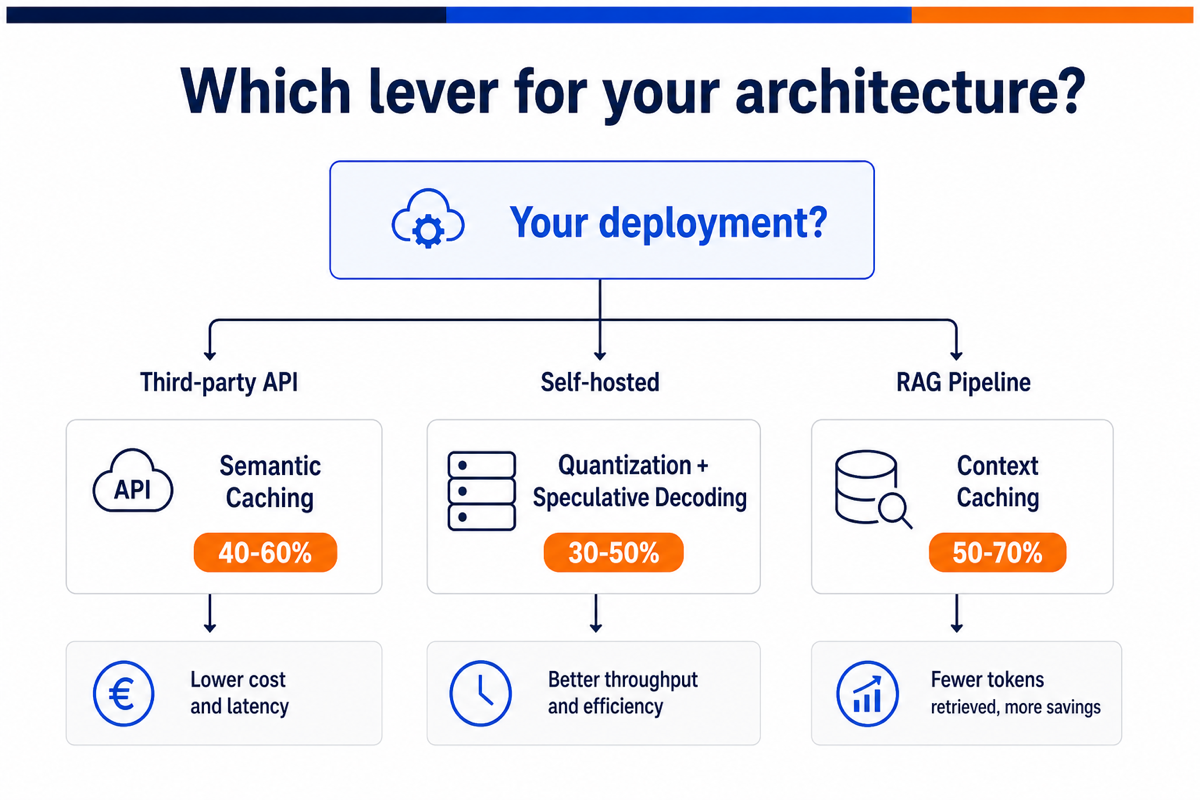
These three levers do not apply uniformly. The starting point depends on your architecture.
If you call third-party APIs (OpenAI, Anthropic, Mistral): Prioritize caching and routing. Quantization does not apply to you. Enable Anthropic prefix caching or OpenAI caching first, this is a configuration change, not a code change. Then instrument your requests to measure actual complexity distribution before choosing a router.
If you host your own models: Quantization becomes your primary lever. INT8 on vLLM is the standard baseline since 2024. Add speculative decoding if latency is your main constraint. Semantic caching applies upstream of serving, independently.
If you have a RAG pipeline in production: Caching on system context and frequently retrieved documents is often the fastest gain. A large portion of RAG cost comes from long prompts containing repetitive chunks. Measure your average injected context size first.
The rule for stacking optimizations: caching first (immediate ROI, zero risk), routing second (requires minimum instrumentation), quantization last if applicable (requires regression testing on your specific use cases). Combined, these three levels can reduce costs by 80% or more according to Morph [2026].
What to set in motion this week
Measure before you optimize. Instrument every LLM call with at least three metrics: input tokens, output tokens, model identifier used. Without this baseline, you will optimize blindly. LangSmith, Helicone, and modern gateway solutions set this up in hours.
Enable prefix caching. If you use Anthropic or OpenAI, enable caching on your system prompts and long contexts. This is a configuration change that can generate 40 to 90% savings on cached tokens within the week. Implementation cost: half an engineering day.
Identify your routine requests. Ask your team to categorize the last 20 LLM calls in production by actual complexity. In the majority of cases, you will find that 50 to 60% of those calls do not require the active premium model.
Plan a routing audit at 30 days. After two weeks of instrumentation, you will have enough data to define a simple routing threshold. The goal is not perfection: a naive router that sends 50% of your routine requests to a model that is 10x cheaper generates real ROI immediately.
The 60% reduction is not a marketing promise. It is documented in enterprise environments with real workloads. The only condition: stop treating all tokens as identical.
Conclusion
LLM inference costs are exploding because teams deploy frontier models on workloads that do not need them, without caching, without routing, without visibility into what they are actually consuming.
Semantic caching, intelligent routing, and quantization are not premature optimizations. They are the foundations of responsible LLM infrastructure. They are implemented progressively, without quality risk, and they deliver measurable results in weeks, not quarters.
The question is not whether you can afford to optimize. It is how long you can afford not to.
Sources: As of July 2026
- [Primary] — The True Cost of Running Enterprise LLMs in Production — Neil Dave — 2026 — https://theneildave.in/blog/enterprise-llm-cost-2026.html
- [Primary] — AI Cost Overrun Survey (Sapio Research for DoiT, 500 finance leaders at 1,000+ employee firms, US/UK) — DoiT — February 2026 — https://www.doit.com/blog/ai-spending-survey
- [Primary] — LLM Cost Optimization: Why Enterprises Overspend 50–90% — LeanLLM — 2025 — https://leanlm.ai/blog/llm-cost-optimization
- [Primary] — How We Cut LLM Costs by 59% With Prompt Caching — ProjectDiscovery — 2025 — https://projectdiscovery.io/blog/how-we-cut-llm-cost-with-prompt-caching
- [Primary] — Prompt Caching: The Secret to 60% Cost Reduction — Thomson Reuters Labs — 2025 — https://medium.com/tr-labs-ml-engineering-blog/prompt-caching-the-secret-to-60-cost-reduction-in-llm-applications-6c792a0ac29b
- [Secondary] — LLM Cost Optimisation in Production: How APAC Enterprises Cut Token Costs 40-60% — Sthambh — 2025 — https://www.sthambh.com/blog/llm-cost-optimisation-production-apac
- [Secondary] — LLM Inference Optimization: Cut Cost & Latency at Every Layer — Morph — 2026 — https://www.morphllm.com/llm-inference-optimization
- [Secondary] — Semantic Caching for LLM Inference (arxiv) — 2026 — https://arxiv.org/pdf/2603.03301
- [Secondary] — RouteLLM: Learning to Route LLMs with Preference Data — ICLR 2025 — https://arxiv.org/abs/2406.18665
- [Secondary] — LLM Inference Optimization Techniques 2026 — Hakia — https://www.hakia.com/tech-insights/llm-inference-optimization/
Comments ()