A2A and MCP in production: the protocol duo making your agents interoperable
The A2A (Agent2Agent) protocol passed its first anniversary in early April 2026 with a number that cuts against the usual skepticism toward open standards: more than 150 organizations run it in production, not pilots, according to the Linux Foundation's announcement. Microsoft, AWS, Salesforce, SAP, and ServiceNow are on that list, alongside Google, which launched the protocol in April 2025 before handing governance to the Linux Foundation two months later.
That number matters because it answers the question most architects have been asking for a year: would agentic interoperability protocols stay conference-slide specifications, or actually reach production inside enterprises with heterogeneous systems? The answer is now settled. What remains is deploying them correctly, and above all understanding how they fit together with MCP, the complementary protocol whose confusion with A2A still slows down many teams.
Two protocols, two different questions
MCP and A2A solve different problems, and conflating them leads to shaky architectures. MCP (Model Context Protocol) connects an agent to its tools: databases, internal APIs, file systems, SaaS services. It is the agent-to-resource layer. An agent that queries BigQuery, reads a Jira ticket, or triggers an action in Salesforce does so through an MCP server.
A2A answers a distinct question: how does an agent delegate a task to another agent, potentially built on a different platform, by a different vendor, without prior manual configuration. It is the agent-to-agent layer. A procurement agent built on Vertex AI negotiating with a logistics agent developed by a partner on a different stack uses A2A to discover capabilities, exchange tasks, and track execution.
The distinction is simple: MCP standardizes what an agent can do with its tools, A2A standardizes how autonomous agents cooperate with each other. A mature enterprise agentic system needs both, rarely one without the other.
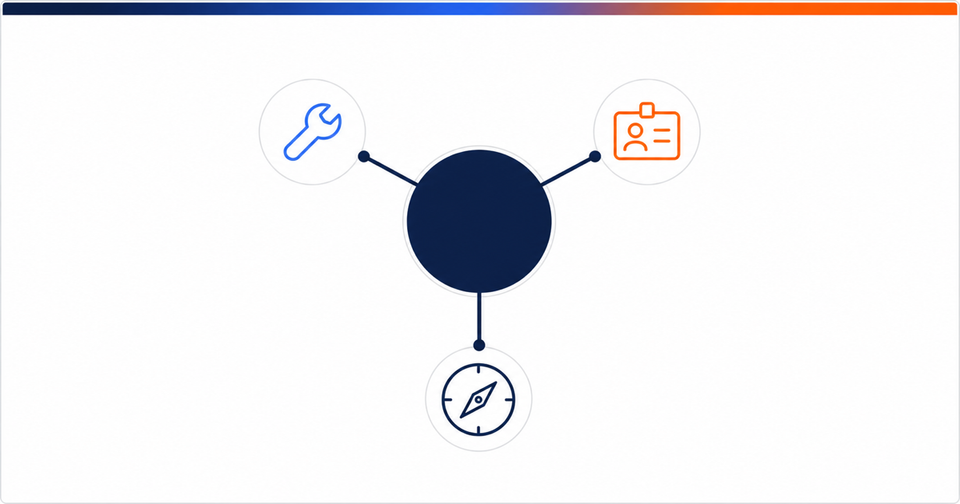
The counterintuitive instinct to correct: most teams discovering A2A evaluate it as a competitor to MCP, something to choose between. The pattern that recurs in production deployments, as in the harness implementation detailed on July 5, is that these protocols stack rather than exclude each other: the harness defines how an agent behaves, MCP defines what it can access, A2A defines who it cooperates with.
What has changed in one year
Three developments reshape the 2026 landscape and justify revisiting an architecture designed in 2025.
The first concerns governance. The Agentic AI Foundation, launched in December 2025 under the Linux Foundation and co-founded by Anthropic, OpenAI, and Block, now governs both MCP and A2A, alongside the goose runtime and the AGENTS.md behavioral specification. Both protocols now live under the same neutral structure, which lowers the risk of divergence between competing ecosystems, a scenario that would have made interoperability illusory.
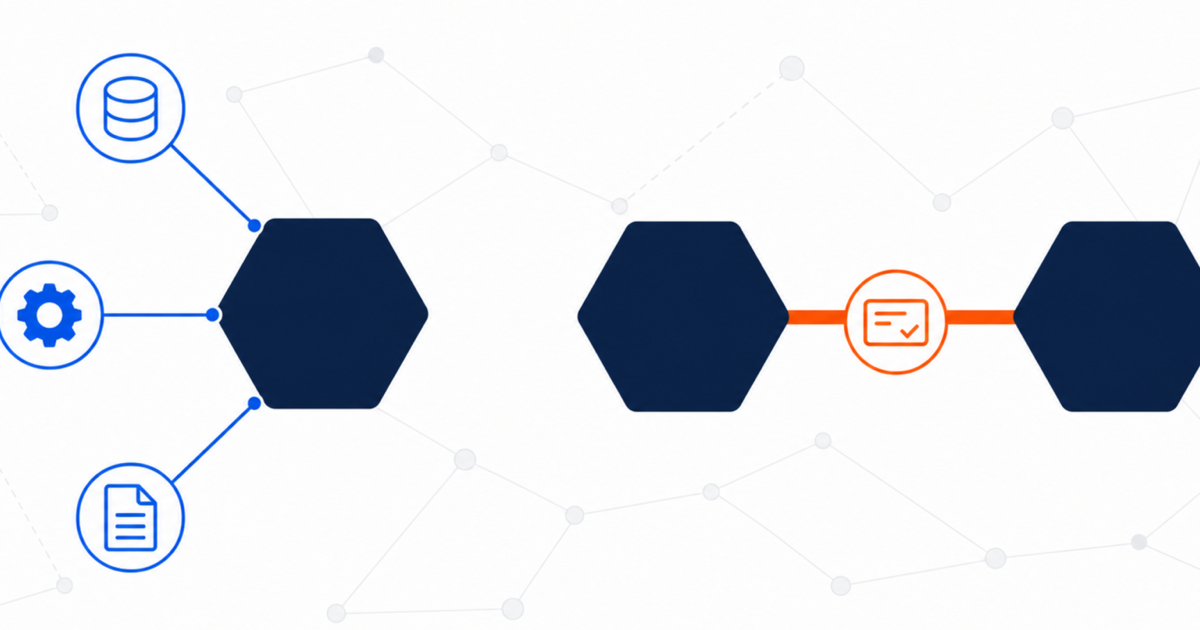
The second development touches A2A's security model. Version 1.2 introduces cryptographically signed agent cards with domain verification. In practice, a Salesforce agent can authenticate a Vertex AI agent without the two systems knowing each other beforehand or exchanging manual configuration. That is the missing piece for deploying A2A across organizations, not just between internal teams.
The third development concerns MCP on the infrastructure side. Google announced at Google Cloud Next '26, in April 2026, more than fifty managed MCP servers in general availability or preview, covering BigQuery, Maps, Compute Engine, and a large part of the Google Cloud ecosystem. More significant for enterprises with an existing API estate: Apigee now acts as an MCP bridge, automatically transcoding already-documented APIs into discoverable MCP tools, without rewriting code or abandoning the security and governance layers already in place.
A reference architecture for combining both
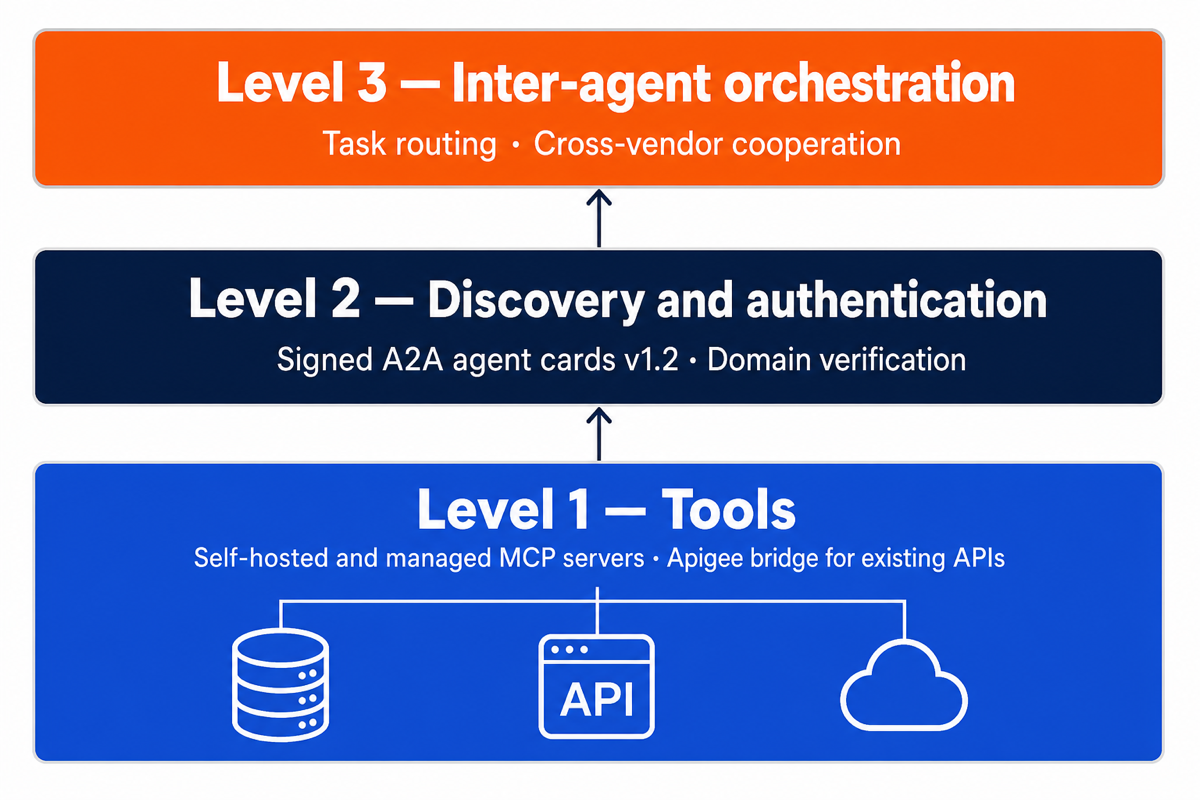
The most common mistake is treating A2A and MCP as alternatives to choose between. They are stacked layers, not competing options. In practice, a reference architecture separates three levels.
At the lowest level, each agent accesses its tools and data through MCP, whether self-hosted servers for sensitive internal systems or managed servers for standard cloud services. A bridge like Apigee exposes the existing API estate without rewriting it, significantly lowering the entry cost for enterprises with substantial legacy.
At the middle level, each agent exposes a signed A2A agent card describing its capabilities, its limits, and its authentication requirements. This is the entry point other agents, internal or external, use to discover what an agent can do before delegating a task to it.
At the top level, an orchestrator or supervisor agent routes tasks between agents via A2A, relying on agent cards to decide which agent is qualified, without needing to know each one's implementation details in advance. This is the layer that makes cooperation possible between an internally built agent and an agent supplied by a partner or vendor, on a different technology stack.
What to set in motion this week
Before scaling A2A beyond a pilot, verify that every exposed agent carries a signed v1.2 agent card, not an earlier version without domain verification. Deployments that expose agents to external partners without this signature layer risk impersonation that no use case justifies.
Map your internal API estate before deciding where to invest in custom MCP servers. A good share of already-documented APIs can be exposed through a bridge like Apigee without additional development, freeing engineering budget for the cases where a dedicated MCP server actually adds value.
Clarify the governance boundary between internal and third-party agents. An agent that only talks to other agents within the same organization can rely on lightweight internal authentication. An agent negotiating with partner or vendor agents needs the full domain verification layer introduced by A2A v1.2.
Test capability discovery before real production traffic. An orchestrator that misroutes a task to an unqualified agent, because an agent card was poorly filled in, produces errors that are hard to diagnose once the system is under load.
Conclusion
One year after launch, A2A is no longer a specification looking for adoption: 150 organizations in production and shared governance with MCP under the Agentic AI Foundation make it a standard to build on, not a bet. The question for architecture teams is no longer whether to choose between A2A and MCP, but how to layer them correctly: MCP to connect each agent to its tools, A2A to connect agents to each other. Enterprises already mapping their API estate and clarifying their internal-external governance boundary are gaining a lead measured in months, not years, over those still waiting for the landscape to settle.
Sources: As of July 2026
- [Primary] A2A Protocol Surpasses 150 Organizations, Lands in Major Cloud Platforms, and Sees Enterprise Production Use in First Year — Linux Foundation — April 2026 — https://www.linuxfoundation.org/press/a2a-protocol-surpasses-150-organizations-lands-in-major-cloud-platforms-and-sees-enterprise-production-use-in-first-year
- [Primary] Google-managed MCP servers are available for everyone — Google Cloud Blog — 2026 — https://cloud.google.com/blog/products/ai-machine-learning/google-managed-mcp-servers-are-available-for-everyone
- [Primary] MCP support for Apigee — Google Cloud Blog — 2026 — https://cloud.google.com/blog/products/ai-machine-learning/mcp-support-for-apigee
- [Primary] Agent2Agent protocol (A2A) is getting an upgrade — Google Cloud Blog — 2026 — https://cloud.google.com/blog/products/ai-machine-learning/agent2agent-protocol-is-getting-an-upgrade
- [Primary] Linux Foundation Announces the Formation of the Agentic AI Foundation (AAIF) — Linux Foundation — December 9, 2025 — https://www.linuxfoundation.org/press/linux-foundation-announces-the-formation-of-the-agentic-ai-foundation
Comments ()