Token Budgeting for Production AI Agents: How to Prevent Cost Explosions
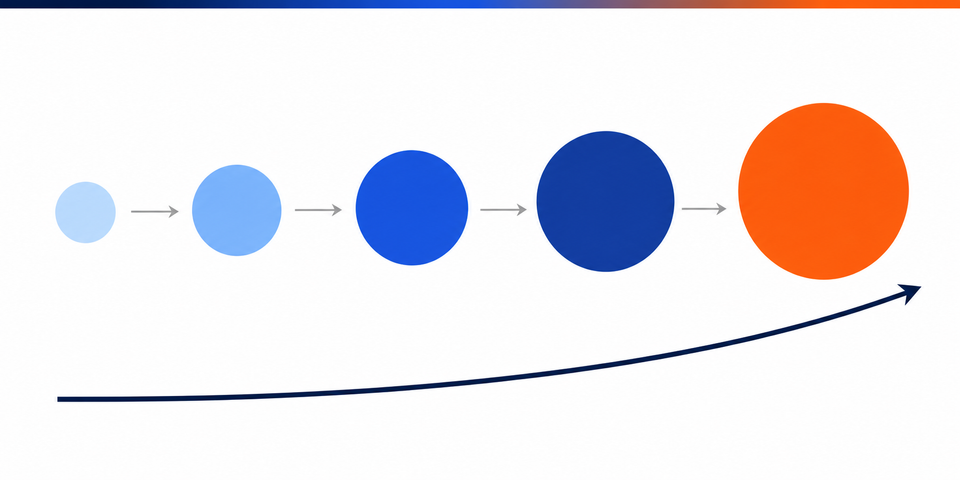
A chatbot answers once and mostly forgets what came before. An agent executing a ten-step task replays its entire context on every turn: system prompt, tool schemas, conversation history. The tenth call carries the accumulated weight of the previous nine. This mechanic, specific to agents and absent from standard conversational use, drives the bill up far faster than intuition suggests.
The MIT Technology Review Insights and Microsoft report published in June 2026 confirms this is not a marginal problem: 43% of tech leaders surveyed cite resource consumption and costs as their primary concern with agents in production. An analysis attributed to Gartner and reported by several trade outlets in March 2026 quantifies the structural gap: agentic workloads reportedly consume 5 to 30 times more tokens per task than a standard chatbot, with some estimates running higher depending on the scenario. The topic already reaches the boardroom.
The counterintuitive instinct to correct: faced with a rising bill, the first temptation is to downgrade the model across the entire loop. The real lever is not model choice, it's managing the context fed into it on every turn. This article builds on the caching and routing levers already covered in the article on LLM inference costs, applying them specifically to agent loops.
Why an agent costs more than a chatbot
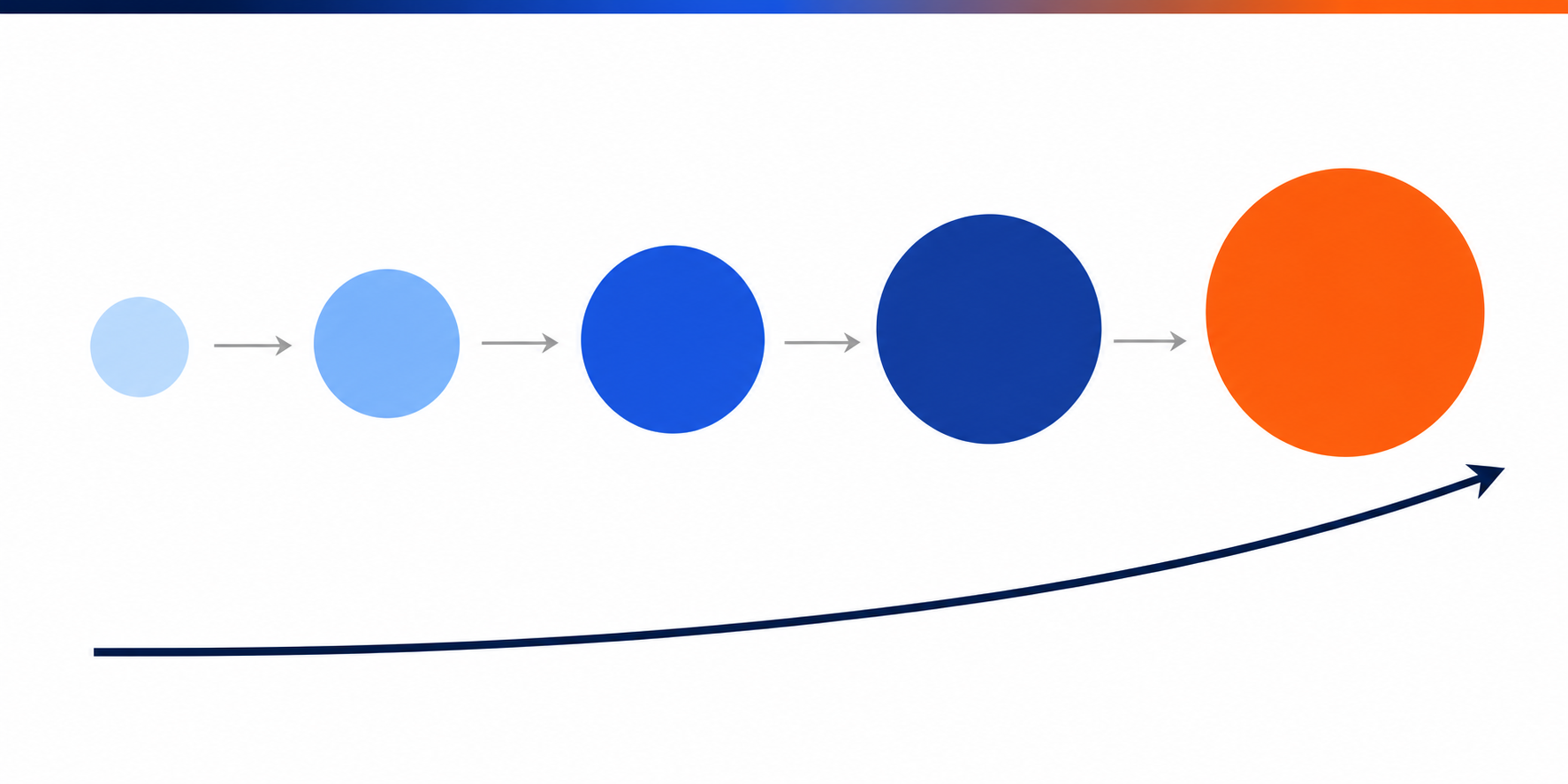
The ReAct pattern (Reasoning + Acting), which structures most production agents, alternates reasoning and tool calls on every turn. Each call sends the model the entire accumulated context: system instructions, available tool definitions, and the full history of previous turns. An agent chaining ten tool calls can carry, in its final call, a context several times heavier than its first.
This is not an implementation flaw, it follows directly from how current models handle context: without persistent memory between calls, every request must re-explain the full situation. The question is not eliminating this repetition, but making it cheaper and more targeted.
Prompt caching, the first lever
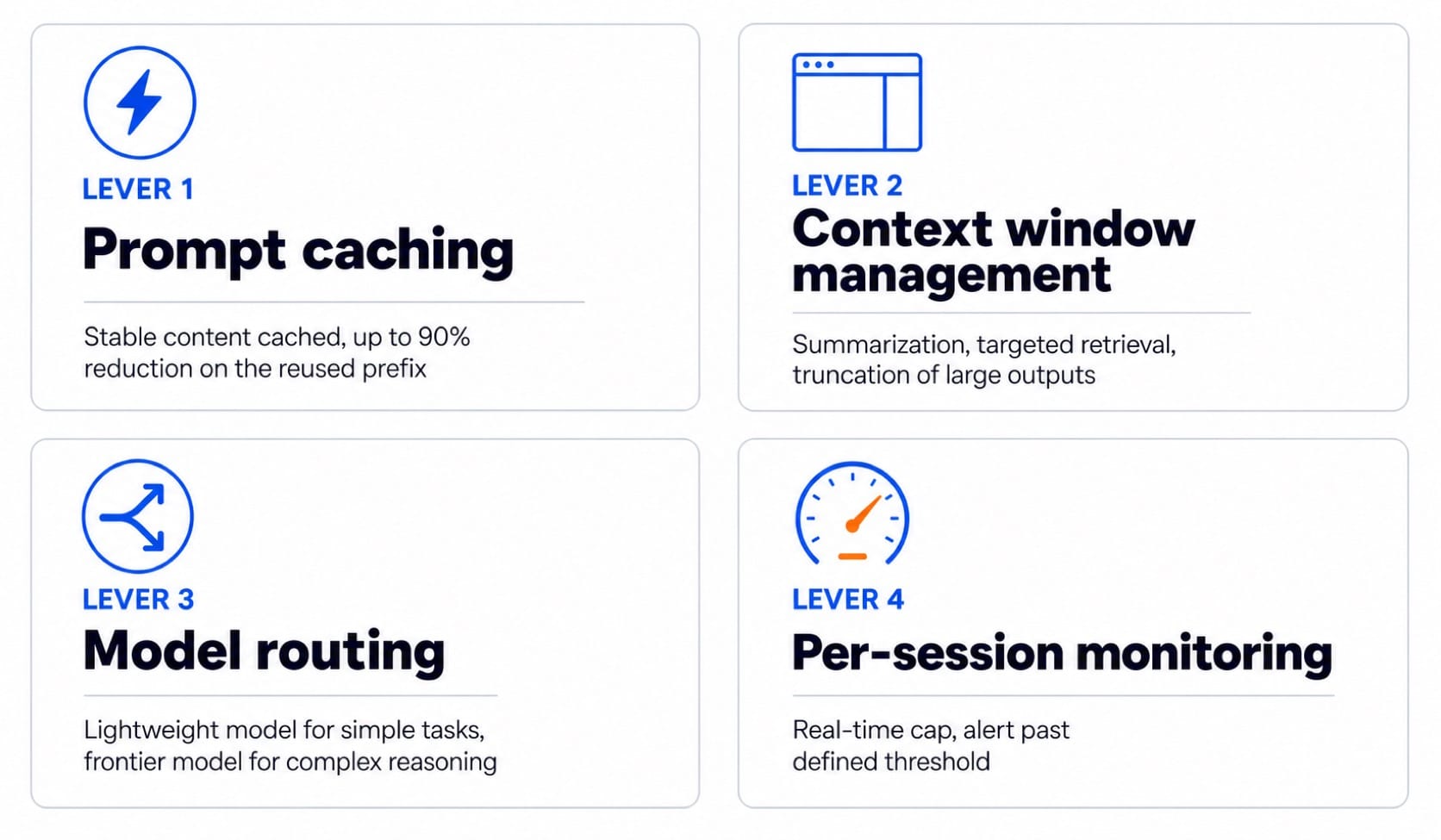
Anthropic, OpenAI, and the major cloud providers all offer some form of prompt caching: the stable portion of the context (system prompt, tool definitions, few-shot examples) is cached server-side, and subsequent calls reusing that same prefix are billed at roughly 10 to 25% of a standard token's price.
The practical rule that follows is simple: place stable content at the start of the prompt, and dynamic content (the specific request, the most recent tool results) at the end. Any dynamic content inserted before the stable prefix invalidates the cache and cancels the gain.
Managing the context window instead of letting it grow
Caching reduces the cost per token, but not the number of tokens carried. The second lever is actively deciding what stays in context rather than accumulating it by default on every turn.
Three techniques recur in mature deployments: periodic summarization of older turns instead of keeping them in full, targeted retrieval that fetches relevant information only when needed instead of holding it permanently in context, and explicit truncation of large tool outputs before reinjection. An agent that queries a database and receives five thousand rows does not need to carry all of them into subsequent turns, a structured summary is usually enough.
Routing to the model that fits the task
Not every step in an agent loop requires the same level of reasoning. Classifying a request, extracting a field, reformatting a response: these are tasks a lighter model handles correctly at a fraction of a frontier model's cost. Reserving the most capable model for steps that genuinely require complex reasoning, multi-step planning, or ambiguous decisions concentrates spend where it produces value.
This approach requires an initial effort to classify loop steps, but teams that have implemented it report significant cost reductions with no measurable quality loss on simple tasks.
Monitoring token usage per session, not just in aggregate
A global monthly budget hides individual sessions that spiral. An agent stuck in a retry loop on a complex incident can consume, in a single session, the equivalent of the budget planned for a hundred normal sessions.
Monitoring that works tracks three levels: real-time consumption per session, with a cap that interrupts or alerts past a defined threshold, consumption per agent or use case over the week, to spot gradual drift, and consumption per team or project for budget allocation. Without this granularity, an overrun only becomes visible on the end-of-month bill, when it is too late to act.
What separates deployments that stay on budget
Organizations that control their agent costs do not rely on a single lever. They combine caching for the stable part of the context, active window management to avoid unnecessary accumulation, routing to the cheapest model capable of doing the job, and real-time monitoring to catch drift before it hits the bill.
Before adding a new agent to production, the question is not only what task it will perform, but what the expected cost per session is, and what mechanism stops a session that exceeds it. An agent without a defined spend cap remains a budget risk waiting to materialize.
To put in motion this week
Enable prompt caching on your production agents this week if you haven't already, checking that stable content (system prompt, tool definitions) is placed at the start of every call. It's the fastest-ROI, lowest-implementation-cost lever of the four.
Set a per-session spend cap on your most heavily used agent, with an alert or automatic interruption past the threshold. An uncapped runaway session is the most expensive and most avoidable scenario.
Measure the complexity distribution of your most active agent loop's steps over the last 20 sessions. You'll likely find that a significant share of those steps doesn't require the premium model currently applied to the entire loop.
Set up token consumption tracking per session, not just monthly aggregate, to catch drift before it hits the end-of-month bill.
Conclusion
The cost of a production agent is not a linear function of tasks processed, it's a function of how context accumulates on every turn. Caching, active window management, routing to the right model, and per-session monitoring aren't optimizations to consider once the budget has already blown out: they're the foundations every long-running agent needs before its first production deployment.
Sources: As of July 2026
- [Primary] — Agent confidence on the technical frontier — MIT Technology Review Insights & Microsoft — June 29, 2026 — https://www.technologyreview.com/2026/06/29/1139635/agent-confidence-on-the-technical-frontier/
- [Secondary] — The AI Agent Token Consumption Gap (citing a March 2026 Gartner analysis) — AgentMarketCap — April 2026 — https://agentmarketcap.ai/blog/2026/04/12/ai-agent-token-consumption-gap-enterprise-agentic-workloads
Comments ()