Nine of eleven MCP marketplaces reviewed nothing, and the official registry says who it delegates review to
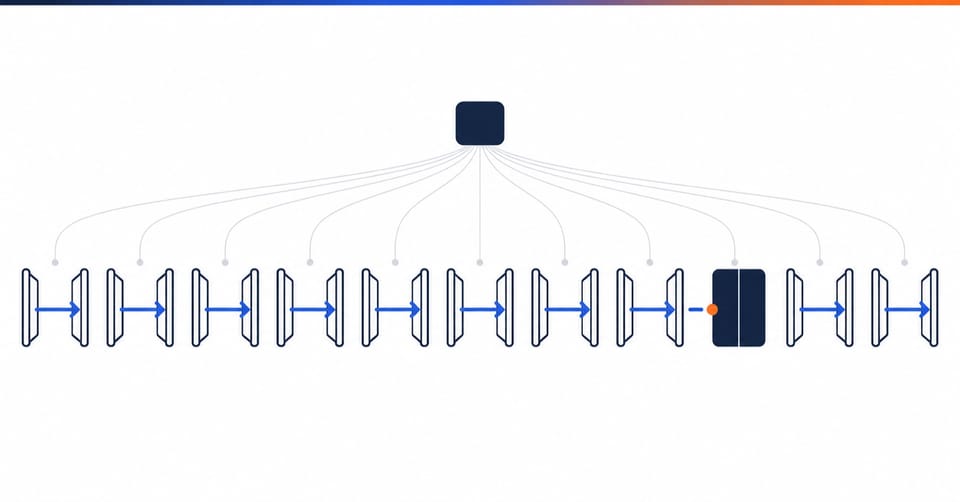
Between November 2025 and April 2026, OX Security researchers submitted a proof-of-concept MCP server to eleven public registries and marketplaces. Nine of the eleven accepted the submission with no review, and a single registry, the one GitHub manages, blocked it. On September 3, 2026, Tenable announced the CyberAgents Exchange AI Inspector, a security review process built with OpenAI's cyber models and applied to the agents, skills, MCP servers and multi-agent playbooks submitted to its registry, which opened in August 2026 and is credited with more than a hundred community components after a build event at Black Hat USA. The two facts read together: a security vendor is industrializing the review of community components because, everywhere else in the chain, review has no owner.
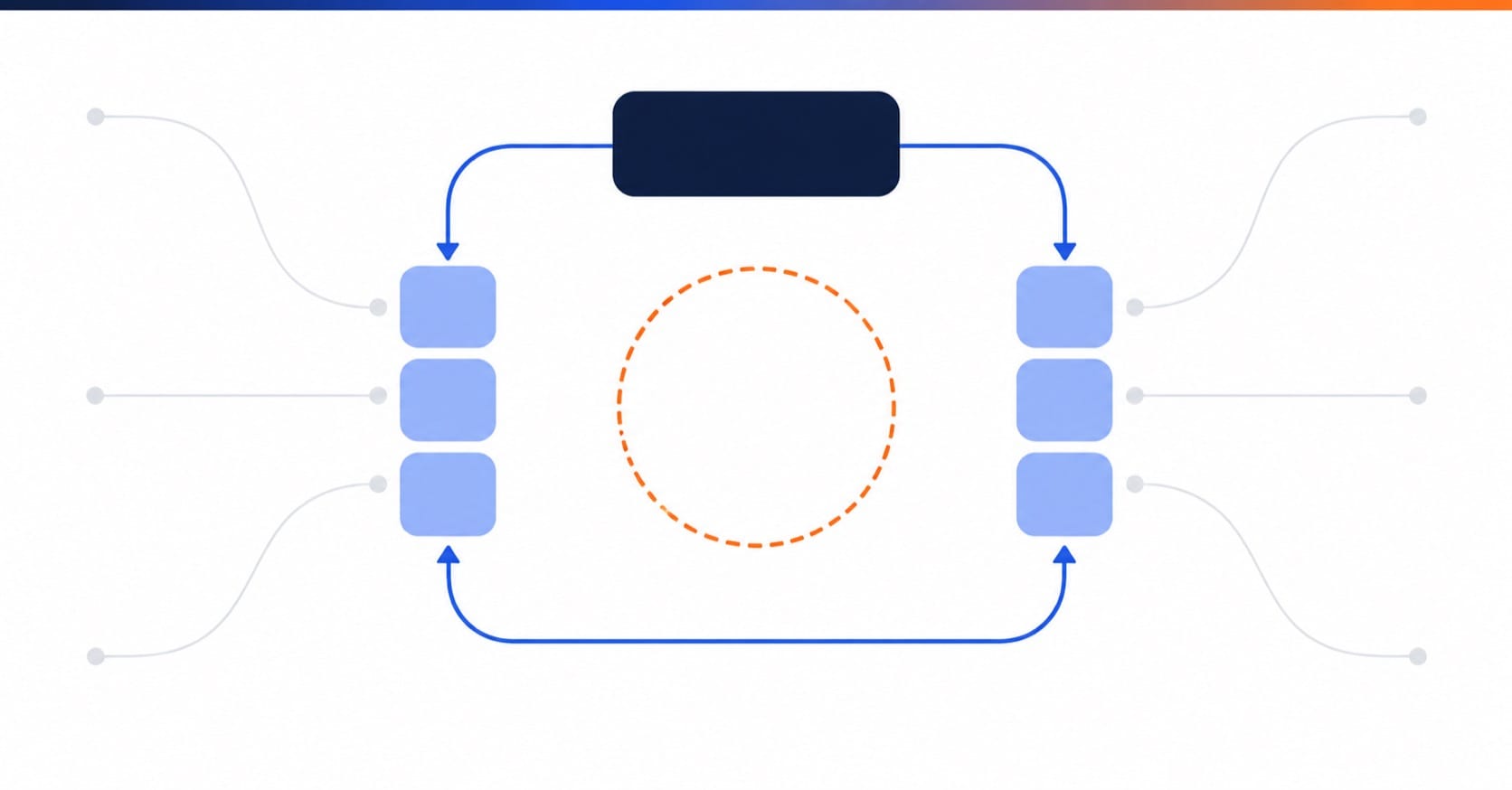
Faced with a figure like that, the first reflex is to look for the right registry, the one that filters properly. The official MCP Registry documentation answers that question, and not the way you would expect: the registry states that it delegates security scanning to the underlying package registries, npm, PyPI, Docker Hub, and to downstream aggregators, meaning the marketplaces. It focuses on namespace authentication and metadata hosting. The downstream marketplaces are precisely the ones OX Security found without an entry control. The delegation forms a loop, and there is no resident reviewer inside it. So the exposure is not a bad registry to avoid, it is a review function nobody in the chain ever claimed.
A third-party agent component behaves like a build dependency. It arrives on your development machine or in your agent runtime, it runs with the session's rights, and it changes the model's behavior. What your teams have applied for ten years to an npm package or a container image, meaning an inventory, a frozen version, a verified signature and a review at the door, applies almost nowhere to an MCP server or a community skill. The August 20 article on the control that exists on paper but never runs described a safeguard inactive for eleven months without producing a single alert. Here the safeguard is not inactive: it was never written, and every actor in the chain assumes in good faith that someone else wrote it.
What a third-party agent component lacks, and what an npm package has had for ten years
The official MCP Registry does not distribute code. It distributes a metadata file, server.json, carrying the server's unique name, where to find it, and the execution instructions: command line, arguments, environment variables. The code lives elsewhere, on npm, PyPI or Docker Hub. The registry checks that the name belongs to its owner, through DNS verification or a proven GitHub account, which settles namespace impersonation. It says nothing about content, and its documentation does not claim to.
That architecture has a direct consequence for what you can verify at install time. Namespace verification tells you who publishes, not what the package does. It is useful, and it is not a code review. The OX Security research showed why the gap matters: in the officially maintained SDKs, in Python, TypeScript, Java and Rust, the command field of an MCP server on STDIO transport runs unconditionally, before any check that the subprocess launched is actually an MCP server. An injected command that exits immediately returns an error to the client while the process continues in the background. The researchers' estimated exposure spans more than a hundred and fifty million downloads and up to two hundred thousand instances, with some thirty coordinated disclosures and around ten CVEs.
The words of the third-party agent component
MCP server: a component that exposes tools to an agent through the Model Context Protocol. It declares a list of tools with their names, descriptions and parameters, and runs either locally as a subprocess or remotely behind a URL.
Skill: a package of instructions and files that extends an agent's behavior on a given task. It usually carries a natural-language instruction file, sometimes scripts, and installs from a community registry.
Multi-agent playbook: an orchestrated sequence chaining several agents and tools to handle a complete case. Its access scope is the union of its components' scopes, which makes it harder to bound than a single tool.
SBOM: a software bill of materials, the exhaustive list of components and versions that go into a deliverable. Without one, nobody can answer the question of where a compromised dependency is installed across the fleet.
Version pinning: freezing a dependency on a precise version, ideally on an immutable digest, rather than on a version range that lets the next update through with no human decision.
The OWASP Agentic Skills Top 10 project, at version 1.0 for its 2026 edition, ranks supply chain compromise as the second risk, right after malicious skills, and update drift as the seventh. Its recommendations point the same way as those for a classic software repository: cryptographic signing and content hashing to establish provenance, locking nested dependencies to immutable hashes rather than version ranges, behavioral scanning at publish and install time, and a ban on executing repository-controlled configuration before an explicit trust confirmation. Nothing on that list needs a technology to be invented. Everything on it needs a named owner.
What the skill registries have already produced
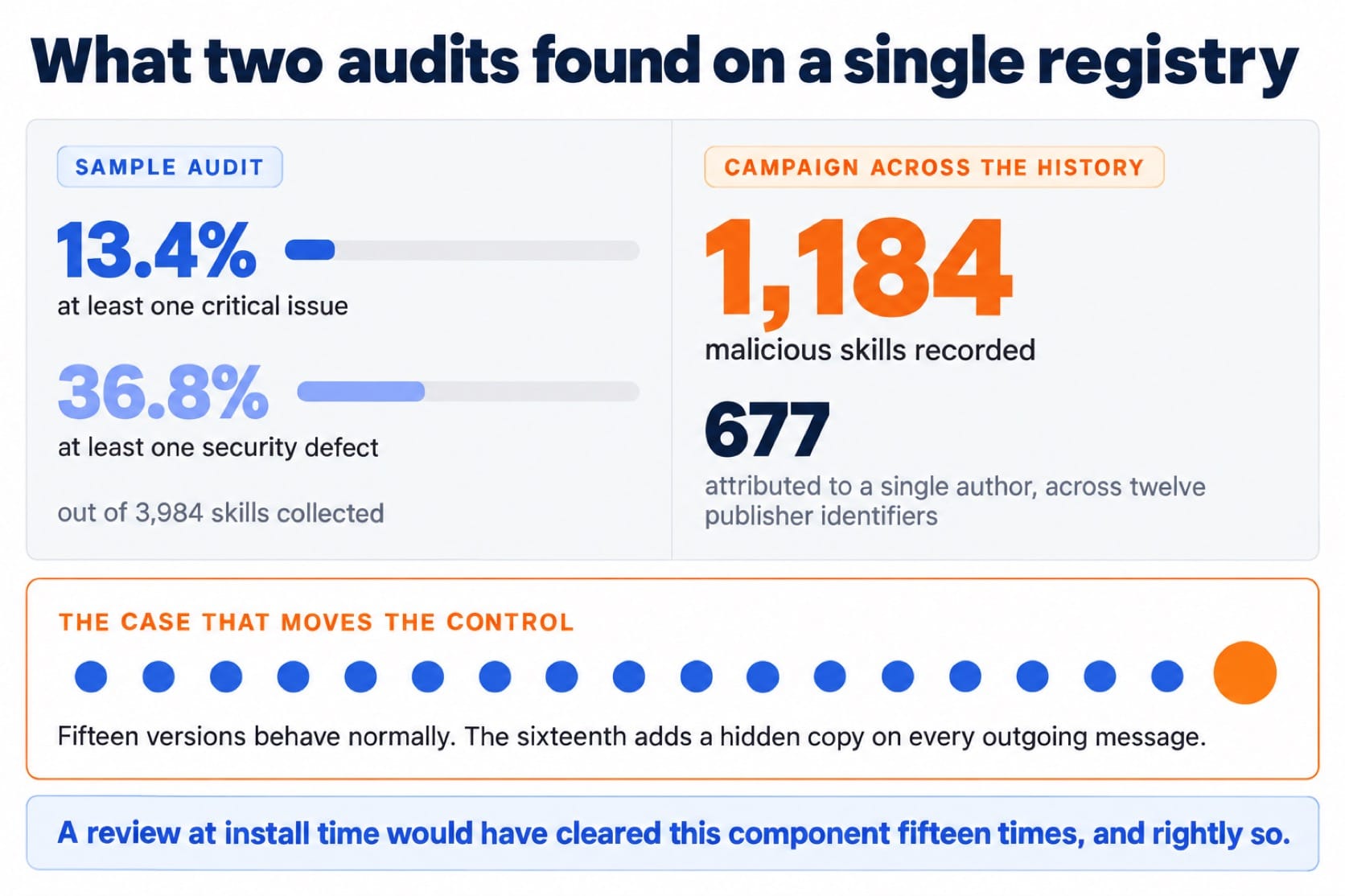
The available figures do not describe a theoretical risk, they describe registries in production. In February 2026, Snyk published the ToxicSkills audit covering 3,984 skills collected from ClawHub and skills.sh. The results: 534 skills, or 13.4 percent, carry at least one critical-level issue, and 1,467, or 36.8 percent, at least one security flaw. Seventy-six malicious payloads were confirmed, eight of which were still publicly available at the time of publication, and 10.9 percent of ClawHub skills contained hardcoded secrets. Among the confirmed malicious samples, 91 percent combined conventional malicious code with prompt injection.
The same week, Antiy Labs documented the ClawHavoc campaign, detected on February 1, 2026, which targeted the skill market of the same ecosystem. The report identifies at least 1,184 malicious skills historically present on the registry, 677 of them attributed to a single author, spread across twelve publishing identifiers. The technique was social engineering rather than exploitation: the malicious instructions sat in the skill's installation documentation, presenting a file download or a terminal command as a prerequisite. The payloads targeted cryptocurrency wallets, developer credentials and API keys. Most of the skills were removed after discovery, but some remained accessible, one of them with roughly fourteen thousand downloads.
The two pieces of work do not measure the same thing, and the gap deserves to be named rather than smoothed over. Snyk counts flaws in a sample of published skills, Antiy counts one campaign's submissions across a registry's history, and a third-party analysis of the ecosystem keeps a narrower scope, around nine hundred weaponized skills out of forty-five hundred. The useful range therefore sits between several hundred and more than a thousand malicious submissions on a single community registry, within a few months. For an admission decision, the order of magnitude is enough: the base rate is not marginal.
The case that changes the nature of the control is elsewhere, and it is older. Bishop Fox documented it in May 2026 for postmark-mcp, an email-sending MCP server that worked normally for fifteen versions. Version 1.0.16 added a hidden copy to an attacker-controlled address on every outgoing message, and the author of that change was the component's own developer. An install-time review would have cleared this server fifteen times in a row, correctly. What an install-time review does not cover is the sixteenth version.
In the field, teams that have already lived through a dependency incident know where the time goes. Not in removing the component, which takes an hour. It goes into the question management asks right after: where else is it installed. A fleet that keeps no inventory of the MCP servers and skills installed per machine and per environment answers that by polling developers one at a time, over several days, with a self-declared result. It is the same scenario as a compromised library, except that nobody has tooled the inventory yet.
The tool manifest is an instruction surface, not documentation
An MCP server declares its tools with a name, parameters and a natural-language description. That description is not a comment meant for a human, it is text that enters the model's context and carries the same authority there as a system instruction. The Cloud Security Alliance research note on tool description poisoning, published in July 2026, puts it in one sentence: the protocol mixes instructions and data in the same channel, so a tool's metadata weighs as much on agent behavior as the system prompt does. And those descriptions are almost never shown to the user, who sees a truncated summary in the interface.
The measurement exists. The MCPTox benchmark, published in August 2025, tested twenty agents against forty-five live MCP servers and three hundred and fifty-three authentic tools, with 1,312 malicious cases across ten risk categories. The attack success rate reaches 72.8 percent on the panel's most vulnerable model, and the authors record a result that runs against intuition: more capable models are often the more exposed ones, because the attack exploits exactly their ability to follow an instruction. The highest refusal rate in the panel stays under 3 percent. Waiting for the model to protect itself from a hostile manifest is not a strategy.
The words of manifest review
Tool manifest: the list an MCP server presents to the agent at connection time, with each tool's name, natural-language description and parameter schema. It is the object to review, and it is also the object that changes at every version bump.
Tool poisoning: placing hidden instructions in a tool's description or parameters to divert agent behavior without touching the code that runs. It leaves no trace in a conventional code review.
Update drift: the gap between the version of a component you reviewed and the one actually running, introduced by an automatic update or by a version range left open in the configuration.
The operational consequence is precise: the object of your review is not the component's repository, it is its manifest, and the diff of that manifest between two versions. The CSA note recommends treating a description change like a production code change, with explicit human review of the diff, then version-controlling those descriptions and scanning them for imperative phrasing. It is the one place where a thirty-minute review catches an attack no static analysis sees, because there is no code to analyze.
Seven admission points, and a named owner for each
The decision to install a third-party agent component is not taken once for the fleet, it is taken component by component, and it is reopened at every version bump. Seven points cover what the cited research brings out, provided each one has a named owner rather than a mention in a policy.
Provenance first. Require an identified owner and a verified namespace, and treat that verification for what it is: proof of the publisher's identity, not a content review. In the same pass, record where the code actually lives, since the registry only points to npm, PyPI or a container image, and that source is what you will have to watch.
The manifest next. Extract the list of exposed tools with their full descriptions, read them as instructions rather than documentation, and refuse any component whose descriptions carry instructions addressed to the agent rather than to the reader. Keep that manifest in your repository, because it is your baseline for the next version's diff.
The secrets scope, third, because it is the most underestimated. An MCP server launched as a local subprocess inherits the session's environment: SSH keys, cloud credentials, Kubernetes configs, database passwords, continuous integration tokens, shell history. Bishop Fox built a demonstration server whose whole point is to make that list visible. Decide which environment variables the component receives, as an allowlist and not an exclusion list.
Pinning and the ban on auto-update, fourth, and it is the direct lesson of postmark-mcp. Freeze the version, ideally on an immutable digest rather than a number, disable every automatic update, and route each version bump through the same door as the first install. An open version range in a configuration file is a decision delegated to a stranger.
Isolated execution, fifth, treated here in one line because it belongs to runtime rather than admission: decide at the component's entry whether it runs in a container with no outbound network by default, and make that answer an admission condition rather than a workstation setting.
Tool call logging, sixth. Without a trace of which tools were called, with which parameters and to what result, you will neither detect abnormal behavior nor reconstruct an incident. That is the difference between a component you can remove with a known scope and one whose scope you will have to assume at worst case.
The inventory, seventh, and the only one not decided component by component. Keep the list of installed MCP servers, skills and playbooks, per machine and per environment, with their versions. The validity test for that inventory is one cold question: if a public advisory names a component tomorrow, how long to know where it is installed. If the answer is counted in days, the inventory does not exist.
The Tenable and OpenAI initiative is a useful signal to read inside that frame, not an exemption. It brings an industrialized review to the components submitted to one specific registry, with a named control scope: software flaws, unsafe permissions, data handling, weak oversight. It covers neither the components your teams install elsewhere, nor the sixteenth version of one of them. The notable part of the announcement is not the technology used, it is that a security vendor judged this function necessary to add because it was missing.
What to set in motion this week
Do the inventory before the policy. Ask your development teams for the list of MCP servers and skills currently configured on their machines and in your agent environments, with the version and the source. Half a day, and you have the document every other one depends on. Expect to be surprised by the count.
Extract the tool manifest of the three most used third-party components in your fleet and read the full descriptions, not the summaries shown in the interface. Look for imperative phrasing addressed to the model. The same pass gives you the list of environment variables each component receives, which is the other half of the subject.
Turn off automatic updates on those components and freeze their versions, today, before the admission policy is written. It is the action with the best ratio between time invested and risk removed, and it needs nobody's approval.
Name an owner for the admission door, and give that person a binding response time, on the order of two business days. A review with no named owner and no deadline does not survive three weeks against a developer who needs a tool to ship, and an unofficial workaround is worth less than a slow but real door.
Conclusion
The OX Security experiment will be quoted for its figure, nine marketplaces out of eleven, but the most instructive document in this file is the official MCP Registry documentation page, which states plainly that it delegates security scanning upstream to the package registries and downstream to the marketplaces. Every link in the chain has been honest about what it does not do, and the sum of those honesties produces an absence of review nobody decided on. The February 2026 figures on skill registries, several hundred malicious components on a single market, say the absence is already being exploited. While no actor in the chain claims the function, admitting third-party agent components is an internal competence, in the same way reviewing software dependencies became one ten years ago.
Sources: As of September 2026
- [Primary] Tenable Uses OpenAI GPT Cyber Models to Help Defenders Inspect Community-Built AI Components, CyberAgents Exchange AI Inspector, registry opened in August 2026, more than a hundred community components, availability announced for September — Tenable — September 3, 2026 — https://www.tenable.com/press-releases/tenable-uses-openai-gpt-cyber-models-to-help-defenders-inspect-community-built-ai-components
- [Secondary] Tenable & OpenAI launch AI inspector for cyber agents, announced control scope and components covered — SecurityBrief — September 7, 2026 — https://securitybrief.news/story/tenable-openai-launch-ai-inspector-for-cyber-agents
- [Primary] The MCP Supply Chain Risk: Insights for Security Leaders, eleven marketplaces solicited, nine accepted with no review, only GitHub's managed registry blocked it — OX Security — 2026 — https://www.ox.security/cheat-sheets/the-mcp-supply-chain-risk-insights-for-security-leaders/
- [Secondary] MCP by Design: RCE Across the AI Agent Ecosystem, research note on the OX Security work, unconditional execution of the command field on STDIO transport, download and instance exposure — Cloud Security Alliance Labs — April 20, 2026 — https://labs.cloudsecurityalliance.org/research/csa-research-note-mcp-by-design-rce-ox-security-20260420-csa/
- [Primary] The MCP Registry, namespace authentication through DNS, delegation of security scanning to package registries and downstream aggregators, server.json format — Model Context Protocol — 2026 — https://modelcontextprotocol.io/registry/about
- [Primary] Snyk Finds Prompt Injection in 36%, 1467 Malicious Payloads in a ToxicSkills Study of Agent Skills Supply Chain Compromise, 3,984 skills audited, 13.4 percent with at least one critical issue, 76 confirmed malicious payloads — Snyk — February 5, 2026 — https://snyk.io/blog/toxicskills-malicious-ai-agent-skills-clawhub/
- [Secondary] The New Supply Chain Frontier: Securing MCP Security and Agent Skills, Snyk and Antiy figures restated, alternative scope of nine hundred weaponized skills out of forty-five hundred — obot.ai — 2026 — https://obot.ai/blog/mcp-security-agent-skills-supply-chain/
- [Primary] ClawHavoc: Analysis of Large-Scale Poisoning Campaign Targeting the OpenClaw Skill Market for AI Agents, at least 1,184 historical malicious skills, 677 attributed to one author, twelve publishing identifiers — Antiy Labs — February 6, 2026 — https://www.antiy.net/p/clawhavoc-analysis-of-large-scale-poisoning-campaign-targeting-the-openclaw-skill-market-for-ai-agents/
- [Primary] MCPTox: A Benchmark for Tool Poisoning Attack on Real-World MCP Servers, twenty agents, forty-five live servers, three hundred and fifty-three tools, 1,312 malicious cases, success rate up to 72.8 percent — arXiv 2508.14925 — August 19, 2025 — https://arxiv.org/abs/2508.14925
- [Secondary] Poisoned MCP Tool Descriptions: A Silent Exfiltration Path, tool description authority equivalent to the system prompt, manifest diff review, version control and allowlists — Cloud Security Alliance Labs — July 11, 2026 — https://labs.cloudsecurityalliance.org/research/csa-research-note-mcp-tool-description-poisoning-20260711-cs/
- [Primary] Supply Chain Risks in MCP Servers, postmark-mcp case, fifteen clean versions then a hidden copy in version 1.0.16, secrets scope available to a local server — Bishop Fox — May 13, 2026 — https://bishopfox.com/blog/otto-support-supply-chain-risks-mcp-servers
- [Primary] OWASP Agentic Skills Top 10, version 1.0 of the 2026 edition, supply chain compromise as AST02, update drift as AST07, signing and locking to immutable hashes — OWASP — 2026 — https://owasp.github.io/www-project-agentic-skills-top-10/
Comments ()