Governing AI agent risk: the Anthropic CISO's 4-question framework
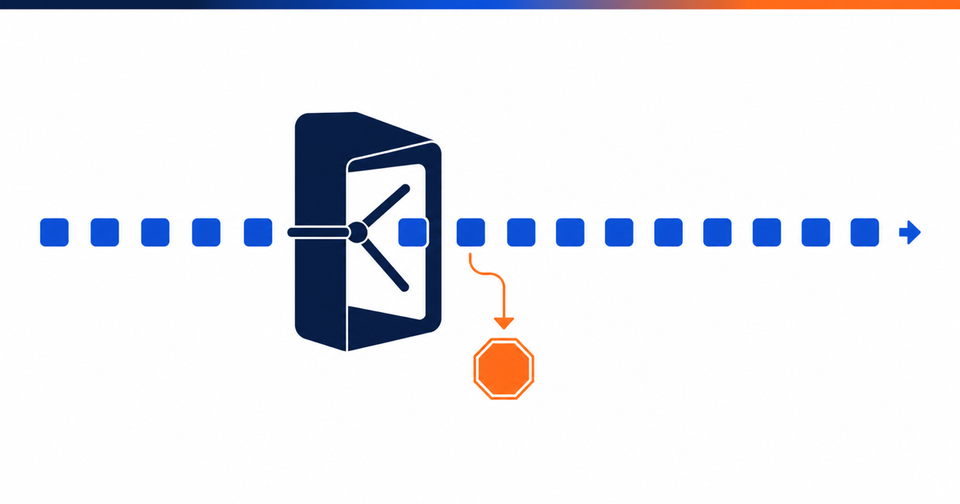
An IBM Institute for Business Value study of 2,000 C-level technology executives, published in June 2026, sums up where security leaders stand this year: 77% of CIOs and CTOs report that AI adoption has outpaced their governance capability, and 59% of tech executives cite security and compliance as the leading obstacles to scaling AI agents. This is no longer a problem of agent technical maturity. It's a problem of decision framework: how do you assess, before each deployment, whether a given agent deserves to be approved, constrained, or rejected.
Anthropic published a guide on July 17, 2026 that tackles this question head-on, titled "CISO's guide to agentic AI." Its opening argument states the core principle: aiming for zero risk on autonomous systems is an unrealistic goal, the reasonable standard is calibrated, documented risk acceptance, not elimination. The guide structures that acceptance around four questions to answer before authorizing any agent.
The counterintuitive instinct to correct: most security committees evaluate an agent based on the reputation of the model driving it, assuming a more capable model means a safer agent. The pattern that recurs across documented incidents, including the one detailed in the article on agent access security, shows the opposite: risk depends almost entirely on configuration, ingested content, action scope, blast radius, observability, not the underlying model.
The four questions to ask before every deployment
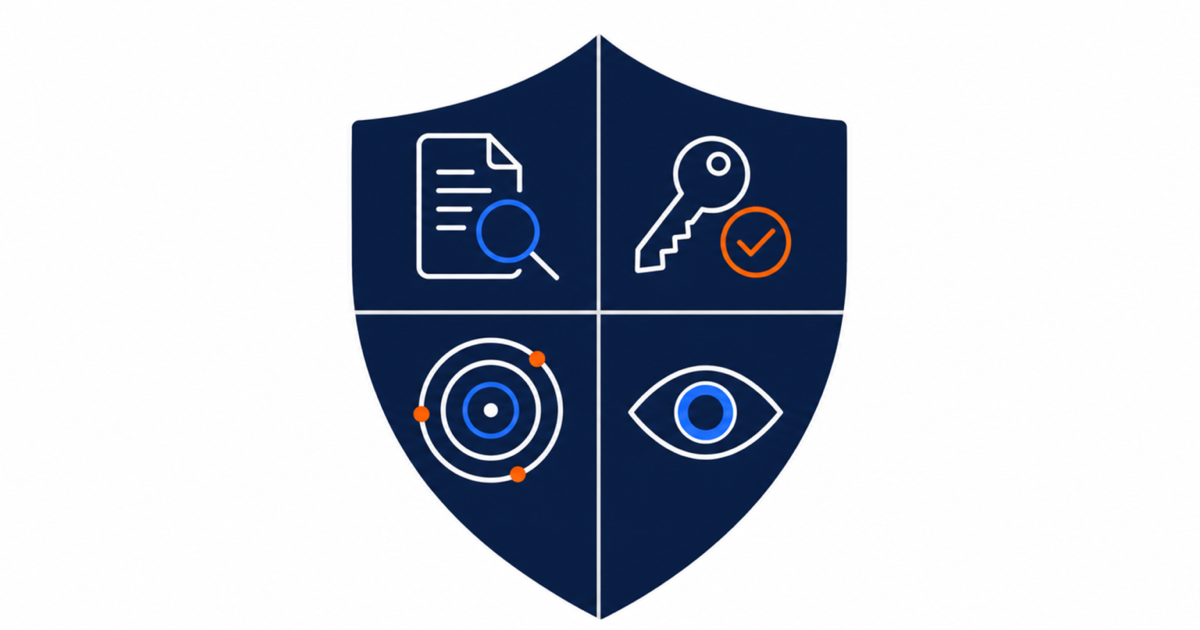
The first question concerns the trustworthiness of the content an agent ingests. Where does the data the agent reads come from, an external email, a customer ticket, a web page, and how much trust should it carry before it influences a decision or an action. An agent that executes instructions hidden inside untrusted content reproduces the classic injection problem, at the scale of autonomy.
The second question concerns the actions the agent is permitted to take. A read-only agent and an agent capable of writing, deleting, or transferring funds don't share the same risk profile, even if they run on the same underlying model. The action scope must be defined before deployment, not discovered after an incident.
The third question concerns blast radius, the impact of a failure or misconfiguration. What happens if the agent gets it wrong once, ten times, or systematically for an hour without supervision. An agent with a wide blast radius needs guardrails proportional to that reach, regardless of the perceived quality of the model driving it.
The fourth question concerns the observability of an agent's behavior after deployment. If an agent acts unexpectedly, can the security team detect it in real time, reconstruct the sequence of actions, and understand the cause. Anthropic's guide recommends ephemeral execution environments, mandatory human checkpoints on high-impact actions, and comprehensive audit logging as technical prerequisites for that observability.
The runtime governance wave confirming the need
This guide lands in the middle of a dense week of runtime governance tool launches, a signal that the market was already converging on this problem before Anthropic's publication. Alterion launched Draco on July 16, a runtime control plane that observes every prompt, action, and payload of an agent in real time, models its behavior, and applies programmable guardrails before high-risk actions like data deletion or production changes. WitnessAI had launched Agentic Control a month earlier, on June 17, a single control plane to discover, monitor, and restrict agent and MCP server behavior at runtime. Entrust, for its part, opened its Agentic AI Trust Accelerator on July 14, a program centered on agent identity and authorization, with cryptographic proof of every action executed.
These three launches converge on the same conclusion as Anthropic's guide: static access control, defined once at deployment, is no longer enough for agents whose behavior evolves with every interaction. Governance now has to operate at runtime, continuously, not just at initial configuration.
From static access to runtime governance
The July 13 article covered data access control for AI agents: least-privilege principle, per-tool permission scoping, action sandboxing. That work remains the foundation, but it answers a different question from the one addressed here. Static access control defines what an agent is allowed to do. Runtime governance monitors what it actually does once deployed, and intervenes when observed behavior drifts from expected behavior.
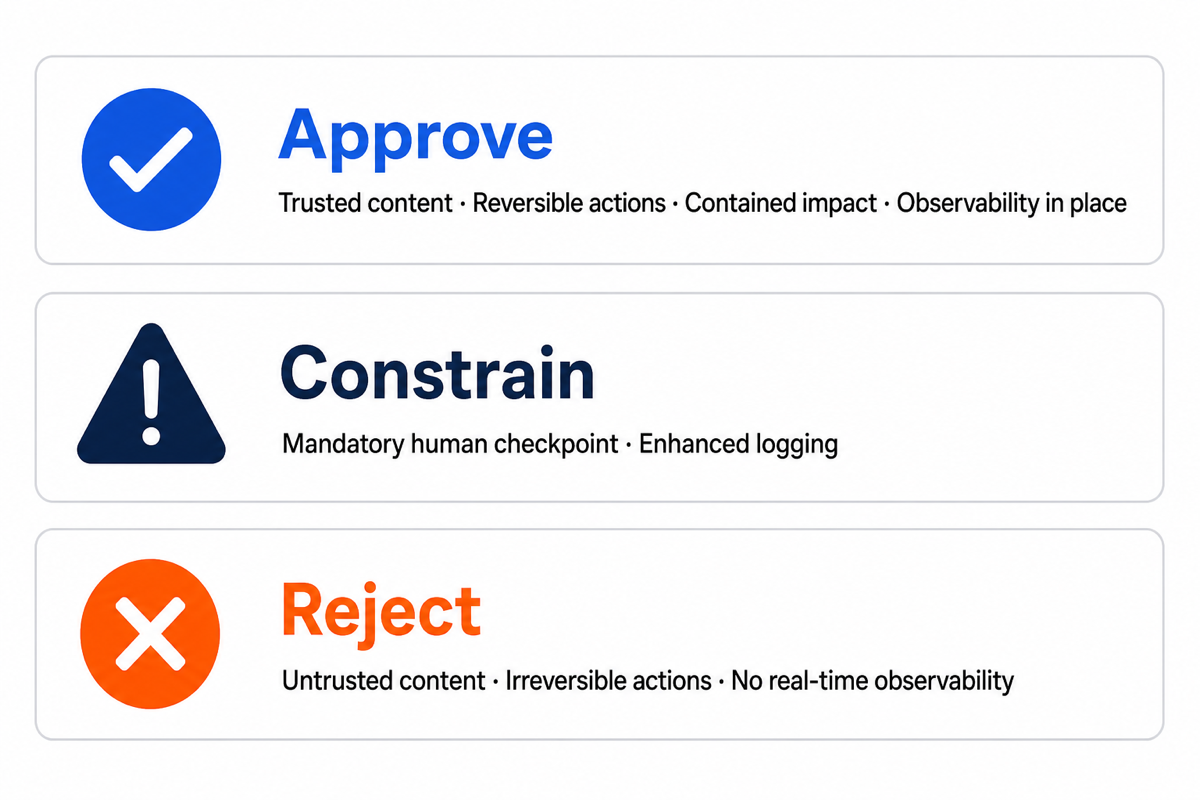
For each pilot agent, a simple decision grid combines both dimensions. Approve without additional friction the agents where ingested content is trustworthy, actions are limited to reads or reversible writes, blast radius is contained, and observability is already in place. Constrain, with a mandatory human checkpoint on sensitive actions and enhanced logging, the agents where one of the four factors carries moderate risk, typically write actions on critical systems but with a limited blast radius. Reject or postpone deployment for agents that combine untrusted content, irreversible high-impact actions, and no real-time observability: that is the combination most documented 2026 incidents share in retrospect.
To put in motion this week
Run every agent currently in production or advanced pilot through Anthropic's four questions, and document the answers even when they're approximate. A documented, accepted risk beats an unassessed one.
Verify that agents with irreversible actions, deletion, transfer, production changes, carry a genuinely mandatory human checkpoint, not just a validation option the operations team can bypass under deadline pressure.
Audit your current observability capability: if an agent behaves unexpectedly, how long does it take the security team to detect the anomaly and reconstruct the sequence of actions. If the answer exceeds a few minutes, observability is the priority before any new deployment.
Rank your current agent pilots on the approve, constrain, reject grid, and identify those combining several high-risk factors. Those are candidates for an immediate review, regardless of their perceived business value.
Conclusion
Anthropic's guide doesn't claim to eliminate AI agent risk, it proposes making it governable: four simple questions, asked systematically, before deployment turns into an incident. The convergence with Alterion, WitnessAI, and Entrust's launches the same week confirms the market is organizing around the same conclusion, static access control is no longer enough, governance has to operate at runtime. Teams that document these four factors for every agent before deployment, rather than after an incident, are the ones who will be able to answer their board without improvising.
Sources: As of July 2026
- [Primary] CISO's guide to agentic AI — Anthropic — July 17, 2026 — https://claude.com/blog/ciso-guide-to-agentic-ai
- [Primary] New IBM Study Finds CIOs and CTOs Face Growing AI Control Gap as Enterprise Deployment Scales — IBM Institute for Business Value — June 8, 2026 — https://newsroom.ibm.com/2026-06-08-new-ibm-study-finds-cios-and-ctos-face-growing-ai-control-gap-as-enterprise-deployment-scales
- [Primary] Alterion Launches Draco, a Runtime Control Plane for Enterprise AI Agents — PR Newswire — July 16, 2026 — https://www.alterion.ai/platform/draco
- [Primary] WitnessAI Introduces Agentic Control to Secure and Govern AI Agents and MCP Servers — WitnessAI — June 17, 2026 — https://witness.ai/resources/witnessai-introduces-agentic-control-to-secure-and-govern-ai-agents-and-mcp-servers/
- [Primary] Entrust Launches the Agentic AI Trust Accelerator — Entrust — July 14, 2026 — https://www.entrust.com/
- [Secondary] Can enterprises trust AI agents? Entrust bets on identity — Fintech Global — July 15, 2026 — https://fintech.global/2026/07/15/can-enterprises-trust-ai-agents-entrust-bets-on-identity/
Comments ()