AI Agents and Access Security: Preventing Unauthorized Data Access
On February 1, 2026, security researchers at Wiz discovered that Moltbook, a viral social network where AI agents post, comment, and interact with each other, was exposing its entire database. The cause: a misconfigured Supabase backend with no row-level security policy, and an API key visible in client-side JavaScript code. The result: 1.5 million API keys in plaintext, spanning OpenAI, Anthropic, AWS, GitHub, and Google Cloud, plus more than 4,000 private conversations between agents accessible to anyone who found the endpoint.
Moltbook illustrates a problem larger than its own configuration negligence. NeuralTrust's 2025 survey of 160 CISOs found that 19.5% had experienced at least one confirmed AI agent security incident. A separate, more widely cited 2026 survey of more than 900 executives and technical practitioners put the figure far higher, 88% reporting at least one confirmed or suspected incident, likely reflecting a looser bar ("suspected" as well as "confirmed") and a less rigorous sampling method. Whichever number you trust more, the direction is the same: agent deployment is moving faster than the access controls meant to accompany it.
The counterintuitive instinct to correct: most teams assume the risk comes from the model itself being compromised, an agent "hacked" through a sophisticated prompt injection. The pattern that recurs across documented incidents, Moltbook included, is more mundane: a correctly built agent that was over-privileged from initial configuration, with no one ever removing the access it didn't need.
What Moltbook reveals about scoping
The incident is not just a story of poor technical configuration. The exposed API keys belonged to individual agents that, in the platform's architecture, had access to permissions far broader than their actual task required. An agent designed to post and comment had no reason to carry credentials granting access to third-party cloud resources within the conversations it exchanged.
This is the classic symptom of over-provisioning: granting an agent a single identity with a broad access perimeter, rather than permissions tightly bounded to the task at hand. When that identity is compromised, exposed, or manipulated through prompt injection, the blast radius matches the entire granted perimeter, not the task the agent was supposed to perform.
Least privilege, applied at runtime
The permissioning model inherited from classic user systems does not transfer directly to agents. A human user receives a role that stays stable over time. An agent benefits from an access scope defined at execution, task by task, that expires with it.
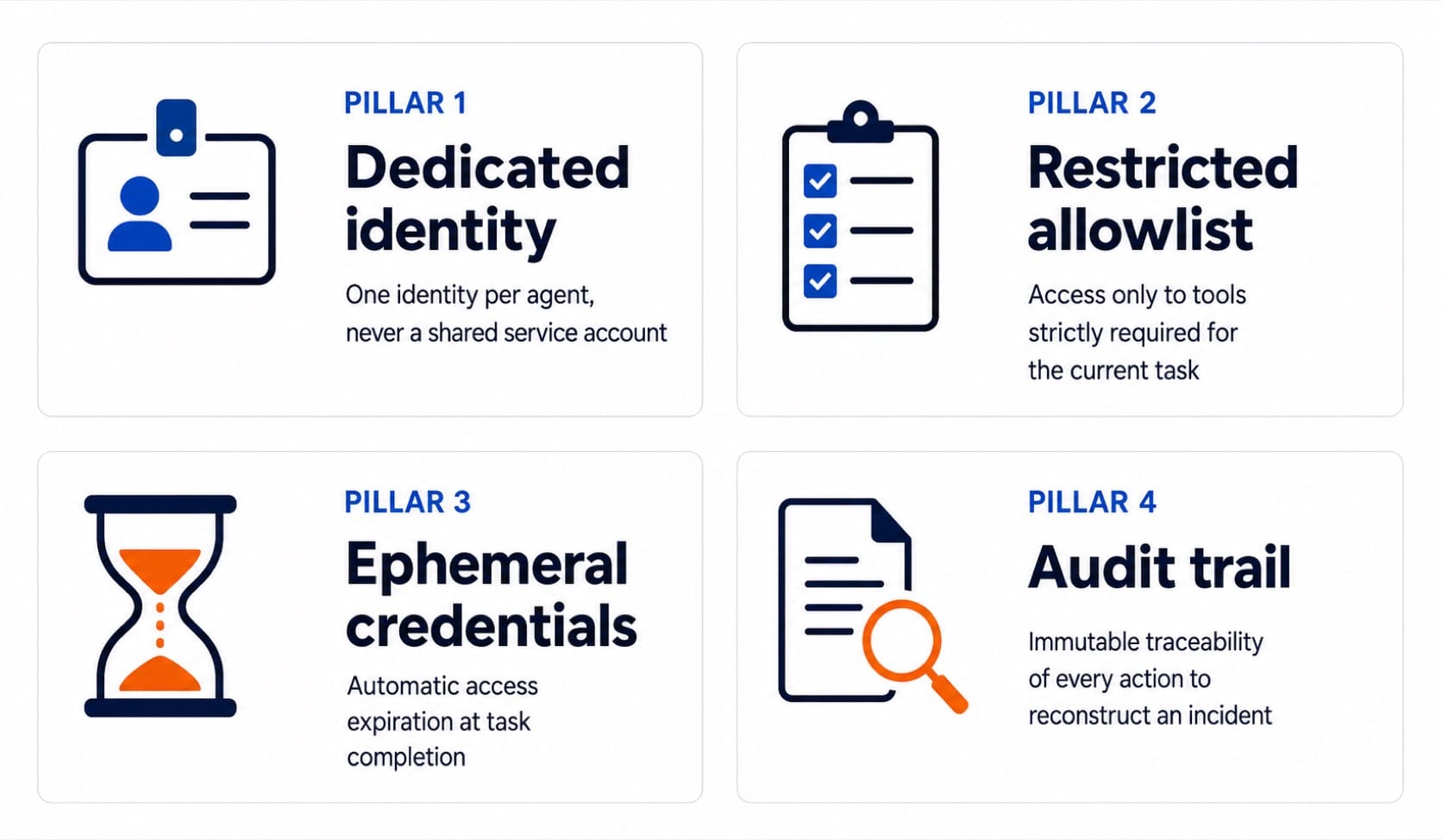
Concretely, this means a dedicated identity per agent rather than a shared service account, a tool allowlist restricted to the strict minimum needed for the current task, and short-lived credentials that expire automatically once the task completes rather than static keys valid indefinitely.
Sandboxing actions and traceability
Restricting permissions is not enough if the agent's actions are not isolated and logged. An agent that runs commands, calls APIs, or modifies data should do so in a contained execution environment, where an unexpected action stays contained rather than propagating to adjacent systems.
Every action should generate an immutable audit trail: which agent, which task, which tool, which data touched, at what time. This traceability is not just a post-hoc compliance requirement. It allows reconstructing the chain of events in case of an incident, and detecting abnormal usage patterns before they escalate into one.
Detecting escalation before exploitation
A well-scoped agent at launch can drift over time. A poorly framed task that pushes the agent to request additional permissions, a chain of tool calls that gradually widens the action perimeter, or a prompt injection attempting to push the agent outside its original role are signals to actively monitor, not just fix after the fact.
Blast radius design should happen upfront, when connecting the agent to its tools and data sources, not after a first incident. The question to ask for every connector added is simple: if this agent is compromised or manipulated, how far can it go with this specific access?
Before connecting an agent to sensitive data
Four checks are enough before putting an agent with access to sensitive data into production. Does the agent have its own identity, distinct from any shared service account? Does the allowed tool list strictly match what the task requires, without comfort margin added just in case? Do credentials expire automatically at the end of the task rather than remaining valid indefinitely? Does a complete audit trail allow every action to be reconstructed after the fact?
An agent without these four guarantees can work perfectly under normal conditions, until the day it does not. Moltbook was not a neglected side project, it was a viral product with more than a million agent users. Access scoping is not a luxury reserved for critical systems, it is a baseline condition for any agent connected to anything beyond public data.
To put in motion this week
List every agent currently in production or advanced pilot and check, for each one, whether it carries its own identity or a shared service account. A service account shared across multiple agents should be split first.
Audit the list of tools and connectors your most exposed agent can reach. Remove any access that exceeds what its current task requires, even access that "might be useful later."
Check the lifetime of credentials your agents use. Static keys valid indefinitely should migrate to auto-expiring credentials first, prioritizing agents with access to sensitive data.
Test your post-incident reconstruction capability: if an agent behaved abnormally tomorrow, how long would it take to trace every action it performed? If the answer exceeds a few minutes, the audit trail is the immediate priority.
Conclusion
Moltbook is not an isolated case, it's a signal amplified by its virality. Access scoping, ephemeral credentials, and audit trails are not measures to reserve for critical systems once an incident has already happened. They are baseline conditions for any agent connected to anything beyond public data, and the article on governing agentic risk extends this logic from static access control to runtime governance.
Sources: As of July 2026
- [Primary] — Hacking Moltbook: AI Social Network Reveals 1.5M API Keys — Wiz — February 2026 — https://www.wiz.io/blog/exposed-moltbook-database-reveals-millions-of-api-keys
- [Primary] — The State of AI Agent Security 2026: What 160 CISOs Reveal About a Dangerous Gap — NeuralTrust — 2026 — https://neuraltrust.ai/blog/the-state-of-ai-agent-security-2026
- [Secondary] — AI Agent Security Vulnerabilities 2026: 88% of Enterprises Already Breached — AI Automation Global — 2026 — https://aiautomationglobal.com/blog/ai-agent-security-identity-crisis-enterprise-2026
Comments ()