Your code went to an anonymous provider, and the reveal undoes nothing
On August 20, 2026, a model appeared on OpenRouter under the identifier stealth/ox-alpha, with no lab name, no technical card and no price: a 1,048,576-token context window, 131,072 tokens of output, text, image and video input, function calling, free for one week. On August 26, Z.ai confirmed to Bloomberg that it was the author and published the model as GLM-5.3-Flash, a mixture-of-experts architecture with 320 billion parameters and 18 billion active, with MIT-licensed weights on Hugging Face. Between those two dates, OpenCode's public dashboard showed 503,000 unique users, 13.12 million completed sessions and 44 trillion tokens processed, roughly 10.6% of the platform's traffic, while OpenRouter's own counter recorded 27.2 trillion on its side.
The instinctive reading of that sequence is a mystery that resolved happily: the model is good, the weights are open, the announced price is aggressive. For a technical leadership team, the fact that matters sits elsewhere. The contractual terms under which those tens of trillions of tokens left did not change retroactively on August 26. Revealing a name informs the calls still to come; it does not requalify the ones that already happened.
The August 18 piece on Stripe's acquisition of OpenRouter treated the gateway as a critical vendor nobody had ever qualified as one. Ox Alpha pushes that reasoning one step further: here the gateway is identified, but the counterparty behind it is not. What follows covers what six days of anonymity actually produced, why the number that triggered adoption was off by a third, and the five-question grid to run before the next stealth model shows up.
Six days, two counters, no name
Ox Alpha presented itself as a reasoning model aimed at code, long-running agents and production workloads. OpenCode relayed a claimed serving capacity of 100 trillion tokens per day during the free period. That figure circulated widely and deserves to be put back in its place: it describes offered capacity, not measured consumption. The 44 trillion recorded on OpenCode, by contrast, is a usage reading.
The vocabulary of this case
Stealth model: a model published on a marketplace under a pseudonym, operated by a provider who chooses not to name itself during a preview period.
Tokenizer: the component that splits text into units the model can process. Each model family splits slightly differently, which leaves a measurable signature even when the weights are hidden.
EULA: the end user license agreement, accepted through use of the service, distinct from the descriptive card shown on a model's page.
MIT-licensed open weights: the model's parameters are downloadable and reusable, including commercially. That says nothing about the terms governing the API hosted by the same publisher.
Two things accelerated adoption beyond curiosity. Patrick Collison, chief executive of Stripe, which had announced its acquisition of OpenRouter on August 19, publicly called the model very impressive. And a first community benchmark result circulated within hours. That second point deserves examination, because it illustrates exactly how an adoption decision gets made in practice.
The number that triggered adoption was corrected by a third
On August 21, developer Ben Davis ran Ox Alpha against a ten-task subset of DeepSWE and reported an 80% pass rate, against 65% for Claude Fable 5 and 52% for GPT-5.6-Sol on the same tasks. Those three numbers are what got shared, quoted and repeated. On a ten-task sample, a single task moves the score by ten points.
On August 23, the same developer published the result of the full 113-task set: roughly 63%, seventeen points below the initial measurement, which he commented on himself by saying the lower figure made much more sense. Independent testing by Day.dev on Kingbench places Ox Alpha at 87.5%, behind GLM-5.3 at 91.25%. What the complete measurements describe is a very good model, not one that dominates its category, which is what the corrected benchmark already said.
The pattern is familiar to anyone who has watched several adoption cycles. The decision to try a model is made on the first available number, not the corrected one, and the endpoint had absorbed the traffic well before the correction circulated. The question that matters for a technical leadership team is not whether the team was wrong to test. It is what, in the process, authorized an outbound call to an unqualified provider on the strength of a ten-task result.
Three contradictory documents for one endpoint
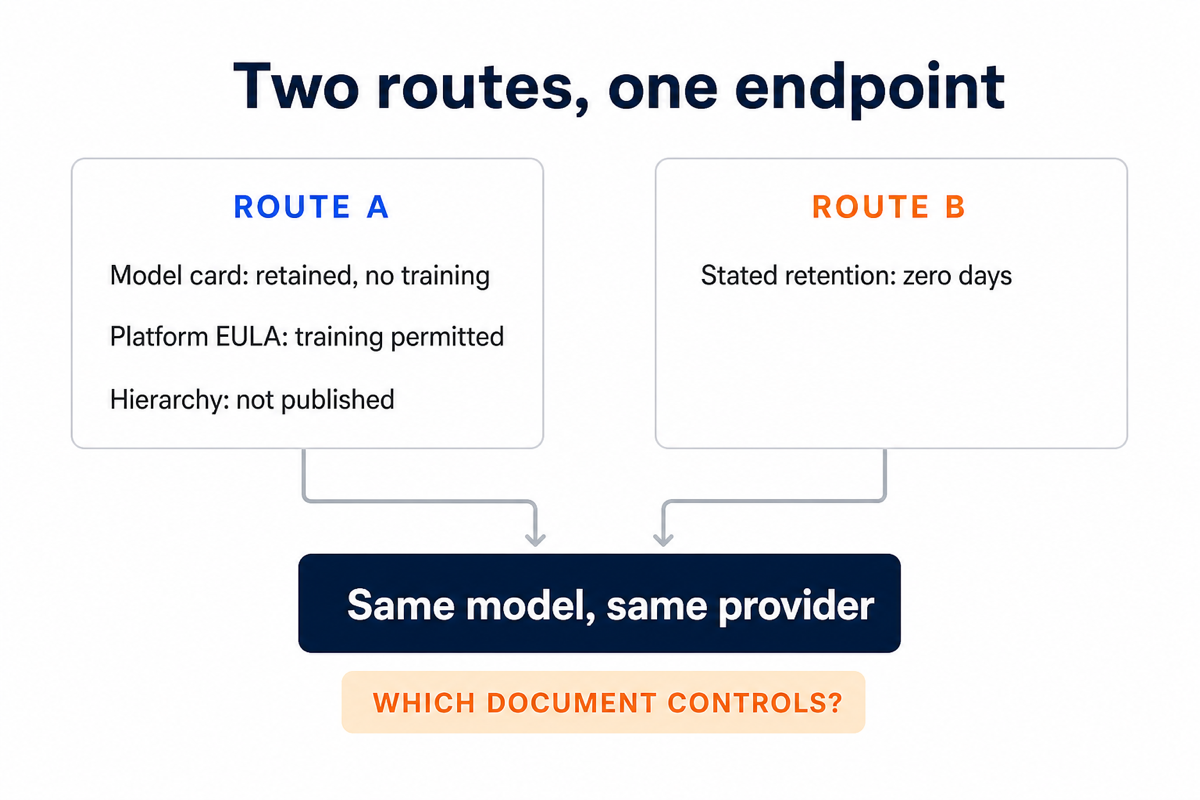
The model card on OpenRouter states that prompts and completions are retained by the provider and are not used for training, then refers all other use to the platform's Stealth Model Terms. A developer reading that sentence reasonably concludes they have a firm guarantee on training.
The stealth program EULA, which governs every model in that category, grants OpenRouter and the unnamed provider the right to use user content for training, evaluation and improvement, and instructs anyone who refuses that use to refrain from accessing stealth models. The published documentation nowhere explains how the conflict resolves, or which document prevails.
A third layer: the OpenCode route to the same model stated zero-day retention and no training use. Two paths to one endpoint, three different statements of the data policy, and no explicit hierarchy between them. This is not a question of trust in the provider, it is a question of which document controls. A data protection officer asked at the time had no way to answer.
What the name adds, and what it does not erase
The community did not wait for the official announcement. Two separate investigations converged, and their method is worth understanding because it changes the nature of the question. Joseph W. Elstner measured the tokenizer signature by comparing token counts returned by the API: across 95 probes covering multiple languages, code samples and Unicode edge cases, Zhipu's released GLM-5 vocabulary matched on 95 of 95, with a mean absolute error of zero, while the best non-GLM candidate covered only 46. Researcher Chetaslua went after the serving layer instead: a deliberately malformed request returned a Java stack trace exposing the internal class com.wd.paas.api.domain.v4.chat.ChatCompletionRequest, which maps to Zhipu's documented API structure, and the error-code dialect observed was the one returned by Z.ai-hosted GLM models, different from the one produced by the same weights served by another host.
That distinction is the only genuinely transferable lesson in the whole file. The tokenizer identifies the lineage of the weights. The error dialect identifies the operator of the service. Those can be two different entities, and it is the second one that holds your prompts, not the first.
What the August 26 reveal adds is therefore substantial in governance terms: a name, a jurisdiction, a license, and a published price of $0.075 per million input tokens and $0.25 per million output tokens with a launch discount through September 9. It also adds structural conditions that anonymity had masked. Z.ai has been on the US Bureau of Industry and Security Entity List since January 2025, and Article 7 of China's National Intelligence Law requires every Chinese organization to cooperate with state intelligence work. These are conditions of law, not allegations, and they belong in a risk assessment regardless of the privacy policy the publisher displays.
On the European side, one point is frequently miscited and warrants care. EU Regulation 2026/1744, the Digital Omnibus on AI, was published in the Official Journal on July 24, 2026 and entered into force on July 27. It deferred the August 2 deadline for the high-risk framework. Article 50's transparency obligations remain applicable, as covered in the July 31 piece on what your compliant vendor does not cover. Using a model whose provider cannot be identified is therefore not prohibited in Europe today, the regulatory situation is still moving, and that is precisely why qualification belongs to your internal governance rather than to a legal deadline.
What the reveal does not erase fits in one sentence. The prompts that left during the six preview days left under stealth terms, and an MIT license covers weights, not data already transmitted. As of August 27, the OpenRouter listing still described the model as operated by an anonymous provider.
The grid to run before the next stealth model
Ox Alpha is the fifth stealth model in six months on OpenRouter, after Z.ai's own GLM-5, Xiaomi's MiMo-V2-Pro which appeared under two pseudonyms, Ant Group's Ling-2.6-flash and Meituan's LongCat-2.0. All were claimed by their publisher after the preview closed. This is no longer a mystery, it is a documented launch playbook, and there will be another one.
Five questions decide whether an endpoint can receive a call from an environment containing proprietary code. A single no is enough to restrict its use to test data.
Is the counterparty identifiable and contractable? A named entity, a registered address, a contract you can enforce. A platform pseudonym is not a counterparty.
Which document prevails in a conflict? If the product card and the platform EULA diverge, the answer has to be written somewhere before the call, not inferred afterwards.
What is the jurisdiction of the service operator, not just of the owner of the weights? That is the lesson of the error dialect: open weights served by a third party fall under that third party's legal obligations.
What happens when the preview ends? A free endpoint that disappears or reprices leaves a switching cost nobody has quantified, exactly the dependency described in the July 25 piece on the multi-model roadmap.
Which data classes are permitted toward this endpoint? The default answer, absent an identified counterparty, is nothing that is not already public.
What to put in motion this week
Search your gateway logs and coding agent configurations for any call to stealth/ox-alpha between August 20 and 26, across both routes. If you find any, the question is not whether the model was good. It is which repositories were loaded into a million-token context window and under which retention regime.
Write down the rule that was missing. An outbound call to a model provider whose legal entity is not named in your vendor register does not leave an environment containing proprietary code, whatever the benchmark circulating that day happens to say.
Add a column to your model register for the operator of the service, separate from the owner of the weights. Those two entries often coincide, and the day they diverge is precisely the day the distinction earns its keep.
Require your gateway to deny uncatalogued providers by default, rather than allowing by default with a blocklist. A blocklist is always one stealth launch behind.
Take the benchmark results circulating internally and check the sample size before checking the score. A seventeen-point gap between a ten-task subset and the full set is not an anomaly, it is what a ten-task sample normally produces.
Conclusion
The Ox Alpha file reads like a security incident, even though no rule was broken and no provider lied. Thousands of teams sent code to a nameless counterparty because nothing in their process required them to have one, and because the only thing missing at the moment of the decision was the question. The next stealth model will arrive with a different pseudonym and a different flattering benchmark, and the five-question grid takes twenty minutes to write.
Sources: As of August 2026
- [Primary] Ox Alpha model page and Stealth provider page — OpenRouter — accessed August 27, 2026 — https://openrouter.ai/stealth/ox-alpha
- [Primary] Stealth Program End User License Agreement — OpenRouter — 2026 — https://openrouter.ai/terms/stealth
- [Primary] Introducing GLM-5.3-Flash, previously previewed as Ox Alpha — Z.ai — August 26, 2026 — https://x.com/Zai_org/status/2092616204787626030
- [Primary] GLM-5.3-Flash, MIT-licensed open weights — Z.ai, Hugging Face — August 26, 2026 — https://huggingface.co/zai-org/GLM-5.3-Flash
- [Primary] The tokenizer is a fingerprint — Joseph W. Elstner — August 23, 2026 — https://isimplifyme.com/whitepapers/the-tokenizer-is-a-fingerprint
- [Secondary] Z.ai open-sources 'Ox Alpha' model as GLM-5.3-Flash — Maria Deutscher, SiliconANGLE — August 26, 2026 — https://siliconangle.com/2026/08/26/z-ai-open-sources-ox-alpha-model-as-glm-5-3-flash/
- [Secondary] Ox Alpha matches Zhipu's GLM tokenizer in 95 of 95 tests — Marcus Schuler, Implicator.ai — August 23, 2026 — https://www.implicator.ai/ox-alpha-zhipu-glm-tokenizer-match/
- [Secondary] Coding model Ox Alpha retains every prompt: you cannot name the company holding them — Kyle Belmonte, Tech Times — August 23, 2026 — https://www.techtimes.com/articles/325244/20260823/coding-model-ox-alpha-retains-every-prompt-you-cannot-name-company-holding-them.htm
- [Secondary] Ox Alpha unmasked: Z.ai's GLM-5.3-Flash clocks 44T tokens — StableLearn — August 26, 2026 — https://stable-learn.com/en/ox-alpha-glm-5-3-flash-zai-reveal-usage/
- [Secondary] Ox Alpha: what we know about the mystery AI model — explainx.ai — August 22, 2026 — https://www.explainx.ai/blog/ox-alpha-what-we-know-mystery-ai-model-august-2026
- [Secondary] CSA research note: EU AI Act high-risk deadline omnibus — Cloud Security Alliance — 2026 — https://labs.cloudsecurityalliance.org/research/csa-research-note-eu-ai-act-high-risk-deadline-omnibus-20260/
Comments ()