Why most enterprise AI projects never leave the pilot Stage and What the survivors do differently

Slug: enterprise-ai-pilot-to-production-failure-framework-2026
Executive Summary
Gartner projects that fewer than 5% of enterprise applications included AI agents in 2025. By end of 2026, that number is expected to reach 40%. The implied growth velocity is extraordinary. What it obscures is the failure rate: most enterprise AI pilots estimates range widely, but the structural pattern is consistent stall before reaching production. Not because the technology fails. The models are mature enough. The failure is organizational. Organizations deploy agents before designing the environments those agents need to operate in. They skip governance. They have no answer to the question "who owns the decision when the agent is wrong?" They build impressive demos and discover that demo conditions don't survive contact with real users, real edge cases, and real operational pressure. This article examines the five checkpoints where AI projects die and what the organizations that successfully scale to production do differently.
3 key insights:
- The technology is not the bottleneck. The organizational design decision ownership, escalation paths, feedback loops is what separates pilots from production.
- The most dangerous phase is not the pilot; it's the six months after a pilot succeeds, when organizations try to scale without rebuilding the underlying architecture.
- The organizations deploying AI at scale treat agents as part of the core operating model, not as a technology overlay. The sequence matters: redesign how work runs before you automate it.
3 actions to take :
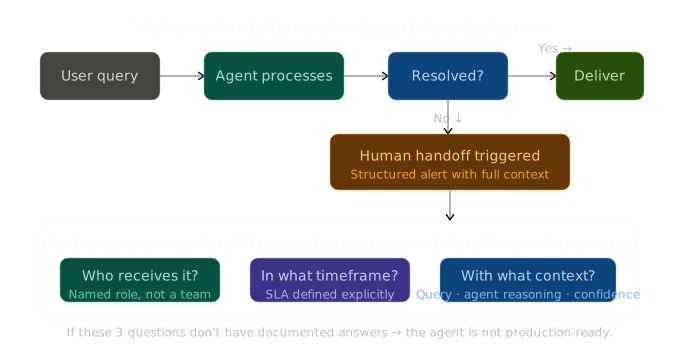
- For every active AI pilot: define the "human handoff protocol" who receives the escalation, in what timeframe, with what context.
- Conduct a production readiness review against the five-checkpoint framework before any pilot moves to scale.
- Identify your AI governance owner the person who owns the answer when the agent fails in production at 2 AM.
Risk if ignored: Stalled AI programs consume budget, erode internal credibility, and create a window for competitors who have solved the production problem to pull ahead.
Introduction
Let's start with an uncomfortable number: the vast majority of enterprise AI pilot programs never reach production.
The precise figure varies by source and definition, but the structural pattern is universal. Organizations launch pilots with genuine enthusiasm. The demos work. The business case is compelling. The technology performs in controlled conditions. Then something happens between the pilot and production and the project stalls.
This is not a 2025 problem that has been solved. It is the defining challenge of 2026, precisely because the scale of deployment is accelerating so rapidly. Gartner projects the share of enterprise applications with task-specific AI agents to jump from under 5% in 2025 to 40% by end of 2026. That velocity creates enormous pressure to move pilots into production. The organizations that cannot do this reliably that succeed in pilots and fail in production will find themselves running expensive experiments while competitors compound AI advantages quarter by quarter.
Understanding why pilots fail, and what the survivors do differently, is the most important operational question in enterprise AI right now.
Why the technology isn't the problem
The natural instinct when an AI pilot fails to scale is to blame the model. Hallucinations. Reliability issues. Edge cases the model can't handle. Compute costs that don't pencil out.
These are real issues. They are rarely the primary cause of pilot failure.
The models available in 2026 across the major providers are mature enough for most enterprise use cases. They are reliable enough to be useful. The question is not whether the model is capable; it is whether the organization is capable of deploying it responsibly.
The failure modes are overwhelmingly organizational:
Agents are deployed before the organizational environment the governance structures, decision authority, escalation protocols, feedback mechanisms has been designed for them. The model encounters a situation it can't resolve, and there is no clear answer to "what happens next?" The agent either fails silently, produces a bad output, or escalates to a system that has no process for receiving the escalation.
The data and integration architecture that worked in the pilot often a curated, controlled subset of real conditions doesn't survive contact with the full operational environment. The context is incomplete. The integrations are brittle. The edge cases the pilot never saw appear immediately in production.
The success metrics defined for the pilot don't map to production value. "The agent answered 87% of test queries correctly" doesn't answer "what is the financial impact of the 13% it got wrong, and who is accountable for those outcomes?"
Governance is retrofitted after incident rather than designed in from the start. The first production failure triggers an emergency review, remediation effort, and often a program pause exactly the pattern that erodes internal credibility and delays the next deployment.
The five checkpoints where AI projects die
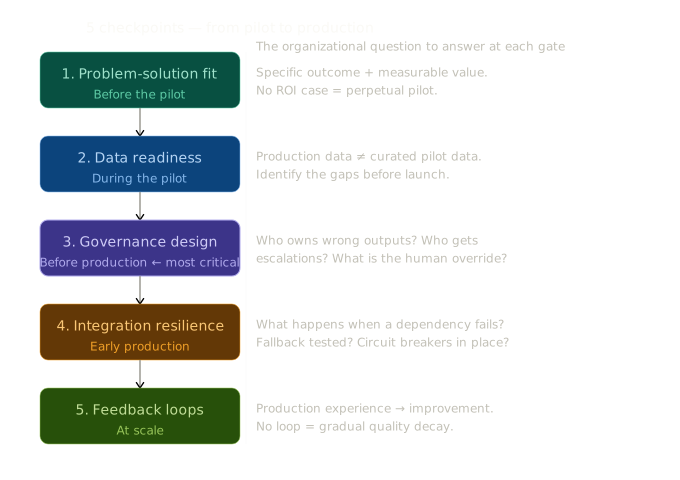
Analyzing the patterns across failed and successful enterprise AI deployments, five checkpoints emerge where programs consistently stall. Each represents a specific organizational design question that must be answered before moving to the next stage.
Checkpoint 1: Problem-solution fit (before the pilot)
The first failure mode is solving the wrong problem. Pilot programs often launch because a technology is exciting, not because a specific business problem with measurable impact has been identified. The organizational question: "What specific decision or task, if improved by AI, generates measurable business value and can we quantify that value?"
Programs that skip this question build impressive demonstrations of capability that cannot generate a ROI case. They run indefinitely as pilots, consuming resources and producing reports, but never generating the organizational commitment required to reach production.
Checkpoint 2: Data and context readiness (during the pilot)
The second failure mode is discovering, after investing in the pilot, that the underlying data and context infrastructure cannot support production requirements. The AI performs beautifully on the curated pilot dataset. It fails on the full operational dataset because the data is messier, less structured, more inconsistent than the pilot revealed.
The organizational question: "Do we have the data infrastructure freshness, structure, accessibility, governance that a production deployment requires? And if not, what is the remediation path and timeline?"
This question must be answered before the pilot is declared a success and moved to scale. The most expensive moment to discover a data infrastructure gap is after announcing a production launch date.
Checkpoint 3: Governance and decision ownership (before production)
The third failure mode and the most consistently underestimated is the absence of governance design. When the agent is wrong, who is accountable? When the agent encounters a scenario outside its operating boundary, who does it escalate to, through what mechanism, with what context? When the agent's output has downstream consequences a customer commitment, a financial transaction, an operational decision who reviews it, when, and at what threshold?
These are not technology questions. They are organizational design questions. And they must have explicit, documented answers before production deployment.
The organizational question: "For every action this agent takes in production, we have defined the accountability, the escalation path, and the human oversight mechanism."
Programs that cannot answer this question comprehensively are not ready for production. Deploying without these answers doesn't skip governance it generates the governance process reactively, under incident conditions, at maximum cost.
Checkpoint 4: Integration and operational resilience (during early production)
The fourth failure mode emerges in the first weeks of production: integrations that worked in the pilot fail under real operational load. A dependent system is unavailable. A data source changes its format. A third-party API hits rate limits. The agent, which was designed assuming reliable integrations, has no graceful failure mode.
The organizational question: "What does the agent do when a dependency fails and have we tested every failure scenario?"
Production AI requires the same resilience engineering as any production system: circuit breakers, fallback behaviors, degraded-mode operations, and alert systems that notify humans before users experience failures. This is standard platform engineering. Applying it to AI agents requires treating them as production systems from the beginning, not as experiments that happen to work.
Checkpoint 5: Feedback loops and continuous improvement (at scale)
The fifth failure mode is success without learning. The agent reaches production. Users adopt it. And then nothing. No systematic collection of feedback. No monitoring of output quality over time. No process for the insights from production to reach the team responsible for improving the system.
Without feedback loops, production AI degrades gradually. The business evolves. The regulatory environment changes. The underlying data shifts. The agent, which was calibrated to an operational context that no longer exists, produces increasingly inconsistent outputs. Users lose confidence. Adoption declines.
The organizational question: "How do we systematically learn from production and how quickly can we implement improvements when problems are identified?"
What the survivors do differently
Across the organizations that successfully scale from pilot to production, a consistent pattern emerges. They don't have better models. They don't have bigger AI teams. They have better organizational design.
They treat agents as operating model changes, not technology deployments. The framing is fundamentally different. A technology deployment says: "We're installing this AI agent to handle X." An operating model change says: "We're redesigning how X gets done, and AI is the enabling technology." The sequence matters. Redesign the workflow first. Define the human role, the decision authority, the escalation paths. Then deploy the agent into a workflow that has been designed to accommodate it.
They define the human handoff protocol before the first production query. Every production agent has a documented answer to: when does the agent escalate, to whom, with what context, in what timeframe? This is not an edge case design. It is the core of the governance architecture. Organizations that design this before deployment experience incidents as handled exceptions. Organizations that don't experience incidents as crises.
They build feedback loops into the production architecture. Every agent interaction successful or not generates structured data: what was asked, what was provided as context, what the agent produced, and (where available) what the actual outcome was. This data flows to a monitoring system that tracks quality metrics over time. Degradation triggers review. Review triggers improvement.
They start with narrow, high-confidence use cases. The organizations that scale successfully don't begin with the most complex or highest-stakes use case. They begin with a use case where the context is clean, the success metric is unambiguous, and the downside of an error is bounded and recoverable. They build confidence organizational, technical, and cultural before expanding scope.
The production readiness assessment
Before any AI pilot moves to production, five questions deserve explicit answers:
- Problem-solution fit: What specific, measurable business outcome does this agent improve and by how much, verified in the pilot?
- Data and context readiness: Does the production data environment match the pilot conditions? What are the known gaps?
- Governance and accountability: Who owns each category of agent action, who receives escalations, and what is the incident response process?
- Integration resilience: What happens when each dependency fails and has each failure scenario been tested?
- Feedback loop design: How does production experience reach the team responsible for improving the system?
If any of these cannot be answered with specificity, the program is not production-ready regardless of how well the pilot performed.
Case study: From stalled pilot to production scale
In an enterprise deployment supporting internal IT operations, the initial AI support agent pilot performed well in controlled testing: resolution rates above target, user satisfaction positive, handle time reduced. The pilot was declared a success.
The production launch revealed three gaps that the pilot had not surfaced. First, the live ticket data was significantly messier than the curated pilot dataset resolution rates dropped immediately. Second, there was no defined escalation path for tickets the agent couldn't resolve; they accumulated in a queue with no human owner. Third, there was no feedback mechanism the team had no visibility into which ticket categories were failing until user complaints reached a threshold.
The remediation followed the framework: a data quality sprint to clean and structure the live ticket ingestion pipeline; a defined escalation protocol (agent-unresolvable tickets route to a named support lead within two business hours); and a weekly quality review using structured output logs.
Three months after remediation, resolution rates exceeded the original pilot benchmark. More significantly: the team now has a production learning loop that systematically improves the system. The pilot had proven the concept. The governance design enabled the scale.
Key takeaways
- Pilot failure is overwhelmingly organizational, not technological. The models are mature enough. The organizations frequently aren't.
- The five checkpoints: problem-solution fit, data and context readiness, governance and decision ownership, integration resilience, and feedback loops.
- The human handoff protocol who receives escalations, when, with what context is the single most important governance design decision for production AI.
- Treat agent deployment as an operating model change, not a technology installation. Redesign the workflow before deploying the agent.
- Narrow, high-confidence use cases first. Build organizational confidence before expanding scope.
Conclusion
The gap between enterprise AI ambition and enterprise AI execution is not closing as fast as the enthusiasm suggests. The velocity of pilot launches is accelerating. The velocity of successful production deployments is not keeping pace.
This is a solvable problem but it requires treating it as an organizational problem, not a technology problem. The models are ready. The question is whether the operating model, the governance architecture, and the feedback mechanisms are ready too.
The five-checkpoint framework is not a guarantee of success. But it is a systematic way to surface the organizational gaps before they surface in production before they generate user complaints, before they create liability, before they cost the program its internal credibility.
The organizations that will lead enterprise AI in 2026 and beyond are not those with the most impressive pilots. They are those that can reliably, repeatedly, move from pilot to production and then from production to learning. That's the capability that compounds. And it's built through organizational design, not model selection.
Author: Godwin Avodagbe Deputy Director Digital Transformation, GALEC (E.Leclerc Group, ~€60B revenue). Founder, eKoura & HitoTec. Cambridge Judge Business School CTO Programme. Specialises in enterprise AI architecture and large-scale digital transformation for European retail.

Comments ()