Why do enterprise AI pilots fail when they move to production?

Slug: context-engineering-enterprise-ai-production-2026
Executive Summary
The enterprise AI conversation has been dominated by prompt engineering: craft the right instructions, get better outputs. That worked for pilots. It doesn't scale to production. The discipline replacing it context engineering treats AI not as a question-answering machine but as a reasoning engine that needs a carefully designed information environment to operate reliably. Context engineering is about what information flows into the model, when, in what structure, with what freshness, governed by what rules. It is the difference between an AI assistant that works in demos and one that works at 2 AM when no one is watching. This article explains why the shift matters, what context engineering actually involves technically, and how to build the context architecture that makes enterprise AI trustworthy at scale.
3 key insights:
- AI models across providers are converging in capability. Competitive advantage is shifting to the context layer the proprietary operational environment you build around the model.
- Prompt engineering optimizes an interaction. Context engineering designs the operating system that interaction runs on. They're not substitutes; context is infrastructure.
- The organizations pulling ahead aren't asking "which model is best?" They're asking "how do we engineer the information environment our agents operate in?"
3 actions to take this week:
- Map every AI use case in your organization against the "context completeness" question: does the model have everything it needs, at the right freshness, with the right structure, to be trustworthy in this task?
- Identify your highest-value AI application and conduct a "context audit" what goes in, where it comes from, how stale it can be, what gets excluded.
- Treat context engineering as infrastructure discipline, not an AI project. Assign it to the same teams that own data pipelines and API governance.
Risk if ignored: Context deficits models operating on incomplete, stale, or unstructured information produce the hallucinations, inconsistencies, and liability events that kill enterprise AI programs.
Introduction
In 2023, the most valuable skill in enterprise AI was knowing how to write a good prompt. A well-structured instruction could coax dramatically better outputs from the same underlying model. Prompt engineering became a job title, a discipline, a competitive differentiator.
In 2026, that's table stakes.
The frontier has moved. The question is no longer "how do I ask the model the right question?" It's "how do I build the environment in which the model can be trusted to act?"
That environment is context. And engineering it deliberately, systematically, at production scale is the discipline defining which enterprise AI programs deliver durable value and which remain permanently in pilot purgatory.
The Convergence Problem
Here's the structural reality reshaping enterprise AI strategy: the major AI models are converging. GPT, Claude, Gemini, and their successors are now broadly similar in capability, available via low-cost APIs, with performance differences that matter in specific technical tasks but rarely determine enterprise outcomes.
If the model isn't the differentiator, what is?
The context layer. The proprietary operational environment your business rules, your data, your compliance constraints, your historical patterns that you build around the model. A model operating in a well-engineered context produces outputs that are accurate, reliable, consistent, and auditable. The same model operating without that context produces outputs that are plausible, often wrong, and impossible to govern.
This is why Cognizant CIO Neal Ramasamy describes context engineering as the critical capability for unlocking AI value: "Context engineering defines the operating system that interaction runs on. In a Fortune 500 environment, that means clearly defining who makes decisions, what authority they have, and how exceptions are handled. Much of that context has traditionally lived in people's heads. AI systems don't have access to it unless it's intentionally designed into the environment."
Most enterprise AI programs treat context as an afterthought. They fine-tune the model. They optimize the prompt. They forget to design the information environment. That's why they fail in production.
What Context Engineering actually is
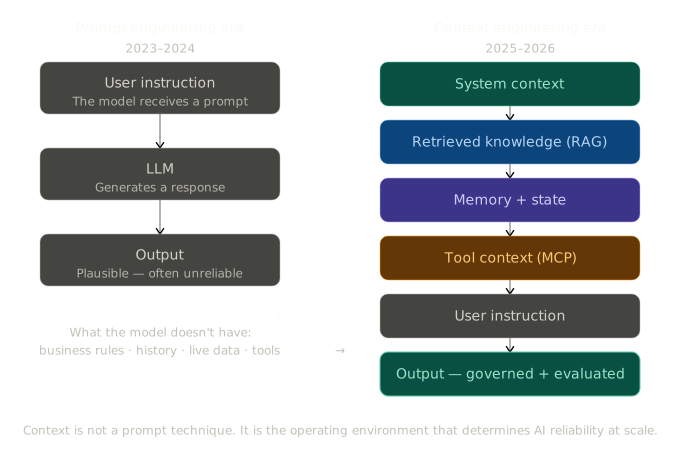
Context engineering is the discipline of designing and managing the complete information environment that shapes AI system behavior what the model knows, when it knows it, in what structure, governed by what rules.
It operates across five dimensions:
System context is the foundational layer: the model's role, its operating constraints, its behavioral guardrails, and the business logic it must respect. This is more than a system prompt. It encodes the organization's decision authority, escalation paths, tone and compliance requirements, and the boundaries of what the agent can and cannot do. In enterprise settings, this context must be maintained, versioned, and governed like any other operational policy.
Retrieved knowledge is the information the model draws from to answer specific queries. This is where RAG (Retrieval-Augmented Generation) sits the pipelines that fetch relevant documents, policies, product data, or customer records and inject them into the model's context at inference time. The quality of retrieval relevance, recency, completeness directly determines output quality. Poor retrieval produces plausible but wrong answers.
Memory and state address the fundamental limitation of language models: they are stateless by design. Every session starts from scratch. Context engineering solves this by maintaining external memory user preferences, conversation history, past decisions, ongoing project state that gets injected into the model's context when relevant. Without this, enterprise AI behaves like a brilliant colleague with severe amnesia: capable but unable to build on prior work.
Tool context defines what the model can do, not just what it knows. In agentic architectures, this includes the tools available to the agent (via MCP servers or direct API integrations), the permissions each tool carries, and the rules governing when the agent can act versus when it must escalate to a human. Tool context determines the operational boundary of the agent.
Governance and evaluation close the loop. Context engineering is not a one-time design exercise. It requires continuous evaluation: are the model's outputs grounded in the retrieved evidence? Are they relevant to the user's actual intent? Are they consistent with organizational policy? These evaluation loops scoring outputs for groundedness, relevance, and factual accuracy are what separate context engineering from context guessing.
The Shift from prompts to pipelines
The practical manifestation of context engineering is the context pipeline: a structured, automated process that assembles the right information, in the right format, at the right moment, before every inference call.
A well-designed context pipeline looks like this:
The user or agent sends a request. Before it reaches the model, the pipeline activates. It retrieves relevant documents from the knowledge base, ranked by semantic relevance and recency. It fetches the user's relevant history and preferences from the memory store. It applies the current session's role and constraint context. It injects real-time data where required current inventory levels, live pricing, regulatory status. It assembles all of this into a structured context window, with the most critical information positioned for maximum model attention. Then and only then it sends the enriched request to the model.
The output passes through evaluation before reaching the user: groundedness check (is this claim supported by the retrieved evidence?), relevance check (does this answer the actual question?), compliance check (does this violate any policy rule?). Failures route to fallback handling, not to the user.
This is the architecture that turns a powerful but unreliable model into a trustworthy enterprise system. It doesn't require a better model. It requires better engineering around the model.
Field pattern: Where context gaps kill production AI
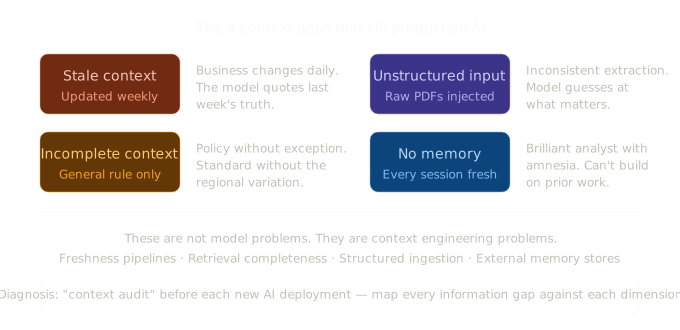
The most consistent failure pattern in enterprise AI deployments is not model hallucination it's context deficit. The model isn't producing wrong answers because the model is broken. It's producing wrong answers because it's operating without the information it needs to be right.
In organizations I support, the same failure modes appear repeatedly:
Stale context: The model's knowledge base is refreshed weekly or monthly. Business reality changes daily. A customer-facing agent confidently quotes a price that changed three days ago. An internal support agent provides a process that was deprecated last month. The model isn't hallucinating it's operating on outdated truth.
Incomplete context: The model knows the general policy but not the exception that applies to this customer. It knows the standard process but not the regional variation. It knows the product description but not the current inventory status. Every gap is a potential error.
Unstructured context: Raw documents injected into the context window without preprocessing produce inconsistent results. The model extracts what it can from PDFs, emails, and spreadsheets but extraction quality is unpredictable. Context engineering requires structured, machine-readable inputs, not raw file dumps.
No memory context: Each conversation starts from scratch. The customer who called last week about a billing issue faces an agent with no memory of that interaction. The project team's AI assistant has no recall of the decision made in last month's planning session. Statelessness is the enemy of organizational value.
Solving these isn't a model problem. It's a context engineering problem.
Implications: Context as competitive moat
The strategic implication is significant and underappreciated: in a world where model capabilities are converging and available at commodity prices, the context layer becomes the enterprise's primary AI competitive advantage.
Your proprietary operational context your business rules, your historical data, your organizational knowledge, your compliance constraints, your customer interaction history cannot be replicated by a competitor running the same model. It's accumulated, structured, and governed over time. It's the intellectual property of your AI program.
As one CTO describes it: the context layer is the enterprise's "most valuable intellectual property in AI." And like all valuable intellectual property, it requires deliberate investment and governance.
The organizations that treat context as infrastructure assigned to data engineering, enterprise architecture, and governance teams will build context advantages that compound. The organizations that treat context as an AI team problem addressed ad hoc when something breaks in production will remain in a perpetual cycle of pilot launches and production failures.
Case study: From keyword search to context-aware intelligence
In one deployment at a large organization, the goal was to evolve an internal search tool a basic keyword interface over operational documentation into a multi-agent assistant capable of supporting complex, multi-step decision workflows.
The initial approach focused on the model: fine-tune for the domain, optimize the prompt, improve the interface. Results were inconsistent. The model produced plausible answers that were frequently outdated, incomplete, or mismatched to the user's operational context.
The reframe was architectural. The team built a context pipeline: a structured ingestion process that transformed raw documentation (PDFs, wikis, operational logs) into machine-readable semantic records with freshness metadata. A retrieval layer that selected relevant records based on semantic similarity, recency, and user role. A memory layer that maintained user context and session history. An evaluation layer that scored every output before delivery.
The gains were not from a better model. They were from better information flow from the user to data sources, to agents, to response. Fewer errors. Faster task completion. Smoother user experiences. The architecture, not the model, was the differentiator.
Key takeaways
- Context engineering is infrastructure, not a prompt technique. It requires the same organizational investment as data pipelines and API governance.
- The five dimensions of enterprise context: system context, retrieved knowledge, memory and state, tool context, and governance/evaluation.
- The context pipeline structured, automated assembly of the right information before every inference is the architectural pattern that distinguishes production AI from demo AI.
- Context gaps (staleness, incompleteness, unstructured inputs, no memory) are the most common cause of production AI failures.
- In a world of converging model capabilities, the context layer is the primary source of durable AI competitive advantage.
Conclusion
The era of prompt engineering as the primary enterprise AI skill is ending. Not because prompts don't matter they do, as the intent layer that guides the model. But because intent without context is like a brilliant analyst without the files they need to analyze. The output might be coherent. It won't be right.
Context engineering is the discipline that gives enterprise AI the information environment it needs to be trustworthy at scale. It's the work of data engineers, enterprise architects, and AI platform teams not just AI researchers and prompt specialists.
The question for enterprise leaders in 2026 is not "which AI model should we use?" It's "how well do we engineer the context our AI operates in?" The answer to that question is what separates the organizations delivering real AI value from those still wondering why their pilots don't scale.
Build the pipeline. Structure the knowledge. Design the memory. That's where enterprise AI actually lives.
Author: Godwin Avodagbe Deputy Director Digital Transformation, GALEC (E.Leclerc Group, ~€60B revenue). Founder, eKoura & HitoTec. Cambridge Judge Business School CTO Programme. Specialises in enterprise AI architecture and large-scale digital transformation for European retail.

Comments ()