SDLC in the Agentic AI Era: How to Rethink Your Development Lifecycle End to End
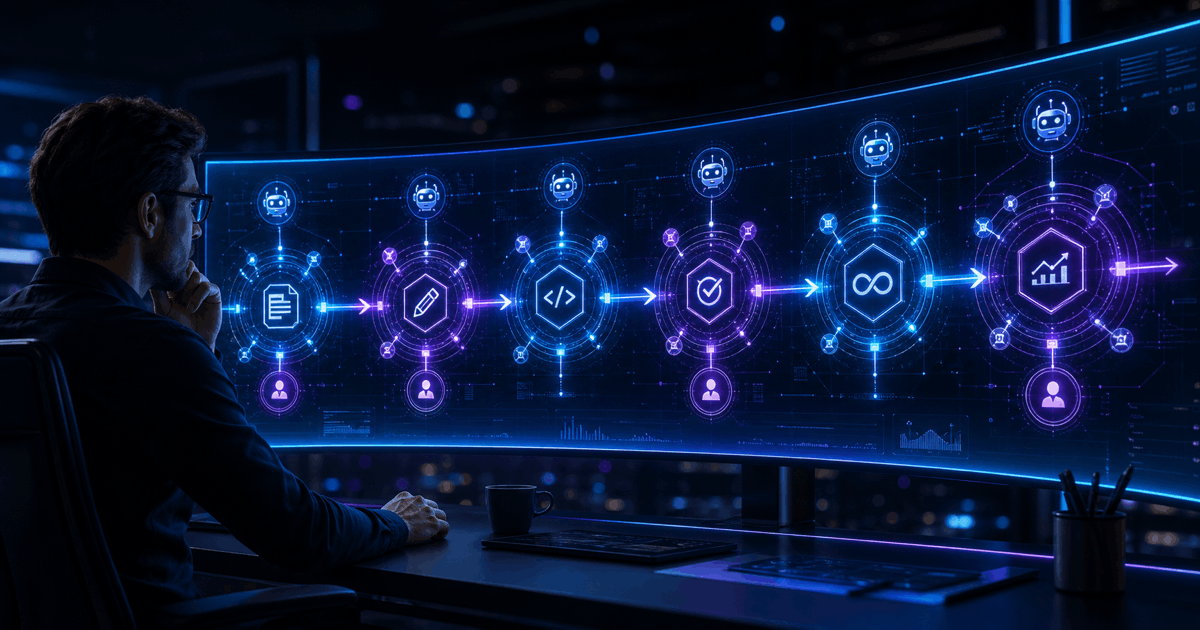
The Software Development Life Cycle hasn't changed structurally in 30 years. Tools have evolved, methodologies too — waterfall, agile, DevOps — but the fundamental phases have stayed the same: specify, design, develop, test, deploy, maintain. That sequence is now being redesigned.
Not because AI helps developers go faster on each step. Because in some teams, AI agents now handle entire sub-sequences autonomously. The question for engineering teams is no longer "which tools to buy" but "which part of the SDLC is still a human process, and why."
1. What "agentic" actually changes in the SDLC logic
A classic SDLC is sequential and human at every decision point. Each phase produces a deliverable that humans review before moving to the next.
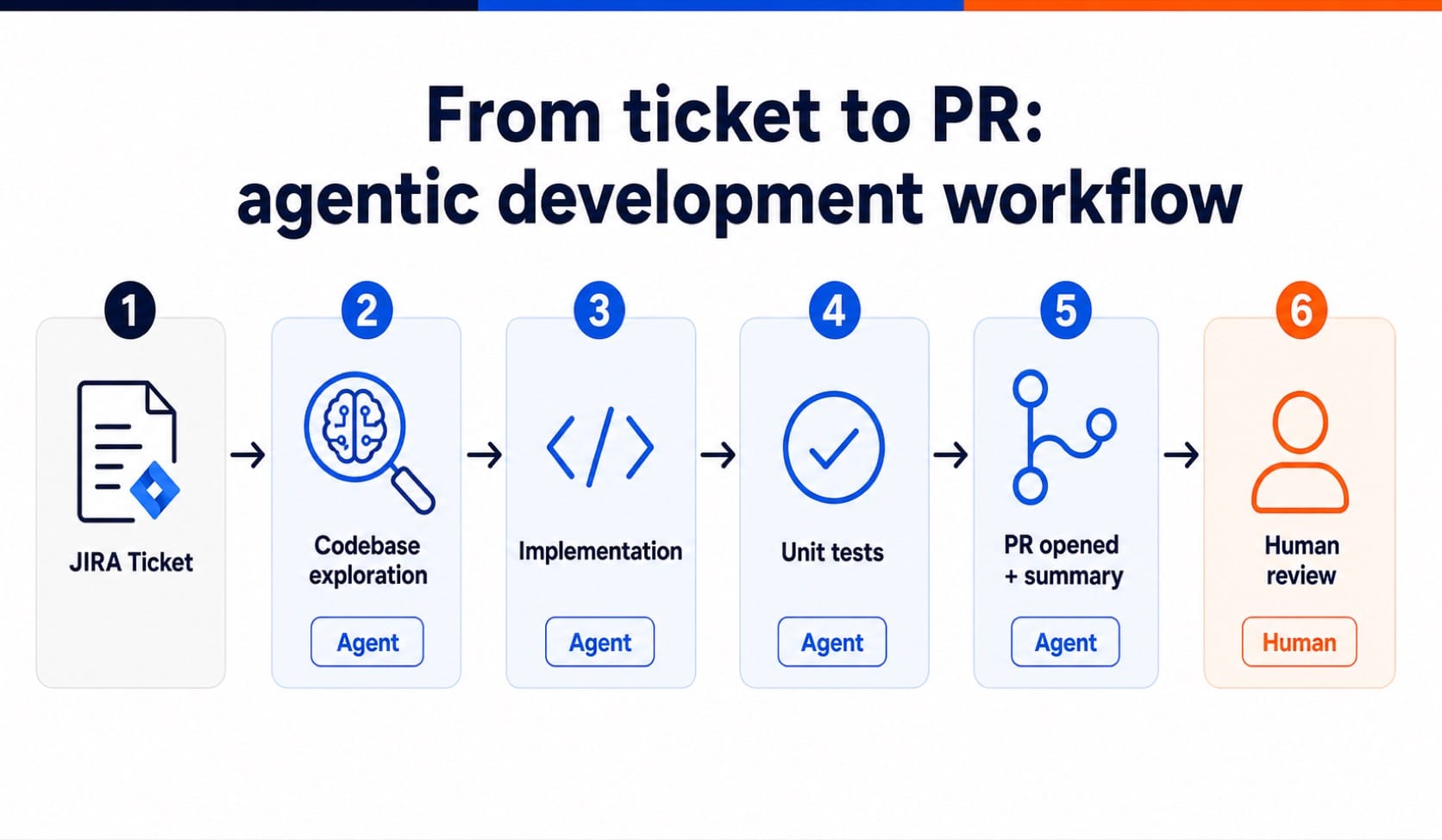
An agentic SDLC redistributes that responsibility. AI agents take ownership of work sequences inside phases, not just isolated tasks. An agent can start from a JIRA ticket, explore the codebase to understand context, propose an implementation, write the corresponding unit tests, open a PR with a change summary, and flag areas that need human review. All in a single call.
Human oversight remains essential, but it shifts: less production, more evaluation.
2. Phase 1: Requirements and specifications
This is the most underestimated phase in current AI transformations.
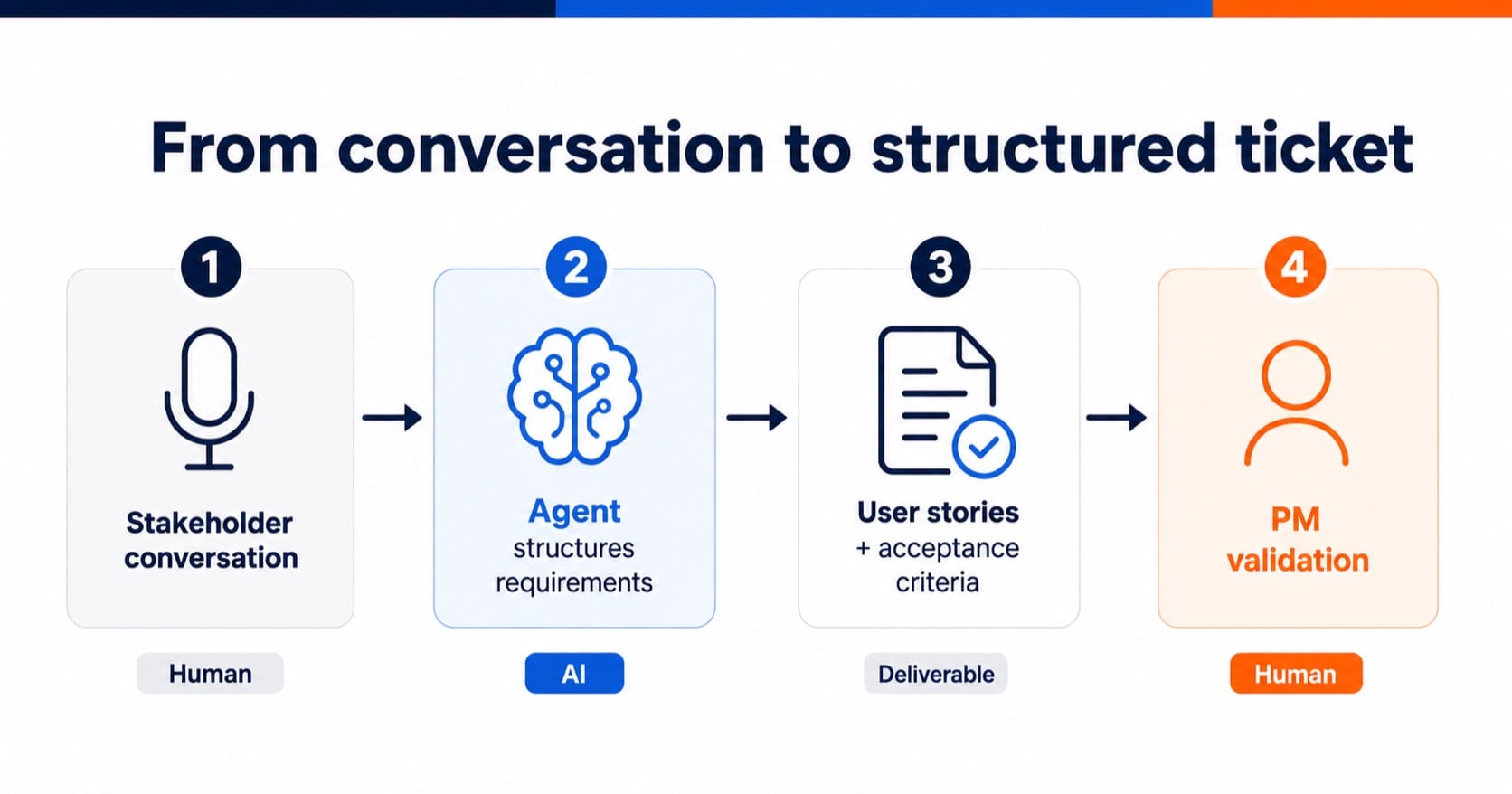
Advanced teams use agents to generate user stories from stakeholder conversations: meeting recordings, product interview transcripts, support tickets. The agent structures requirements, identifies ambiguities, and proposes acceptance criteria. The product manager validates, adjusts, and signs off.
Tools like Miro AI, Linear AI, and spec-generation plugins for Notion now structure requirements directly from recorded conversations. Microsoft and Accenture's research on the spec-first approach shows that when teams treat specifications as the primary artifact (before the code), the quality of instructions given to coding agents improves significantly, reducing corrective iterations during the sprint.
What doesn't change: someone needs to understand the business problem deeply enough to judge whether the agent captured the right priorities. AI structures, humans arbitrate.
3. Phase 2: Design and architecture
AI agents remain limited on system architecture (long-term trade-off reasoning, organizational dependencies, undocumented constraints). But they are useful in two precise areas.
First, generating initial architecture proposals from requirements: sequence diagrams, data models, service decomposition. These proposals don't replace a senior architect's decision, but they accelerate the exploration phase and surface angles that might not have been anticipated.
Second, architectural compliance review: an agent can check whether a proposed implementation follows defined patterns (DDD, hexagonal, event-driven), flag deviations, and produce a consistency report before human review.
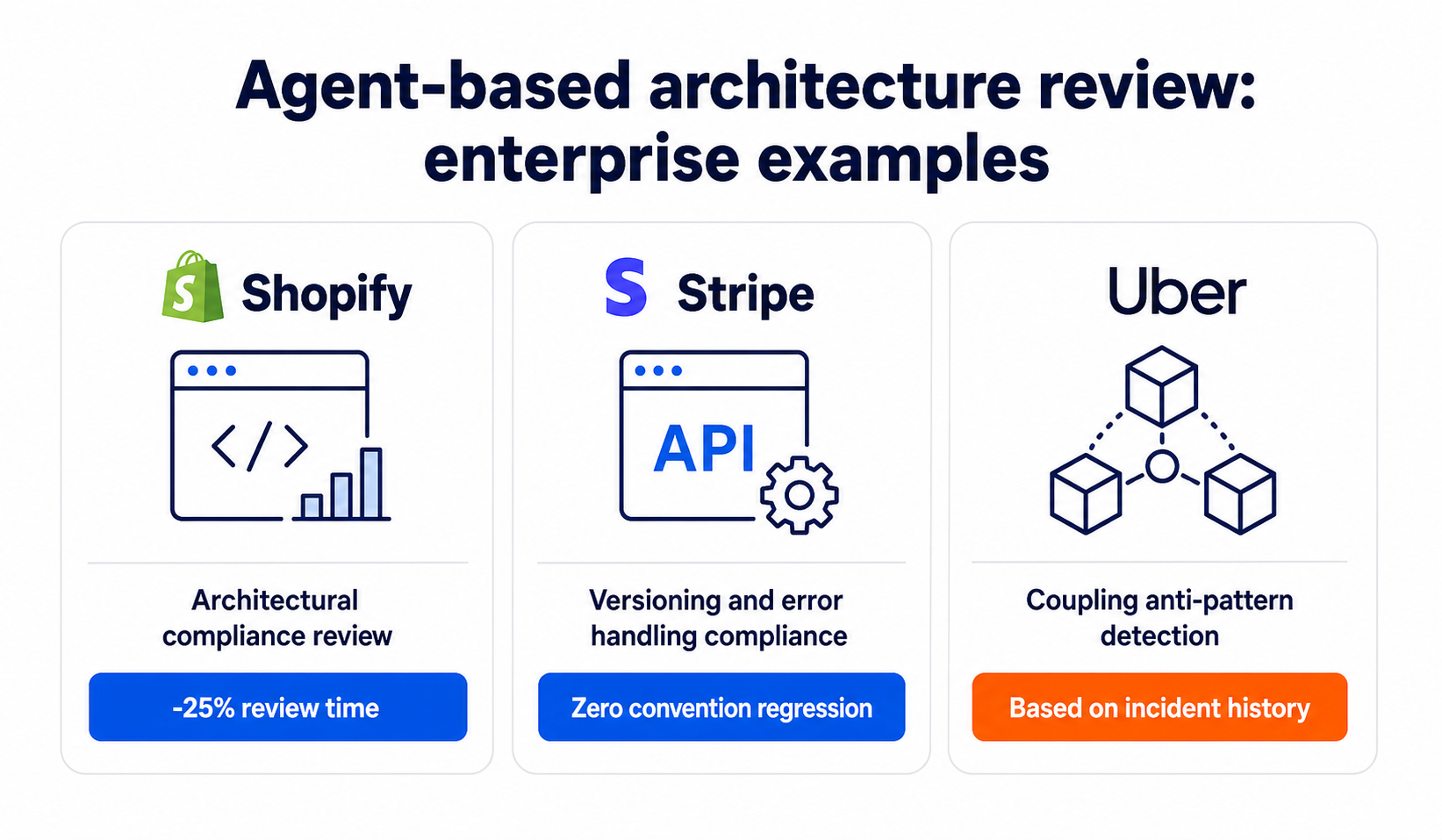
A few documented cases: Shopify deployed agents that automatically analyze PRs to detect violations of their internal architecture principles. Lead engineer review time on standard PRs dropped 25% since deployment. Stripe uses agents to verify new API compliance with its versioning conventions and error-handling patterns before any human review. At Uber, agents scan microservice architecture proposals to detect tight-coupling anti-patterns identified in the platform's incident history.
4. Phase 3: Development and code review
This is where agents have the most visible and best-documented impact.
On development: Claude Code, Cursor, and GitHub Copilot Workspace no longer generate snippets. They handle complete issues, navigate the codebase, manage imports and dependencies, and propose testable implementations. Anthropic has measured that 30% of PRs opened on projects using Claude Code are now initiated directly by the agent.
On code review, the market has structured itself around two complementary approaches.
Deterministic verification platforms apply static rules with a precision that AI alone cannot guarantee. SonarQube remains the enterprise reference: 6,500+ built-in rules across 35+ languages, Quality Gates that automatically block merges on critical issues. In 2025, SonarSource launched AI Code Assurance, a module that detects AI-generated code and applies reinforced verification rules to it. Measured result across their customer base: 24% fewer vulnerabilities, 20% fewer defects on AI-generated code. The weak point: the Community edition does not support branch analysis or PR decoration, making it impractical for modern pull request workflows. Enterprise pricing starts at $20,000/year with per-line-of-code billing that can escalate quickly. Semgrep positions as the security-first alternative: 20,000+ security rules, cross-file data flow analysis (taint analysis), SCA with reachability evaluation. Ideal for teams whose primary constraint is security compliance (fintech, healthcare, defense).
LLM-based reviewers bring what static rules cannot: context understanding, narrative change summaries, architectural suggestions. CodeRabbit analyzes the PR diff in its full context (linked Jira tickets, PR history, code dependency graph) and runs 40+ linters and SAST tools with zero configuration. The concrete gain for teams: every PR arrives with a structured summary saving 10 to 15 minutes of context-loading per reviewer. On teams processing 30 to 50 PRs per week, that's a meaningful saving. Qodo (formerly CodiumAI, rebranded in 2025) launched Qodo 2.0 in February 2026 with a multi-agent architecture that achieved the highest F1 score (60.1%) among the 8 tools tested in the DevTools Academy 2025 benchmark. It covers 11 languages and natively integrates review processes into GitHub, GitLab, and Bitbucket. Greptile is the tool to watch for large codebases: it indexes the entire repo and provides cross-file context that other tools miss.
Pros/cons in summary:
SonarQube remains essential for teams requiring strict Quality Gates, compliance audit trails, and self-hosted or air-gapped deployment. Its gaps on generative AI make it a complement, not a substitute for LLM-native tools. CodeRabbit is the most accessible entry point ($24/month, zero config) but cloud-only and sometimes verbose. Semgrep is the choice for security-first teams with a need for custom rules and advanced taint analysis. Qodo and Greptile become the right call when contextual understanding of the codebase is a prerequisite.
The remaining watch point: an agent-generated PR is smooth, well-formatted, and gives an impression of quality. That's precisely what makes it dangerous if the reviewer skims it without evaluating the underlying business logic. Human review must shift toward the "why" rather than the "how."
5. Phase 4: Testing and QA
Automated test generation is the most mature transformation to date — and also where tooling differences are the most pronounced.
Qodo (formerly CodiumAI) analyzes code structure, dependencies, and existing test patterns to generate contextually relevant tests. It identifies edge cases: null values, concurrent states, missing permissions. Recognized by Gartner as a Visionary in 2025, it raised $40M in Series A and covers 11 languages. Documented client case: a product team at a European SaaS scale-up saw coverage move from 58% to 87% in 6 weeks after deploying Qodo, without modifying their development workflow.
Diffblue Cover takes a radically different approach: reinforcement learning rather than LLMs. The agent generates a test, checks whether it passes, learns from failure, and generates a new test. This loop produces bytecode-precise tests that LLM-based approaches cannot guarantee. Diffblue specializes in Java (Spring, Hibernate, enterprise Java patterns) and explicitly targets large legacy codebases. Their strongest documented use case: 40 to 70% reduction in regression time on legacy modules, with tests that don't require maintenance after each refactor.
What these tools don't solve: agents generate tests that pass on the code as written, not necessarily on the behavior the code should have. In domains where "what to test" is itself a domain expertise, human oversight remains indispensable. An agent cannot know that a VAT calculation on exports must behave differently depending on the destination country if that rule isn't in the code.
Pros/cons: Qodo wins on accessibility, multi-language support, and integration into existing PR workflows. Diffblue wins on bytecode precision for enterprise Java. The two are complementary, not substitutable. Human QA repositions on exploratory testing (finding what nobody specified) and validating business-critical cases.
6. Phase 5: CI/CD and deployment
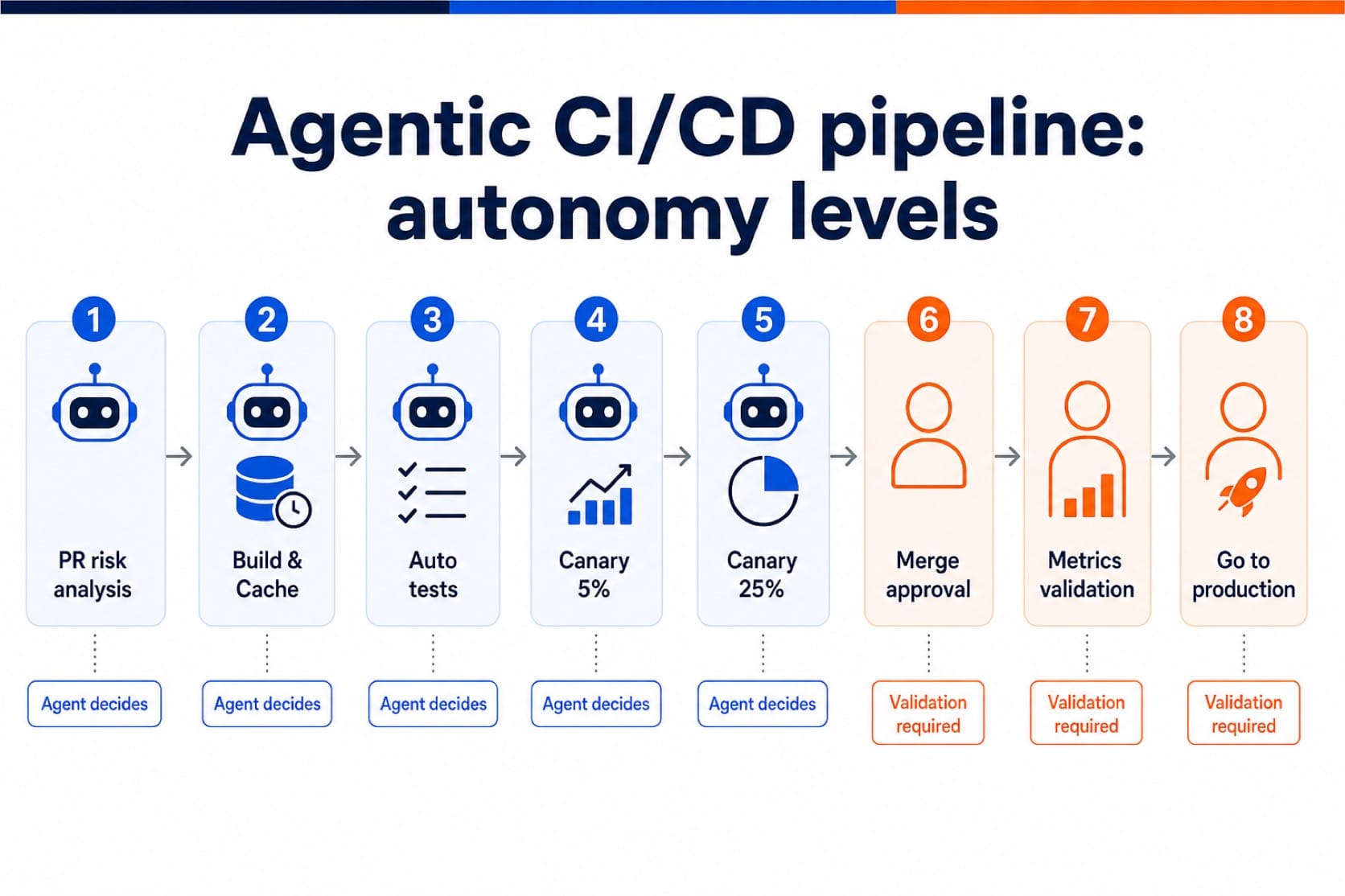
CI/CD pipelines now integrate AI agents at three levels, with very different maturity depending on the team.
Pre-merge risk analysis. The agent evaluates the potential impact of a PR before merge by comparing change patterns with past incident history. GitHub launched a tech preview of its "Agentic Workflows" in February 2025, allowing agents to trigger and supervise entire CI/CD sequences from a ticket or conversation. Tools like Harness AI and Trunk.io have offered production pre-merge risk evaluation since 2025: they flag high-risk PRs before the full pipeline even runs.
Pipeline optimization. Agents analyze build times, detect bottlenecks (redundant steps, misconfigured cache, poorly ordered tests) and propose reorganizations. At Netflix, CI/CD optimization agents reduced average build times by 22% by dynamically reordering test suites based on their failure probability for the current PR. At LinkedIn, a similar system saved the equivalent of 4,000 hours of compute per month on CI infrastructure.
Autonomous rollout decisions. This is the most advanced and least widespread level (only 2% of organizations have deployed agentic AI at this scale, according to a 2025 market study). Agents drive canary releases by automatically adjusting traffic percentages based on real-time error metrics. Uber Eats uses this type of agent for deployments in high-traffic regions: if the error rate exceeds a configured threshold in the first 10 minutes of a canary, rollback triggers without human intervention.
Pros/cons: Pre-merge risk analysis is the easiest gain to deploy and the most immediately measurable. Pipeline optimization requires an initial instrumentation investment but has a clear ROI for large teams. Autonomous rollout decisions require a solid governance framework before going to production: which decisions the agent can make alone, which require human validation, and under what conditions automatic rollback is triggered.
7. Phase 6: Monitoring and maintenance
This is the phase where long-term gains are the most significant and the least visible in current roadmaps.
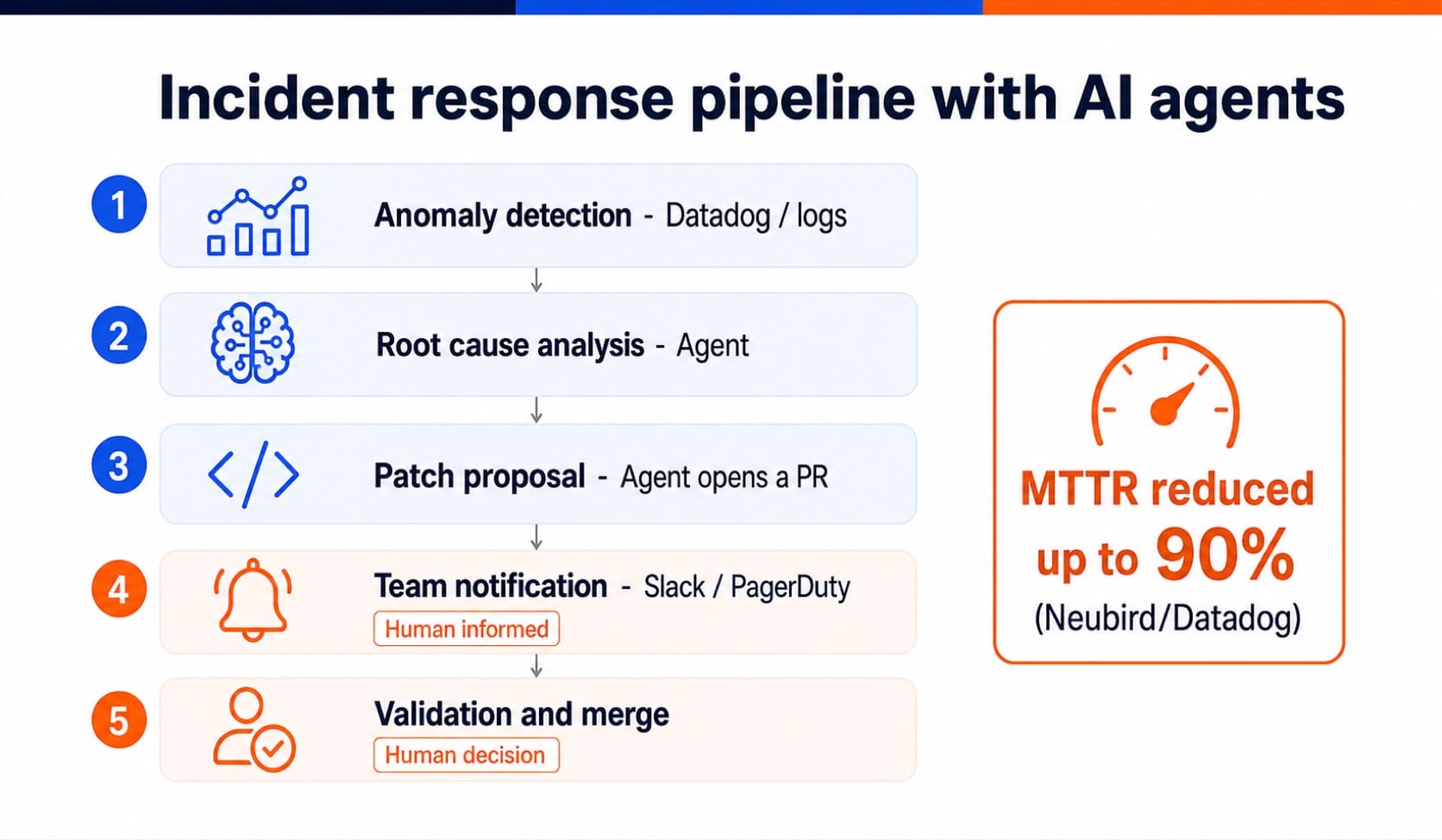
Incident detection and resolution. Monitoring agents analyze logs, identify recurring error patterns, and open remediation tickets before the incident becomes critical. PagerDuty launched a suite of specialized agents in 2025-2026: SRE Agent (autonomous incident investigation), Scribe Agent (automatic post-mortem documentation), Insights Agent (correlation between past incidents and current patterns). Datadog made its MCP Server (Model Context Protocol) available, allowing external agents to access Datadog metrics, traces, and logs to trigger corrective actions. Combined with AWS DevOps Agent (GA in 2026), the pipeline runs: Datadog detection → root cause analysis by the agent → Slack/PagerDuty notification with patch proposal → PR submitted for human validation.
Neubird, a specialized startup, integrates these Datadog data streams into autonomous agentic workflows and measures MTTR (Mean Time To Resolve) reductions of up to 90% on repetitive incidents. A 2025 SolarWinds study measured an average saving of 4.87 hours per incident across an enterprise panel using AI incident management platforms.
Legacy code maintenance. Agents like Cursor in exploration mode map dependencies, explain undocumented modules, and generate documentation from existing code. Several 2025 case studies report a 40% reduction in onboarding time on codebases of several million lines.
Pros/cons: Agentic monitoring works very well on repetitive incidents with known patterns. It remains limited on new or organizationally complex incidents (incidents caused by an undocumented process change, for example). Automated legacy documentation generation is one of the most mature and lowest-risk applications.
8. The new bottlenecks
When agents accelerate every SDLC phase, bottlenecks shift rather than disappear.
Human review becomes the primary bottleneck. If agents generate three times more code, review teams must process three times more PRs. Without increased review capacity, the production gain becomes a validation debt. GitHub measures on its own teams that code generation speed increased 55% with AI assistants, but review time per PR increased 23% (more complex reviews since PRs are denser). The ratio of generated PRs to review capacity is the first indicator to monitor during a coding agent deployment.
Requirements quality becomes critical. Agents generating code from ambiguous specs produce ambiguous code at scale. Investment in the specification phase, traditionally undervalued, becomes structural. Atlassian documented this internally: the teams that benefited most from coding agents were those whose JIRA tickets already included precise acceptance criteria, edge case examples, and explicit technical constraints.
Agent attack surface is a real risk. An agent with access to the codebase, environment secrets, deployment pipeline, and database represents a significant attack surface if misconfigured. Agent access policy must be as rigorous as that applied to human accounts: least privilege principle, credential rotation, audit trail of all actions. Snyk and Wiz both published 2025 reports documenting security incidents linked to AI agents configured with overly broad permissions in CI/CD pipelines.
9. A 6-point audit plan
One audit per phase, to complete in the next 30 days:
- Requirements: do you have a process to capture and structure needs before development? If not, this is the first place where agents deliver value without risk.
- Architecture: have you documented your internal architecture patterns precisely enough for an agent to verify them? Unformalized conventions will be ignored.
- Development: do you measure the rate of agent-initiated PRs in your teams? If you don't know, you're flying blind.
- Testing: what is your current coverage? Below 70%, automated test generation is the fastest gain available in your SDLC.
- CI/CD: have you defined an autonomous decision policy for your pipeline? Without it, agents operate in a governance vacuum.
- Monitoring: do you have agents opening remediation tickets before incidents? If not, you're reacting where you could be anticipating.
Conclusion
The agentic SDLC isn't a faster SDLC. It's a SDLC where human responsibilities have shifted phase: less production, more architecture and evaluation; less reaction, more governance.
Teams that have understood this no longer ask "how do we use AI in our process." They ask "which decisions still need a human, and how do we position them in the right place."
That's as much an organizational question as a technology one.
Sources:
- AI Code Review 2026: SonarQube vs CodeRabbit vs Copilot Compared — Lushbinary — 2026
- 13 Best Automated Code Review Tools in 2026 — Sourcegraph — 2026
- SonarQube Review 2026: Honest Enterprise Take — TECHSY — 2026
- Qodo vs Diffblue: AI Test Generation Compared — DEV Community — 2026
- Transforming SDLC with AI: Diffblue Cover's impact on unit test automation — Diffblue — 2025
- Agentic CI/CD: The Future of Development Integrations in 2026 — Barecheck — 2026
- Production-Ready Autonomous Incident Resolution with AWS DevOps Agent and Datadog MCP Server — AWS DevOps Blog — 2026
- 5 best AI-powered incident management platforms 2026 — incident.io — 2026
- How AI Is Changing the Software Development Lifecycle — GitHub Blog — 2025
- Agentic Coding in 2026 — Times of AI — 2026
- Spec-Driven Development: From Code to Contract in the Age of AI Coding Assistants — arXiv — 2026
Comments ()