RAG vs Fine-tuning in 2026: The Real Question Isn't Technical
The False Debate Wasting Your Team's Time
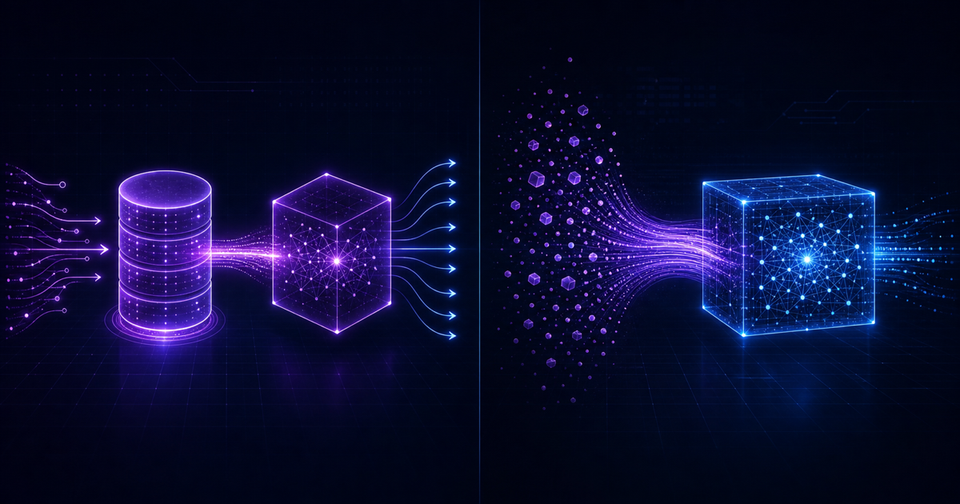
Two techniques dominate enterprise AI projects today. RAG (Retrieval-Augmented Generation) connects a language model to your external data in real time: at each query, the system retrieves relevant information from your document base and passes it to the model to generate a contextualized response. Fine-tuning, on the other hand, consists of retraining a model on your proprietary data to permanently modify its behavior, style, or knowledge — that data is then encoded directly into the model's weights.
Every month, data teams in hundreds of organizations hold the same meeting: "Should we go with RAG or fine-tuning?" Data scientists pull out their benchmarks, ML engineers compare GPU costs, and the meeting ends with a carefully constructed technical consensus built on the wrong question.
Because the real question isn't: "Which technique performs best on this benchmark?"
The real question is: "Should your data live in your infrastructure, or in a model?"
This reframe turns a technical decision into a strategic one. And that decision should be made by the CDO — not the data scientists.
What the Numbers Actually Say
Production deployment data for 2025-2026 is unambiguous. According to Menlo Ventures' 2025 State of Generative AI in the Enterprise report: 51% of enterprise AI deployments use RAG in production. Only 9% rely primarily on fine-tuning.
This isn't an accident. It reflects economic and operational reality:
- Time to production: A RAG system can be deployed in days. A fine-tuned model requires weeks to months of data preparation, training, and evaluation.
- Maintenance cost: A model fine-tuned on static data must be retrained every time the knowledge base changes significantly. RAG updates automatically as your data changes.
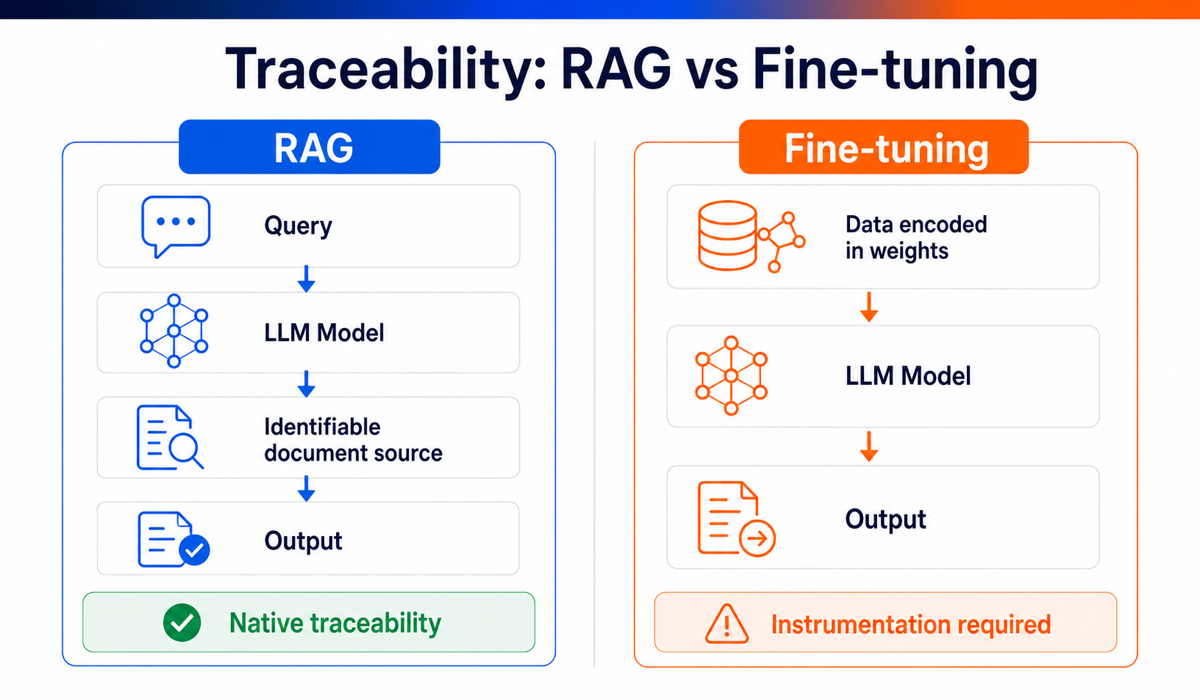
- Traceability: RAG architectures natively link every output to its source — a regulatory requirement in 2026 with the EU AI Act entering its first major enforcement cycle in August 2026.
And yet: teams combining both approaches achieve 96% accuracy on benchmarks, versus 89% for RAG-only and 91% for fine-tuning-only.
The question isn't "which one to choose" — it's "which one first, and for what."
The Real Dividing Line: Data Ownership
Here's what most decision frameworks miss.
When you fine-tune a model, your proprietary data — internal manuals, customer histories, business processes — gets encoded into the model weights. It becomes inseparable from the model. It travels with it. If that model is hosted by a cloud provider, your sensitive data is effectively in their infrastructure.
When you deploy RAG, your data stays in your lakehouse, your vector store, your existing systems. The model accesses it on demand but doesn't "learn" it. You retain control.
For a CDO in 2026, this isn't a footnote. It's the decision.
In finance, healthcare, or any regulated sector, the question of where your training data lives is exactly the kind of question EU AI Act auditors will ask. RAG architectures answer it naturally; fine-tuned models require additional logging instrumentation to prove traceability.
Two Decision Axes (Not the Usual Ten)
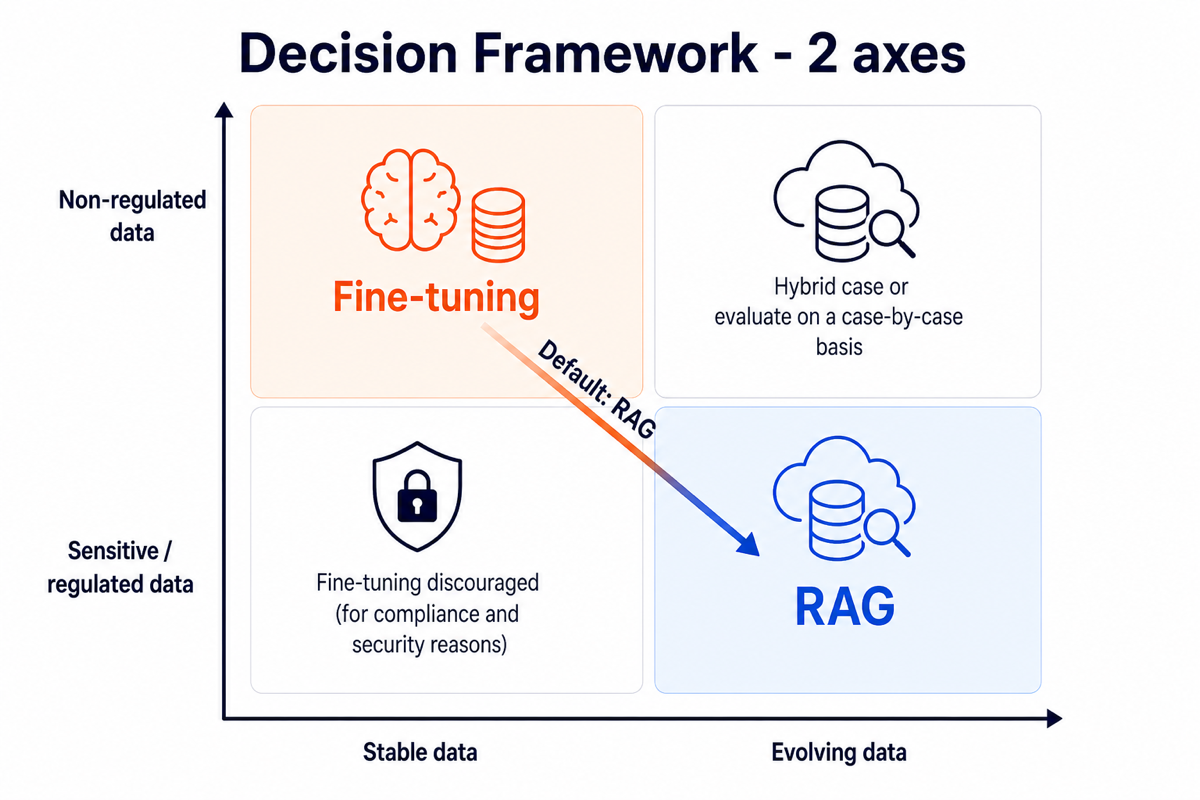
Most published frameworks compare RAG and fine-tuning across a dozen criteria. In practice, two axes cover 90% of enterprise decisions.
Axis 1: Knowledge Freshness vs. Stability
- Your domain evolves rapidly (prices, products, regulations, customers) → RAG
- Your domain is stable and specialized (precise medical terminology, house style, constrained output format) → Fine-tuning candidate
Axis 2: Data Ownership vs. Speed to Market
- You have sensitive or regulated data, and compliance is non-negotiable → RAG (your data stays in your infrastructure)
- You need specific, repeatable behavior (brand tone, structured JSON output, decision protocol) → Fine-tuning candidate
The decision rule is simple: if both axes point to RAG, start with RAG. If one axis points toward fine-tuning and the other toward RAG, pilot RAG for 60 days and evaluate residual behavioral gaps — those gaps become your fine-tuning scope.
What LoRA Changes (and What It Doesn't)
An important nuance for 2026: fine-tuning costs have dropped by an order of magnitude thanks to methods like LoRA and QLoRA. A fine-tuning run that cost $50,000 in GPU compute in 2023 can now be done for $3,000–$5,000.
Does this change the strategic decision? No. It changes the entry threshold for testing.
What LoRA doesn't change:
- The data sovereignty question (your weights remain exposed if your hosting provider changes)
- The complexity of maintaining and versioning fine-tuned models
- Initial time to production
- The absence of native traceability compared to RAG
What LoRA does change: behavioral fine-tuning (style, format) is now accessible to teams without massive GPU budgets. For tuning a tone of voice or a structured output format, that's a real argument.
But for fresh, proprietary business knowledge? RAG remains unmatched.
From Technical Question to Organizational Decision
1. Audit your active projects
Map your 3 to 5 active or pipeline AI projects. For each one, ask both questions:
- How often do the source data change?
- Can the source data leave your infrastructure?
If the answer to either creates risk, you have your answer.
2. Separate knowledge decisions from behavior decisions
RAG solves a knowledge problem. Fine-tuning solves a behavior problem. These two needs can coexist in the same application — and often must.
3. Define your regulatory fallback strategy
With the EU AI Act in its enforcement cycle since August 2026, any "high-risk" AI application must have documented input-output traceability. Check whether your fine-tuned production pipelines have this instrumentation. If not, that's an active compliance risk.
4. Set the success criterion before you choose
Before starting any project, define the business metric that will prove your approach works. "Accuracy on an internal benchmark" is not a sufficient criterion. "First-contact resolution rate in customer support" or "contract drafting time" are.
Conclusion: Take the Decision Back
The RAG vs fine-tuning debate has been framed wrong from the start — because it has been captured by the technical side of organizations.
Where your data lives, how quickly it evolves, and what you need to prove to an auditor — those are CDO questions, not data scientist questions.
In 2026, the organizations moving fastest on AI are those where governance and architecture are aligned from the first decision. Not after.
Make the strategic decision first. The engineers will adapt.
Sources:
- Primary — "2025: The State of Generative AI in the Enterprise" — Menlo Ventures — 2025 — https://menlovc.com/perspective/2025-the-state-of-generative-ai-in-the-enterprise/
- Primary — "2025 Mid-Year LLM Market Update" — Menlo Ventures — July 2025 — https://menlovc.com/perspective/2025-mid-year-llm-market-update/
- Primary — "RAG vs Fine-Tuning for Enterprise AI" — QueryNow — 2026 — https://www.querynow.com/blog/rag-vs-fine-tuning-enterprise-ai-629555
- Secondary — "RAG vs Fine-tuning for B2B Knowledge Systems" — Medium/Elizabeta Kuzevska — April 2026 — https://medium.com/@elizabetakuzevska/rag-vs-fine-tuning-for-b2b-knowledge-systems-the-decision-framework-2f9a221eddd6
- Secondary — "Fine-Tuning LLMs in 2026: When RAG Isn't Enough" — BigData Boutique — 2026 — https://bigdataboutique.com/blog/fine-tuning-llms-when-rag-isnt-enough
- Secondary — "RAG vs. Fine-Tuning" — IBM Think — 2026 — https://www.ibm.com/think/topics/rag-vs-fine-tuning
Comments ()