Lee Kuan Yew: what you learn when you build a country

There are three things you need to know about Lee Kuan Yew when he takes power in 1959: he's 35 years old, Singapore is on the brink of collapse, and he has no intention of running a campaign.
The situation is brutal. The island he's handed is a colonial port they've just thrown away: no army, no natural resources, a population ravaged by unemployment and ethnic tensions, endemic corruption, street gangs controlling neighborhoods. The obvious solutions would come from a politician: promises of wage hikes, campaigns against gangs, speeches about corruption. A leader who appeases the moment.
Lee sees the problem differently. He doesn't ask: how do I calm the crowd? He asks: what structure would produce a country that works? And he concludes quickly: a structure where every lever is chosen on purpose, put in place once, and lasts fifty years.
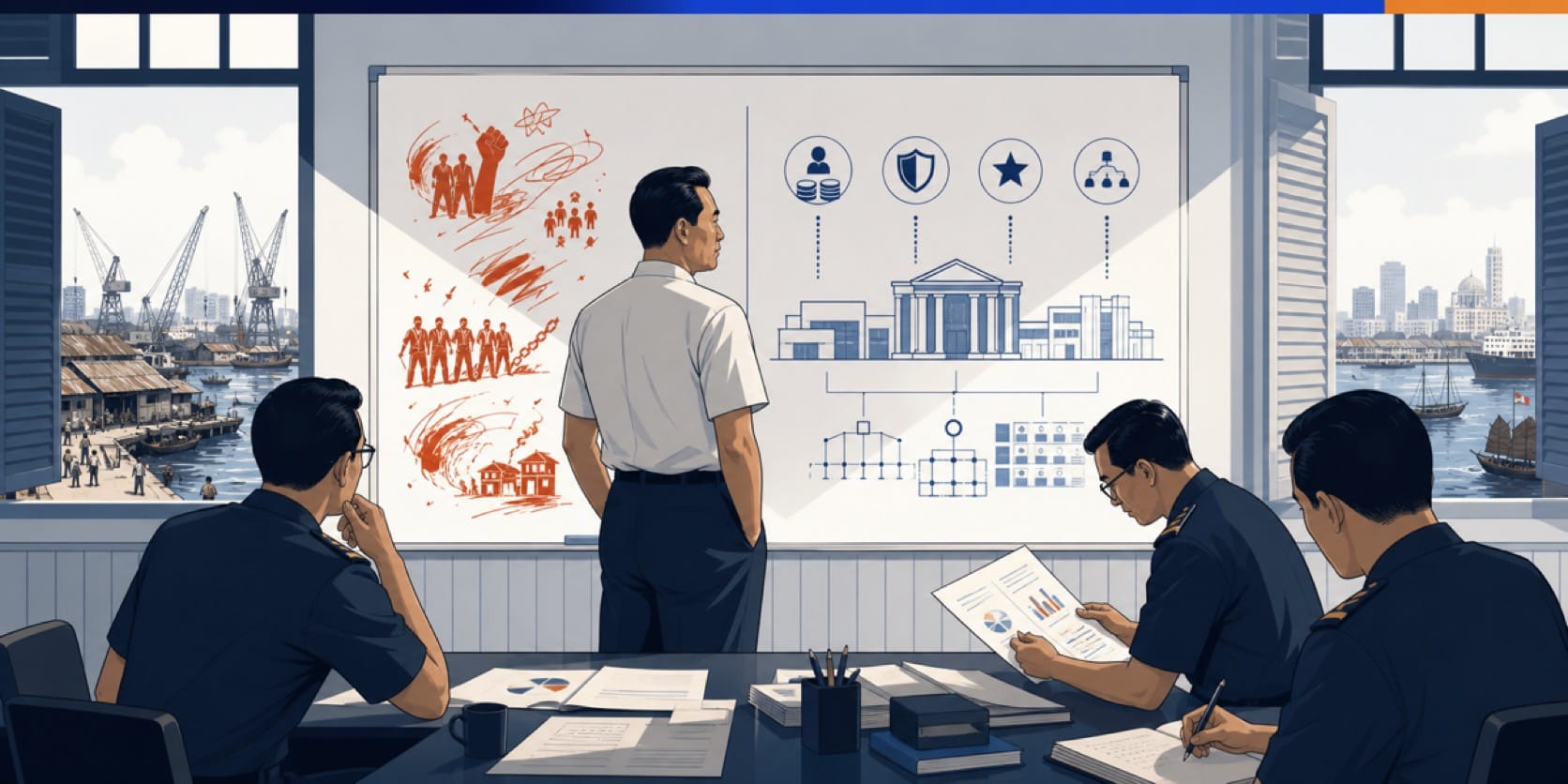
Three architects, three levers
Before taking power, Lee could have gone three ways. The first would have been conventional: raise civil service salaries to reduce corruption (he'd heard that). The second would have been spectacular: a national anti-corruption campaign built on exemplary punishment and public spectacle, rather than structure. The third was architectural.
He chose the third, in three moves.
First, he raises the salaries of public officials. Not to reward them. So that honesty costs nothing to those who practice it. A civil servant earning 10,000 dollars a month has little reason to accept a bribe to double his salary. It's a structure, not a poster. It's also, at the same time, a filter: the best candidates, who could have gone private, now accept public service.
Second lever: he creates the Corrupt Practices Investigation Bureau (CPIB), an independent institution placed directly under the Prime Minister's authority, with no ministry able to bury it. The CPIB isn't an anti-corruption agency. It's a structural weapon: every civil servant, from minister downward, knows no one is above it. Not as promise, as fact.
Third lever: he simplifies the bureaucracy. Every authorization requiring a discretionary signature is an opportunity to extract a bribe. He eliminates unnecessary procedures, centralizes rules, makes them public. A permit application doesn't depend on "knowing someone." It depends on a form and a criterion, written in black and white. It's mechanical. It's a structure.
Twenty years later, corruption hasn't vanished. But it's rare. And crucially, it's no longer the cost of normal functioning. It's become an anomaly, not a practice. Lee hadn't put out the fire. He'd built a system where the fire doesn't start.
Meritocracy as skeleton
Lee's genius is that he understands you can't build competent institutions if you hire people because they're from the right party, the right community, or know the right minister. You hire people because they're the best.
In 1971, he declares Singapore a meritocracy. Not as a campaign slogan. As a precise description of how government works. The highest posts are not elected, not bought, not inherited. They're given to those with the best academic record, the best scores on civil service exams, and who are then systematically trained in the art of governance.
This creates a strange dynamic. Brilliant young Singaporeans know that if they perform in school, if they pass the civil service entrance exams, they can actually run a ministry at 40. Not through connection, not through favors. Through competence. The elite this creates isn't hereditary or party-based. It's an elite of people selected early for aptitude and trained since. It's a structure that reproduces itself.
And it has a consequence: you can't govern Singapore with rhetoric. Your ministers are engineers, mathematicians, people who know how to read a spreadsheet. They ask you questions like: what's your data? What's your plan? How will you measure the result? A promise that doesn't hold on a page of numbers never makes it to cabinet meetings.
Efficiency as a side effect
What people call the efficiency of Singapore's civil service isn't accidental. It's the predictable product of three structures reinforcing each other: competitive salaries, meritocratic selection, and data-driven governance.
You can manage Bangkok traffic jams with awareness campaigns. You can also redesign the city with traffic data, circulation schedules adapted by district and hour, fines for polluters. Lee chooses the second way. Not because it's more humane. Because it works.
The same logic applies to housing (the State builds and sells apartments to those who can't afford them, creating social stability without depending on charity), to education (you select the best students early, train them intensively, rather than pretending everyone will attend university), to language (Mandarin, English, and Malay are taught without ideological debate, it's functional), to road code (strict laws, applied impartially).
None of this would have yielded results if Lee had solved each problem piecemeal. Road closed? Awareness campaign. School failing? A new charismatic director. Dangerous neighborhood? Police increase patrols. After each intervention, you were back where you started.
Lee didn't build for the quarter. He built for the half-century.
What the leader should take from it
If you decide tomorrow that your company has a turnover problem, you can raise salaries (parameter). You can launch an internal campaign to valorize the culture (signal). Or you can ask: what structure would produce natural retention?
That's the question Lee would ask. And he'd look for the levers: what promotion system would make people feel they can actually advance? What framework would make a manager have no incentive to reward political loyalty over competence? What would change if every decision had to be justified by data, not by opinion?
These structural levers don't act in three months. But in three years, you start seeing the system reorganize. In five years, it's natural. In ten years, it's the culture.
The leader's dilemma, in Lee's view, is never between action and inaction. It's between action on the symptom and action on the structure. And he understood well that one structural action, carried out once with rigor, produces more result than a thousand urgent interventions.
The builder's question
What structure in your organization would produce the results you're seeking if it were put in place once and left to function? And what are the three levers that would keep it in place?
Sources:
- Lee Kuan Yew, From Third World to First: The Singapore Story, 1965-2000 (HarperCollins, 2000)
- Jon S.T. Quah, "Lee Kuan Yew's role in minimising corruption in Singapore," Public Administration and Policy, Emerald Publishing, 2022 — https://www.emerald.com/pap/article/25/2/163/317418/Lee-Kuan-Yew-s-role-in-minimising-corruption-in
- "Lee's Lasting Legacy" — Council on Foreign Relations — https://www.cfr.org/articles/lees-lasting-legacy
Comments ()