GKE Hypercluster, Predictive Latency Boost, KV Cache Tiering: GKE becomes an RL-first platform
Everyone is watching the models. Meanwhile, Google is quietly rebuilding the layer that makes them run.
Cloud Next 2026 delivered 10 GKE announcements in the span of two keynote hours. Taken one by one, each looks like an incremental improvement. Taken together, they point to something far more structural: GKE as the de facto operating system for reinforcement learning at industrial scale.
If you are a Platform Engineer or CTO deciding between managed Kubernetes and a sovereign stack, this post is for you.

The problem nobody states clearly
Reinforcement learning at scale has three structural enemies that vanilla Kubernetes does not solve:
1. The straggler effect. In a distributed RL job, the whole batch waits for the slowest worker. Result: your GPUs running at 4 EUR per hour sit at 30% utilization while you wait on one slow node.
2. The long-context bottleneck. Long-context models (128k tokens and beyond) generate massive KV Caches that no longer fit in RAM. Without intelligent tiering, either you limit context or you buy 10x more memory.
3. Provisioning latency. An RL Sandbox that takes 3 minutes to start in order to execute a 2-second reward eval is an economic absurdity repeated thousands of times per run.
Those 10 GKE announcements map almost perfectly to these three problems.
The 10 announcements, organized by layer
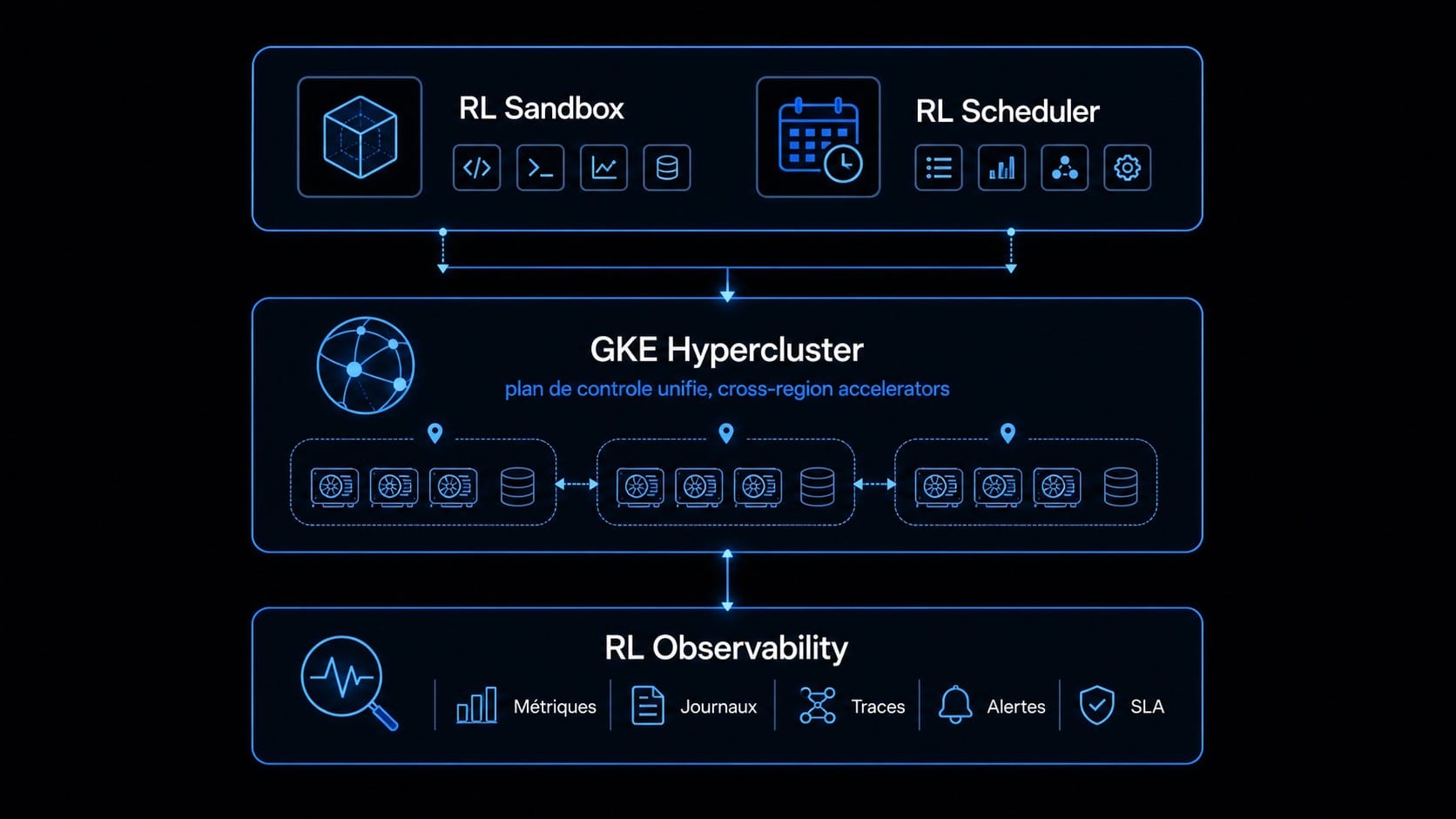
Layer 1 — RL infrastructure (announcements 123, 126, 127, 128)
GKE Hypercluster (123) — Private GA A single control plane to orchestrate millions of accelerators across regions. This is no longer "a Kubernetes cluster." It is a unified compute fabric. The direct implication for platform teams: you no longer need third-party tooling to manage multi-cluster fragmentation. The control plane becomes the single integration point.
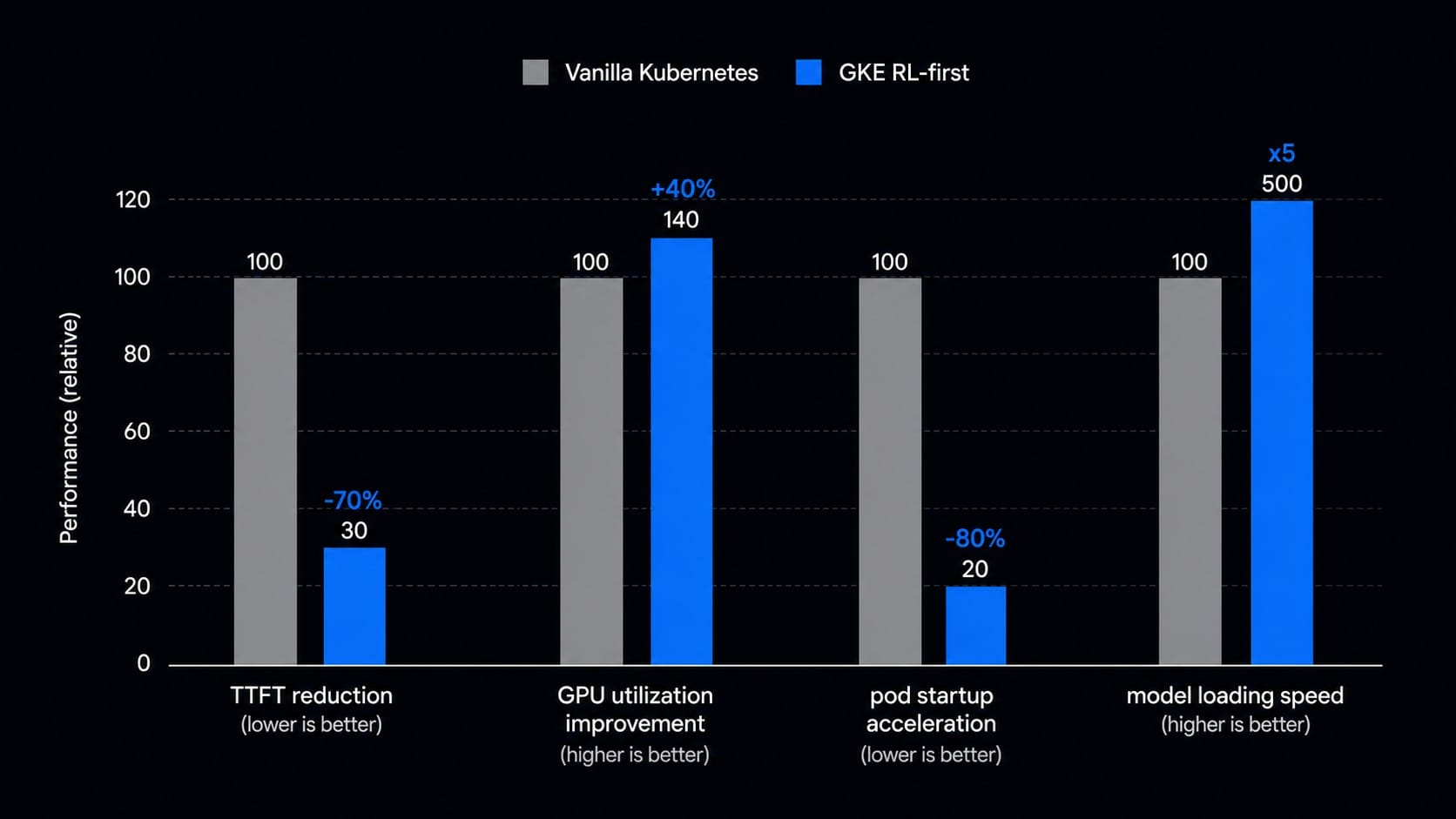
RL Scheduler (126) — Announced It addresses the straggler effect through intelligent inter-batch routing. The scheduler analyzes real-time capacity and reallocates workloads before one slow worker blocks the rest. On Google's internal benchmarks, GPU utilization gains exceed 40% on intensive RL jobs.
RL Sandbox (127) — Announced Kernel-level isolation for tool calling and reward evaluation, with millisecond provisioning. This is the most underestimated announcement in the set. Today, in many organizations I advise, reward eval isolation is still improvised with Kubernetes namespaces or lightweight VMs. The result is usually one of two things: security issues or unacceptable latency. RL Sandbox addresses both at the same time.
RL Observability + Reliability (128) — Announced Out-of-the-box dashboards to debug and optimize the full RL loop. This is not a side note: RL observability is currently the blind spot in most cloud stacks. Teams instrument manually with Prometheus/Grafana patchworks that do not understand RL semantics such as reward convergence, policy update frequency, or KL divergence. GKE now handles that natively.
Layer 2 — Inference performance (announcements 124, 125, 131)
Predictive Latency Boost (124) — Preview Cuts Time-to-First-Token (TTFT) by 70% using real-time capacity-aware routing. The mechanism is straightforward: instead of routing to the "available" node, GKE predicts the effective latency of each node based on current load and redirects to the optimal one. For conversational apps or real-time agents, a 70% TTFT reduction is not just a metric. It is the difference between a usable product and a frustrating one.
Auto KV Cache Storage Tiering (125) — Announced RAM + Local SSD + GCS/Lustre in automatic tiering for long-context KV Caches. KV Cache management is the number one cost problem for teams deploying 70B+ models with extended context windows. Without tiering, the choice is brutal: limit context or massively overprovision high-end memory. Automatic tiering removes that dilemma. Estimated cost impact versus RAM-only: 3x to 5x lower depending on usage profile.
Rapid Model Loading on GKE (131) — Available 5x faster through run:AI Streamer and Rapid Cache. Model loading, especially for 70B+ LLMs, is often the invisible bottleneck: 8 to 15 minutes to bring up a serving pod. At 5x faster, you get below 3 minutes. On rolling deployments or frequent autoscaling events, the impact on total infrastructure cost is significant.
Layer 3 — Day-to-day operations (announcements 122, 129, 130)
GKE Agent Sandbox (122) — Available An add-on for isolated, stateful, single-replica workloads optimized for agents. This is GKE's answer to autonomous agent patterns: each agent runs in its own isolated sandbox, with persistent state and minimal attack surface. Useful as soon as you deploy long-lived agents that accumulate context over time.
Scaling on Custom Metrics (129) — Available Intent-based autoscaling beyond CPU and memory. The good news: you can now scale on any business metric that matters, whether queue depth, p95 latency, or RL job backlog. The bad news: it still depends on clean instrumentation. If your apps do not expose meaningful custom metrics, this feature will not save you.
Accelerated Node + Pod Startup (130) — Available 4x faster node startup, 80% lower pod startup time. These numbers matter for teams doing aggressive scale-to-zero or short-burst workloads. In practice, this makes autoscaling patterns viable that were previously uneconomical because warm-up times were too high.
GKE versus vanilla Kubernetes: the honest tradeoff
The question every Platform Engineer asks is: "Can I replicate this on my own Kubernetes infrastructure?"
What you can replicate:
- Scaling on custom metrics: KEDA has done that for a long time
- Basic observability: Prometheus + Grafana + custom dashboards
- Faster model loading: with the right distributed storage optimizations
What you cannot replicate easily:
- GKE Hypercluster: a unified control plane for millions of accelerators across regions is a multi-year platform engineering problem
- RL Scheduler with intelligent routing: vanilla Kubernetes schedulers do not understand RL semantics
- Automatic KV Cache tiering: you can build it, but it is 6 to 18 months of specialized work
- Predictive Latency Boost: real-time predictive capacity routing is Google IP
My take: for a team with fewer than 20 platform engineers, the managed GKE stack becomes economically rational as soon as you have meaningful RL or LLM serving workloads. For organizations that have already invested heavily in sovereign Kubernetes expertise, the tradeoff is less obvious, but announcements 123, 124, 125, and 126 deserve serious analysis.
What this changes for Platform Engineers
Three concrete implications:
1. RL becomes a first-class workload on Kubernetes. It is no longer a hack. GKE now provides the semantics, scheduling, isolation, and observability. Teams waiting for "RL tooling to mature" have fewer excuses.
2. The cost of long context drops by an order of magnitude. Automatic KV Cache tiering, combined with rapid model loading, changes the economics of 128k+ token deployments. Recalculate your TCO.
3. Integrated RL observability will create a speed asymmetry. Teams using GKE's out-of-the-box dashboards will iterate faster than teams building their own instrumentation. It is not spectacular, but over 12 months it becomes a real competitive divergence.
Recommended next action
If you run inference or training infrastructure on Kubernetes, take 30 minutes this week to model the impact of announcements 124 and 125 on your current TCO. The numbers often speak for themselves.
Want regular deep dives on the cloud announcements that truly change AI infrastructure? Join the Think with Godwin newsletter for technical analysis without fluff, twice a week.
Announcements covered: #122 GKE Agent Sandbox, #123 GKE Hypercluster, #124 Predictive Latency Boost, #125 Auto KV Cache Storage Tiering, #126 RL Scheduler, #127 RL Sandbox, #128 RL Observability + Reliability, #129 Scaling on Custom Metrics, #130 Accelerated Node + Pod Startup, #131 Rapid Model Loading on GKE
Tags: #GKE #Kubernetes #RLOps
Comments ()