Devin, OpenHands, Scion: which execution environment for your agents in 2026?
In the July 5 article on harness engineering in practice, we established the harness as the layer that determines 90% of an agent's behavior. Today, the natural follow-up question: where does that agent actually run? On what infrastructure? With what isolation guarantees?
The counterintuitive instinct to correct upfront: most teams evaluate these three tools on perceived autonomy, when the criterion that actually drives production adoption is auditability. A more autonomous but opaque agent consistently stalls at compliance review; a less flashy agent whose every action is traceable clears security review on the first pass.
This is not an operational detail. It is an architecture decision that conditions security, costs, and the ability to scale. In 2026, three distinct approaches have established themselves as references: Devin, OpenHands, and Scion.
What an execution environment actually does
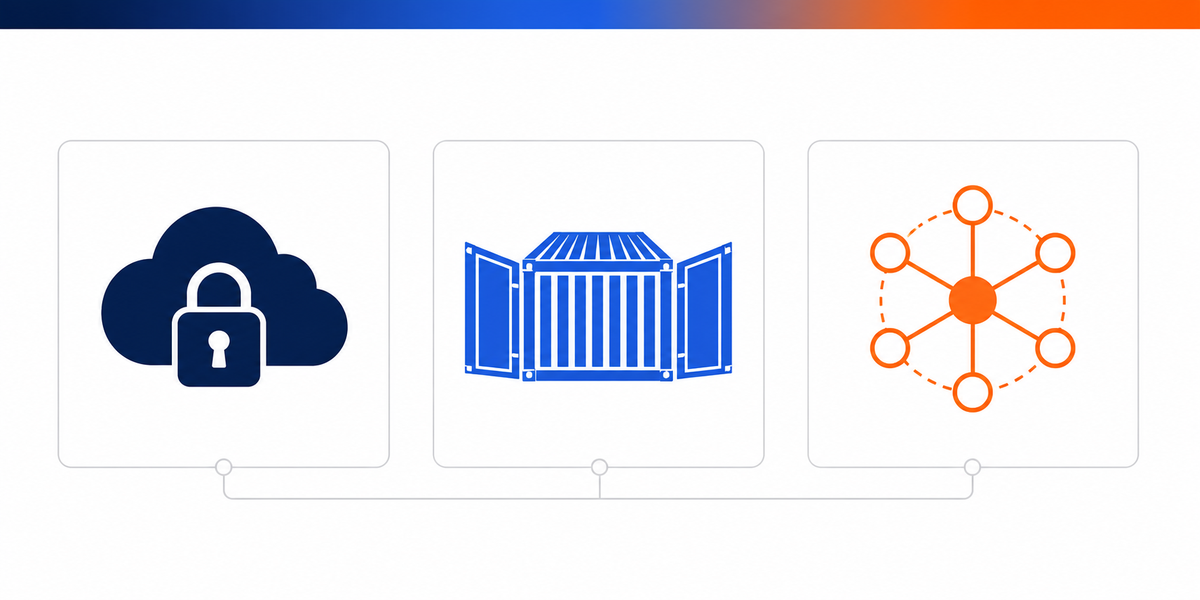
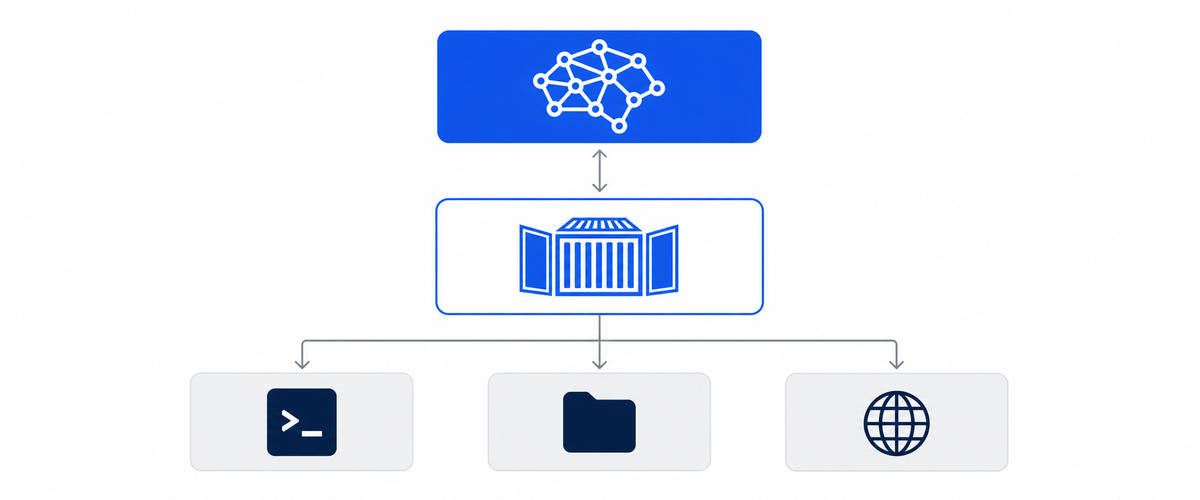
An AI agent execution environment is the layer that handles everything a language model cannot do on its own: launching a terminal, accessing a file system, running code, browsing the web, calling APIs, and above all isolating those actions from the rest of your infrastructure.
Without this layer, an agent operates blind or, worse, with unbounded access to your systems. The most documented security incidents in production agents rarely come from the model itself: they come from a misconfigured or absent execution environment.
Three criteria dominate the choice of an execution environment in enterprise: isolation level (sandboxing), multi-agent support, and production maturity.
Devin: the proprietary pioneer
Launched by Cognition AI in March 2024, Devin popularized the idea of an "autonomous software engineer." The agent relies on proprietary cloud infrastructure, with a dedicated sandbox per session, access to a browser and terminal, and the ability to work asynchronously on long-running tasks.
What sets it apart: context persistence across sessions. Devin maintains a form of working memory across projects, allowing it to resume a task where it left off without manual re-contextualization.
What limits it: the black box. The execution environment is entirely managed by Cognition AI, with no access to internal logs and no way to customize isolation. For teams with strict compliance requirements around data localization, this is a hard blocker.
Cost: approximately $500 per month for team access. No self-hosted option.
OpenHands: the open source leader
Formerly OpenDevin, OpenHands is today one of the most visible and widely adopted open source execution environments for coding agents: over 70,000 GitHub stars and 490+ active contributors as tracked on its public repository, MIT license, and an architecture designed from the start for flexibility.
The principle is straightforward: each agent session runs in an isolated Docker container. The agent has access to a terminal, an editor, a browser, and can call any LLM through a unified interface (Claude, GPT-4o, Gemini, Llama). The model choice is decoupled from the environment.
What sets it apart: total control. Teams can audit the code, customize permissions per container, integrate the environment into their CI/CD via API, and depend on no vendor for execution. Infrastructure costs are limited to LLM tokens and container compute.
What limits it: operational overhead. Deploying OpenHands in production requires managing container orchestration, resource limits, and session persistence. For a small team without dedicated DevOps, this is real friction.
OpenHands' CodeAct architecture deserves a mention: rather than calling tools via JSON functions, the agent generates and executes Python code directly to interact with its environment. This makes actions auditable and reproducible.
Scion: the Google Cloud approach
Scion is an open source project from Google Cloud, led by Google's agent infrastructure team. Its positioning differs from the previous two: it is not an agent, it is an agent orchestrator.
The metaphor used by the Google team is telling: Scion is a "hypervisor for agents." Just as a hypervisor manages multiple virtual machines on a single host, Scion manages multiple agents in distinct GCP containers, with a standardized communication protocol between them.
The environment is harness-agnostic: Scion does not dictate how an agent is built; it provides the execution substrate and coordination layer. A Claude Code agent, a LangGraph agent, and a custom agent can coexist in the same orchestration.
What sets it apart: native multi-agent architecture. Where Devin and OpenHands are designed for a single agent per task, Scion is built for workflows where multiple specialized agents collaborate in parallel or in sequence.
What limits it: maturity level. Scion is explicitly presented as an experimental testbed. There is no stabilized production documentation, and the API may evolve between versions. As of today, Scion suits teams experimenting with multi-agent architecture, not those who need reliable weekly deployments.
Comparison across five dimensions
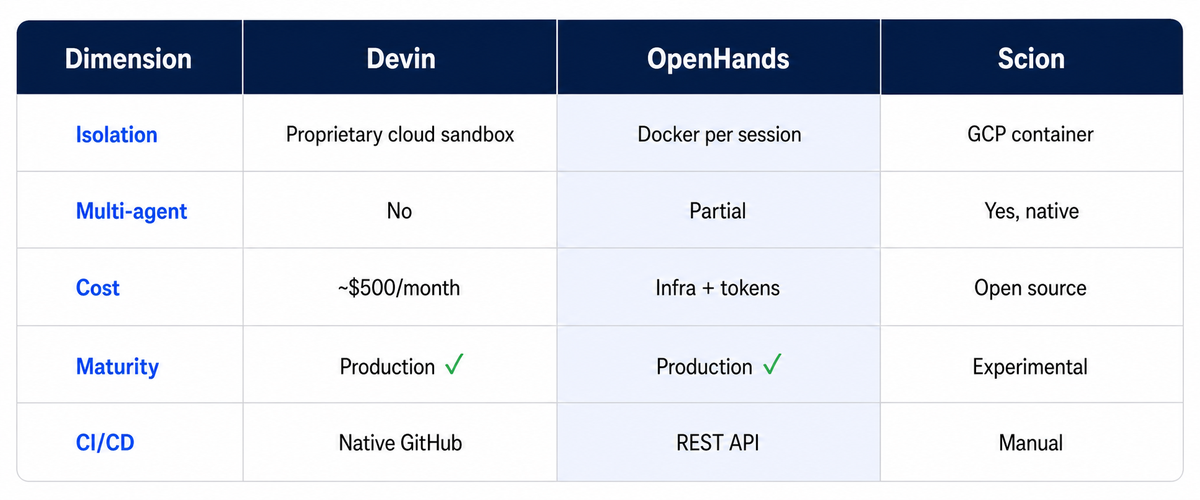
| Dimension | Devin | OpenHands | Scion |
|---|---|---|---|
| Isolation | Proprietary cloud sandbox | Docker per session | GCP container |
| Multi-agent | No (single agent) | Partial (external orchestrator) | Yes, native |
| Cost | ~$500/month | Infra + tokens only | Open source (GCP) |
| Production maturity | Yes | Yes | Experimental |
| CI/CD integration | Native GitHub | Via REST API | Manual |
Which profile fits which tool
Devin fits teams that want a turnkey solution with no deployment friction, whose use cases are well-scoped autonomous engineering tasks (ticket resolution, PR generation, documentation maintenance). The trade-off is complete dependency on Cognition AI and no ability to audit execution.
OpenHands is the choice for technical teams that want control: model selection, action auditing, integration into an existing CI pipeline, compliance on data localization. The active community (daily contributions on GitHub) ensures rapid evolution. It is the most widely deployed of the three in production, with documented deployments in teams of 5 to 500 engineers.
Scion is best reserved for teams exploring multi-agent architecture with an appetite for Google Cloud technologies. Its main value in 2026 is experimental: testing agent-to-agent workflows before industry standards stabilize.
A practical note: OpenHands and Scion are not mutually exclusive. Several teams use OpenHands as the execution environment for individual agents and experiment with Scion as an orchestration layer on top. The harness defined in the July 5 article applies to each individual agent, independently of the orchestrator.
What this means for your roadmap
The choice of execution environment is not an isolated technical decision. It conditions what you can audit, what you can certify to a regulatory auditor, and what you can reuse when you add a second or third agent.
In 2026, the trend is clear: teams that started with Devin for its simplicity are progressively migrating to OpenHands as compliance or cost requirements tighten. Teams anticipating multi-agent architectures are watching Scion closely, without yet deploying it in production.
The question is not which tool is best. It is which one matches your team's current state and the agent maturity you are targeting in 12 months.
To put in motion this week
List your current or planned agent use cases and rank them on two axes: regulatory audit need and multi-agent need. A single agent without strict compliance requirements can start on Devin. A use case subject to audit or requiring integration into an existing CI pipeline points to OpenHands.
If you start on Devin for speed of setup, document now the trigger that would justify a migration to OpenHands: a monthly cost threshold, a data localization requirement, or a need to audit the agent's actions.
If you anticipate multi-agent workflows within the next 12 months, test Scion in a development environment now, without waiting for production stabilization. The goal is to understand the coordination model before you need it under pressure.
Verify that the harness defined for your agents (July 5 article) stays portable across execution environments. A harness too tightly coupled to Devin's infrastructure, for instance, complicates a future migration to OpenHands.
Conclusion
Devin, OpenHands, and Scion answer three different needs rather than three ways of solving the same problem: speed of setup without audit requirements for Devin, control and compliance for OpenHands, multi-agent experimentation for Scion. The deciding criterion is not the tool's perceived power, it's the auditability your organization needs today and the multi-agent trajectory you're anticipating at 12 months.
Sources: As of July 2026
- [Primary] — OpenHands GitHub Repository (70k+ stars, 490+ contributors, MIT license) — GoogleCloudPlatform / All-Hands-AI — 2026 — https://github.com/All-Hands-AI/OpenHands
- [Secondary] — Google Open Sources Experimental Multi-Agent Orchestration Testbed Scion — InfoQ — April 2026 — https://www.infoq.com/news/2026/04/google-agent-testbed-scion/
- [Primary] — Scion Overview — Google Cloud Platform — 2026 — https://googlecloudplatform.github.io/scion/overview/
- [Secondary] — OpenHands Review 2026: 70K Stars — VibeCoding — 2026 — https://vibecoding.app/blog/openhands-review

Comments ()