The Developer in 2026: What Agentic AI Really Changes in Your Engineering Teams

Eighteen months ago, a developer who didn't use GitHub Copilot was viewed with curiosity. Today, a developer who can't orchestrate AI agents is quietly falling behind.
What the industry still calls "AI-assisted programming" has become something fundamentally different. And most CTOs haven't updated their hiring frameworks, evaluation criteria, or team structures to match. Here's a frank take on what's actually changing — and what you need to anticipate over the next 18 months.
1. The Number Nobody Is Actually Talking About
73% of engineering teams use AI coding tools daily in 2026, up from 41% in 2025. Claude Code hit $2.5 billion in annualized revenue by February 2026 — nine months in, with 6× adoption growth between April 2025 and January 2026. GitHub Copilot claims 26 million users with 29% enterprise adoption.
This isn't an S-curve adoption story anymore. It's rapid saturation.
But here's the number that should actually concern you: senior developers (3+ years of experience) gain 40–50% in productivity with these tools. Junior developers gain only 15–25%. Not because the tools are worse for them — but because they lack the judgment to evaluate, refine, and reject AI outputs.
2. The Death of Vibe Coding — and What Comes Next
In February 2026, Andrej Karpathy — the person who coined the term "vibe coding" in 2025 — announced that the vibe coding era was effectively over. Its successor: agentic engineering.
The difference isn't cosmetic. Vibe coding was: write a prompt, accept the code, test, iterate. Agentic engineering is: define an objective, delegate a sequence of actions to an autonomous agent (planning, writing, testing, debugging, committing), and intervene at critical decision points.
Claude Code, GitHub Copilot Workspace, Cursor in agent mode — these tools no longer complete your sentences. They handle tasks. They navigate your codebase, open PRs, run tests, read error logs, and self-correct. A developer who knows how to orchestrate them is equivalent to a two- or three-person team from three years ago.
3. What Actually Changes in the Developer Profile
Here's the concrete shift:
What matters less:
- Typing speed and writing boilerplate
- Memorizing APIs and syntax
- Line-by-line debugging for hours
What matters more:
- Breaking down complex problems into precise instruction sequences
- The judgment to evaluate an agent's output (accept, adjust, reject)
- System architecture fluency — to assess whether the agent's proposed solution is coherent with the whole
- Security awareness — to identify what an agent should never be allowed to do
- Communication — to write specs precise enough that an agent doesn't head in the wrong direction
The 2026 developer is part architect, part reviewer, part AI operator. 92% of US developers use AI tools daily. But daily use doesn't guarantee mastery.
4. The Impact on Your Teams — The Silent Restructuring Already Happening
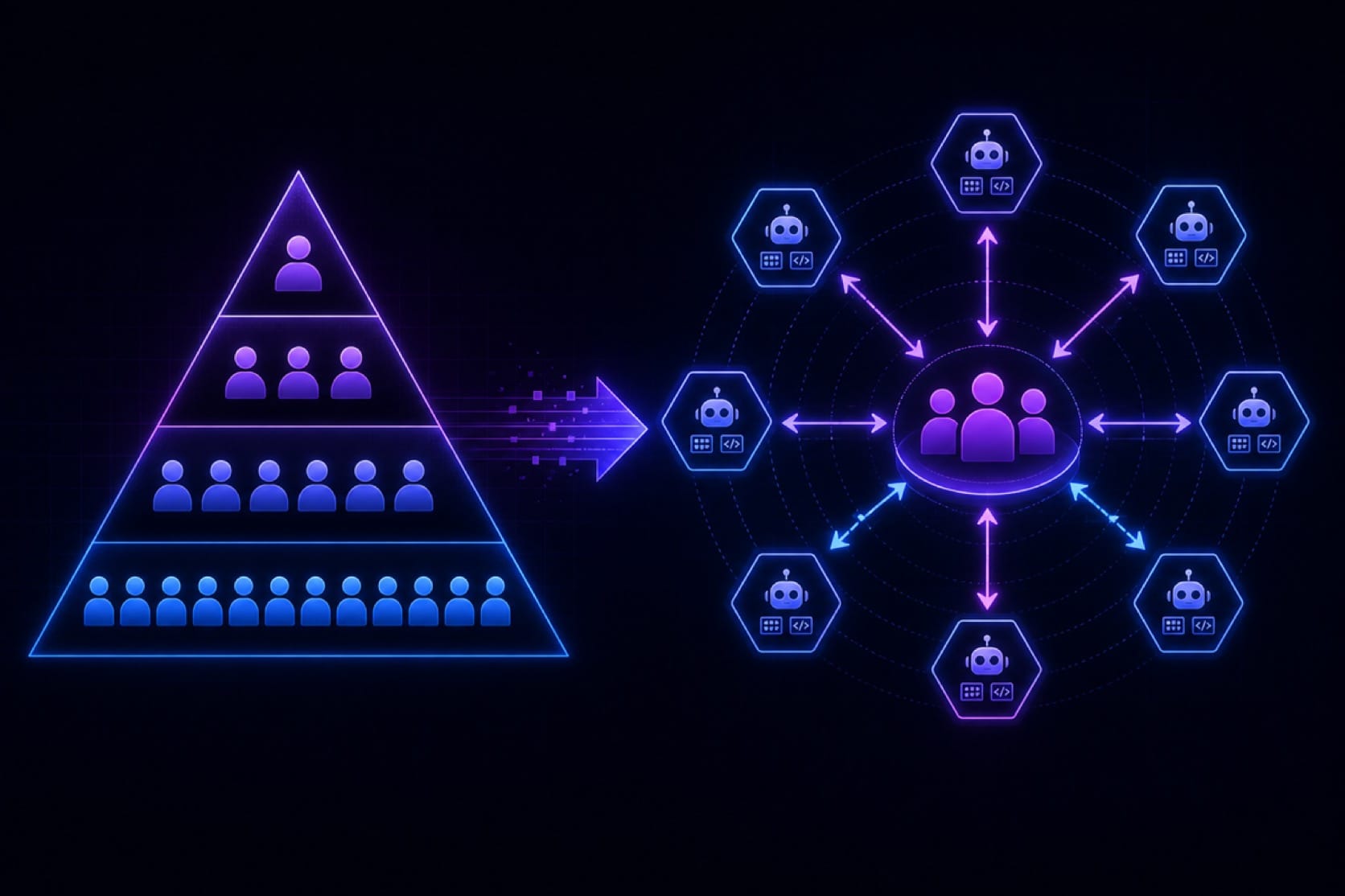
The Pyramid Has Inverted
Teams that previously won by being broad (many juniors for volume) are restructuring. Agents handle volume now. What matters is supervision quality.
Companies like Netflix, Shopify, and Goldman Sachs — which have deployed Claude Code at scale — found that smaller teams of seniors supervising agents deliver more than larger teams operating the old way.
The High-Potential Junior Has a New Profile
Until now, you hired a junior for their ability to produce simple code under supervision. Tomorrow, you'll hire them for their ability to quickly learn where the agent fails and fix it. The junior of tomorrow must understand architecture well enough to evaluate a PR generated by an agent — without having written every line themselves.
That's a fundamentally different skill. And it isn't taught yet in most training programs.
Seniors Become Multipliers
A senior who masters agent orchestration can today handle a scope of work that would have required 3–4 people three years ago. That's an opportunity, not a threat — provided your organization chooses to properly value these profiles rather than simply reducing headcount.
5. What CTOs Are (and Aren't) Doing at This Stage
Here's an honest snapshot:
Already in place at leading organizations:
- AI usage standards in the SDLC (mandatory review of agent-generated PRs, no direct merges)
- Sandboxed agent environments with strictly limited permissions
- Different tracking metrics: not lines of code, but cycle time, revert rate, review quality
Still missing at most organizations:
- Updated hiring criteria — few JDs explicitly ask for "ability to orchestrate and evaluate AI agents"
- Training plans for mid-levels who never developed output evaluation skills
- Thinking on IP and security for generated code — particularly in regulated sectors
- Guardrails on what agents can and cannot do in production environments
6. The 18-Month Anticipation Framework
Questions you should be asking now:
On hiring: Do your job descriptions still ask for "3 years of React experience" or are you looking for someone who can drive an agent on a complex React codebase? These aren't the same thing.
On training: Can your mid-levels evaluate a 500-line diff generated by Claude Code in 30 seconds? If not, that's an immediate operational risk.
On organization: Have you clarified who is responsible when an agent introduces a production bug? The developer who approved the PR? The lead? The AI system?
On costs: Claude Code costs roughly $100/month per developer. A senior who orchestrates agents is 2–3× more productive. The ROI is positive — but only if you're measuring the right output.
On security: Have you defined an access policy for your agents? An agent with access to your production database, environment secrets, and GitHub repo is an attack vector if misconfigured. (We'll cover this in a future article.)
7. What the CTO Should Do This Week
- Audit actual adoption in your teams — not just purchased licenses, but real usage and output review quality
- Identify 2–3 seniors who already master agent orchestration — these are your future AI engineering leads
- Revise a current job posting to explicitly include agent evaluation competencies
- Define a minimal policy: which environments agents can access, which actions require human approval
- Schedule a 2-hour session with your leads: live demo of a complete workflow with Claude Code or Copilot Workspace — to align everyone on what "production-ready with agents" actually means
Conclusion: The Risk Isn't AI — It's the Lag
The mistake would be treating this as an HR or long-term training issue. It's a short-term competitiveness question. Teams that have learned to orchestrate agents effectively ship faster, with fewer people, across broader scopes.
Your competitors are already doing this. The question isn't whether you need to adapt your teams — it's how fast you can do it without sacrificing quality.
Sources:
- Agentic Coding in 2026: AI's Impact on Software Development — Times of AI — 2026
- 2026 Agentic Coding Trends Report — Anthropic — 2026
- Vibe Coding: Impact of AI on Software Teams in 2026 — 2am.tech — 2026
- AI Coding Agents 2026: Cursor, Claude Code, and GitHub Copilot — Programming Helper Tech — 2026
- Redefining the future of software engineering — MIT Technology Review — April 2026
Comments ()