Delegate or supervise: what 300 tech leaders reveal about your agent roadmap
The question is no longer "should we deploy AI agents?" Three hundred tech leaders have settled it: according to the Agent Confidence Index published in June 2026 by MIT Technology Review Insights and Microsoft, 78% of them have agents in production or in pilot. The real question has become: which tasks can you trust them with, and which ones require close human oversight?
This distinction matters more than it might seem. A study published in the Harvard Business Review in May 2026 (Emma Wiles, Boston University) shows that managers who treat an agent as a "coworker" detect 18% fewer errors in its work than those who treat it as a tool. How you name and position your agents in your organization has measurable consequences on your teams' vigilance.
The method behind the numbers
The Agent Confidence Index is based on 300 tech executives surveyed between February and March 2026, from companies of 500 to 10,000 employees, across all sectors. For each of the 101 tasks evaluated, the score reflects the aggregate confidence level to delegate that task to an agent without systematic human supervision.
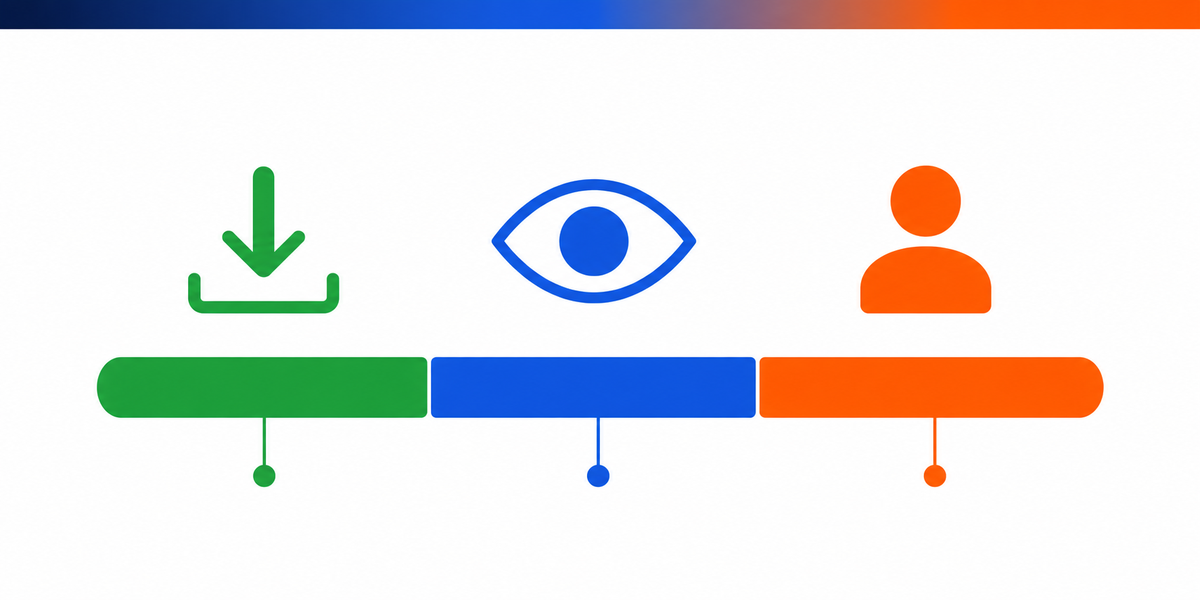
The scale runs from 0 to 100. A score above 75 means the majority of decision-makers are ready to delegate without a safety net. Between 50 and 75, confidence is conditional: a robust harness and periodic supervision are expected. Below 50, decision-makers consider that a human must remain in the loop systematically.
This is not a technical performance benchmark. It is a signal about the perceived maturity of agents in real operational contexts, with the real stakes that come with them.
Zone 1: delegate now (score above 75)
High-scoring tasks are those where agents have proven their reliability at scale and where the cost of an error remains manageable.
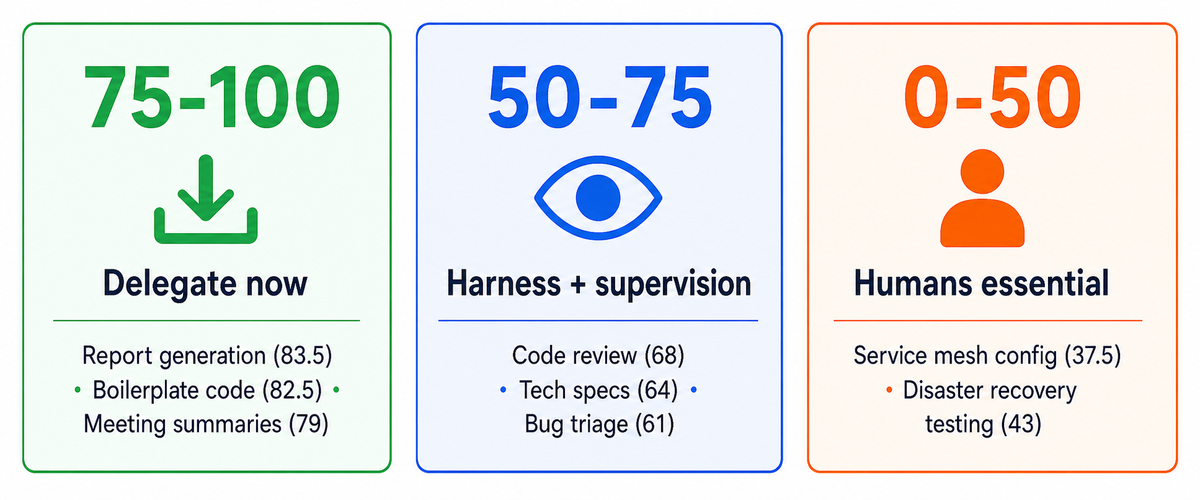
At the top of the ranking: automated report generation (83.5) and boilerplate code generation (82.5). These two tasks share a common profile: well-defined scope, verifiable output, low systemic risk. An agent that generates a weekly analysis report can make mistakes without irreversible consequences. A human reviews, corrects, publishes.
Other high-scoring tasks: meeting and ticket summarization (79), data formatting and transformation (77), technical documentation writing (76).
The signal for a CTO: these tasks are your entry point. They allow you to build internal trust in agents, train teams on supervision, and measure quick ROI before tackling more complex tasks.
Zone 2: harness and supervision (score 50 to 75)
This zone is the densest in the report, and the most instructive. It covers tasks where agents can bring real value, but where execution conditions determine everything.
Representative tasks include: code review (68), technical specification writing (64), production bug triage (61), unit test generation (58).
What this zone reveals: confidence is not intrinsic to the task, it is intrinsic to context. An agent that generates unit tests in a CI pipeline with automatic validation and mandatory human review before merge inspires more confidence than an agent operating without constraints. This is exactly the role of the harness described in previous articles on harness engineering: creating the conditions under which confidence is justified.
The Agent Confidence Index notes that 43% of decision-makers identify resource consumption and costs as their main concern in this zone. An agent triaging bugs that loops on a complex incident can generate significant inference costs for an uncertain result. Supervision is not only qualitative: it is also economic.
Zone 3: humans remain essential (score below 50)
The lowest scores in the report are consistent with intuition: they correspond to tasks where errors are costly, difficult to detect, or have irreversible consequences.
At the bottom of the ranking: service mesh configuration (37.5) and disaster recovery testing (43). These tasks involve critical systems where an incorrect action can bring down an entire infrastructure. The contextual complexity exceeds what agents can reliably handle today.
A counterintuitive finding from the report: several tasks that technical experts consider "perfect for agents" receive low scores because the practitioners who execute them daily do not trust agents to handle them. A Stanford study cited in this report surveyed 1,500 workers across 104 jobs: the tasks that engineers thought most suited for agents were often the ones practitioners least wanted to delegate.
This gap between architects' vision and operators' reality is one of the most important lessons of the report. Adoption cannot be decreed.
What this changes for your organization
The question of terminology deserves to be addressed directly. Wiles's study on managers reveals a precise mechanism: when an agent is presented as a "colleague" or "digital employee" with a name and a job description, humans tend to grant it a social status that reduces their vigilance. They are 44% more likely to escalate the agent's decisions rather than correct them themselves, which negates the expected productivity gain.
Daron Acemoglu, economist at MIT and 2024 Nobel laureate, put it directly in a June 2026 MIT Technology Review interview: agents "should be optimized so that they can improve human capabilities," which is not how most of them are designed today. This framing shifts the nature of the deployment decision: the question is not "can this agent do this task?" but "how does this human-agent system produce better results than either alone?"
Several principles emerge from the synthesis of the report and associated studies:
Name your agents as tools, not collaborators. Anthropomorphic identity creates measurably reduced vigilance. An agent is called "ticket-synthesis" or "report-generator," not "Alex" or "your engineering assistant."
Build verification loops before expanding scope. Organizations that progress fastest in agent adoption are not those that deploy most broadly: they are those with the most rigorous validation processes on a restricted scope.
Measure perceived confidence in your teams, not just technical performance. If your engineers do not trust the agent on task X, the agent's performance score on that task tells you little about your ability to operate it.
The decision framework
For each task you are considering handing to an agent, three questions are sufficient:
What is the cost of an undetected error? If the answer is "significant and difficult to reverse," stay in zone 3 regardless of the agent's theoretical performance.
Do you have a harness capable of bounding the action scope? Without isolation, logging, and execution constraints, zone 2 tasks slide toward zone 3 behaviors.
Are your teams trained to supervise, not just to delegate? Supervising an agent requires different skills than directly executing a task. It is not less work, it is different work.
To put in motion this week
Run your 10 most advanced agent use cases through the three decision-grid questions, and sort them into zone 1, 2, or 3. Cases misclassified into zone 3 for lack of asking these questions explicitly are the ones that generate the most incidents.
Audit how your agents are named and presented internally. An agent given a first name or a job title should be renamed functionally before its next deployment, the vigilance gain measured in the Wiles study is immediate and free.
For every zone 2 task, verify that a bounded harness (isolation, logging, execution constraints) actually exists, not just on paper. A zone 2 task without a robust harness behaves like a zone 3 task.
Train your teams on agent supervision as a distinct skill, with dedicated time, not as an informal add-on to existing workload.
Conclusion
The Agent Confidence Index is not a definitive ranking. It is a snapshot of what 300 decision-makers have learned the hard way. In 18 months, several tasks currently in zone 3 will migrate to zone 2 as agents and harnesses mature. Your roadmap should anticipate these migrations rather than be caught off guard by them.
Sources: As of July 2026
- [Primary] — Agent confidence on the technical frontier (300 tech leaders, 101 tasks) — MIT Technology Review Insights & Microsoft — June 29, 2026 — https://www.technologyreview.com/2026/06/29/1139635/agent-confidence-on-the-technical-frontier/
- [Primary] — AI agents are not your "coworkers" — MIT Technology Review — June 29, 2026 — https://www.technologyreview.com/2026/06/29/1139849/ai-agents-are-not-your-coworkers/
- [Primary] — Research: Why You Shouldn't Treat AI Agents Like Employees — Emma Wiles, Harvard Business Review — May 2026 — https://hbr.org/2026/05/research-why-you-shouldnt-treat-ai-agents-like-employees
- [Primary] — Research: Why You Shouldn't Treat AI Agents Like Employees — Boston University Questrom Insights — 2026 — https://insights.bu.edu/research-why-you-shouldnt-treat-ai-agents-like-employees/
- [Primary] — What Workers Really Want From AI — Stanford Future of Work / SALT Lab — 2025-2026 — https://news.stanford.edu/stories/2025/07/what-workers-really-want-from-ai
Comments ()