CTO, CDO, CAIO: Who Really Owns AI Strategy in Your Organization?
📌 This article is written for tech executives and C-suite members navigating the proliferation of AI roles within their organizations. It draws on data published between October 2025 and February 2026.
The question everyone asks behind closed doors
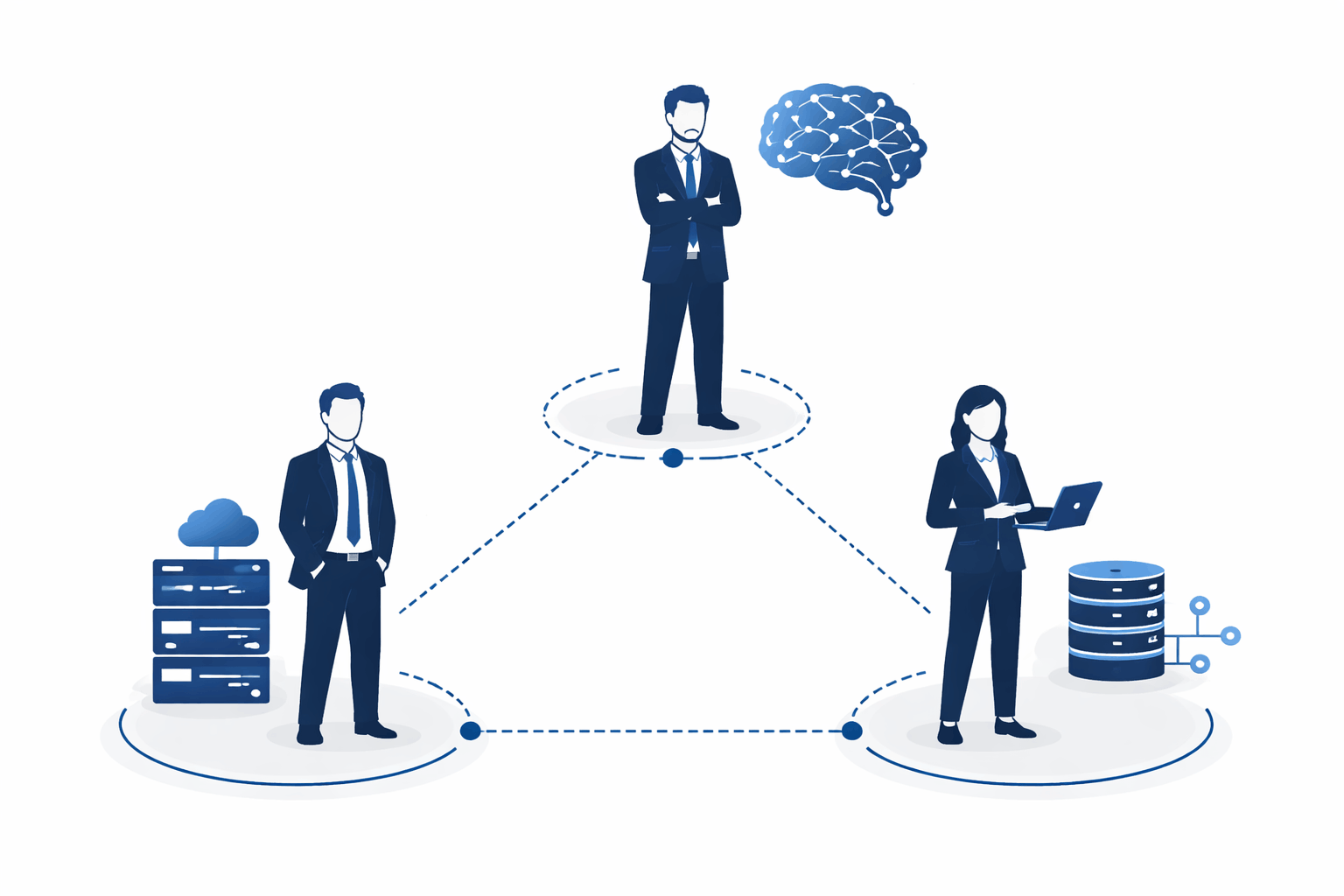
In every large organization I encounter in 2026, the same question surfaces — rarely asked openly, always present in the background during AI steering committees:
"Who owns the AI strategy — the CTO, the CDO, or the new Chief AI Officer we just hired?"
And behind that question, a painful operational reality: three owners, three roadmaps, budget arbitrations settled through internal politics rather than strategic coherence.
Recent data paints a precise picture of where large organizations stand: 90% of enterprises have now appointed a CDO, and 38% have also named a Chief AI Officer — with 52% of respondents believing a CAIO or equivalent should be appointed in their organization.
As of: January 2026 — Source: Data & AI Leadership Exchange 2026 Executive Benchmark Survey, 600+ CDO/CAIO respondents
Three roles. One territory. Here's how to untangle the challenge.
Why this ambiguity is dangerous — and expensive
Before defining who does what, we need to name the real cost of the blur.
When AI governance is unclear between CTO, CDO, and CAIO:
- AI projects stall waiting for decisions that navigate between three functions with different agendas.
- Budgets fragment into competing initiatives rather than compounding into a coherent architecture.
- Front-line teams receive contradictory signals: the CTO wants infrastructure standardization, the CDO wants data flexibility, the CAIO wants rapid experimentation.
- Vendors exploit the gaps and sell the same solution three times to three different stakeholders.
A typical organization today uses 11 generative AI models and plans to use at least 16 by the end of 2026. Without clear governance across these three roles, model sprawl becomes unmanageable.
As of: 2025 — Source: IBM Institute for Business Value — Chief AI Officer Report
The counter-intuitive insight: The question isn't "should we create a CAIO role?" — it's "how do we redefine the complementarity between CTO, CDO, and CAIO so that AI delivers business value instead of internal politics?"
The CTO in 2026: from technical lead to Chief Transformation Officer
The CTO role is undergoing its deepest mutation since the advent of cloud computing.
According to Egon Zehnder's February 2026 analysis on the evolution of the CTO role in technology services: "The CTO is really becoming a Chief AI Officer — not because the job is only about GenAI models, but because AI now sits at the center of delivery, go-to-market economics, and differentiation."
As of: February 2026 — Source: Egon Zehnder — "The CTO's New Mandate in Technology Services", 2026-02
But the same analysis points to a critical tension: most CTOs spend 90% of their energy on productivity and cost reduction — while boards expect 90% of focus on revenue growth.
In practice, in large organizations, the 2026 CTO is simultaneously piloting three horizons:
| Horizon | What the CTO must do | What gets in the way |
|---|---|---|
| Defend | Maintain stability of production systems | Absorbs 70–80% of real time |
| Extend | Integrate AI into existing processes | Depends on CDO for data |
| Disrupt | Rethink business models with AI | Not their historical mandate |
What the CTO uniquely owns: architecture, infrastructure, security, delivery. They define how AI is built and deployed reliably and at scale. They are the guarantor of production-readiness.
What they can't do alone: decide which data feeds the models, or which business use case justifies the investment.
The CDO in 2026: from data custodian to AI co-architect
The CDO has historically had an existence problem: many organizations created the role as a defensive function (compliance, data quality, GDPR) before realizing it was the keystone of any AI strategy.
The good news: the CDO role is now widely accepted and established. The bad news: most CDOs are still positioned as "data janitors" rather than transformation co-pilots.
For AI to deliver ROI, the CDO must control four critical dimensions:
1. Data quality upstream of models
No good AI without reliable data. The CDO defines quality standards, documents data lineage, and certifies datasets before they enter AI pipelines. It's foundational work, rarely visible, absolutely critical.
2. AI model governance in production
76% of organizations admit their AI governance doesn't keep pace with employees' actual AI usage. The CDO is the only role positioned to close this gap — by defining usage rules, supervision mechanisms, and audit processes.
As of: January 2026 — Source: CDO Insights 2026 — Informatica / Salesforce, 600 data leaders
3. AI regulatory compliance
With the EU AI Act entering full enforcement on August 2, 2026, the CDO becomes the AI compliance owner in European organizations — in partnership with the DPO and CISO. This is new territory that few CDOs have yet claimed.
4. Organizational AI literacy
75% of data leaders say their employees need upskilling in data literacy, and 74% in AI literacy. The CDO drives these programs — not merely as an HR exercise, but as a prerequisite to AI ROI.
What the CDO uniquely owns: data strategy, governance, compliance, AI literacy. They define what AI works with and under what conditions.
What they can't do alone: decide on technical architecture, or validate business use cases without business unit support.
The CAIO in 2026: the youngest, most ambiguous, potentially most strategic role
38% of large organizations now have a Chief AI Officer. And in 61% of cases, that CAIO controls the organization's AI budget.
As of: 2025 — Source: IBM IBV — Chief AI Officer Report (600+ CAIOs, 22 geographies)
But the role definition remains blurry in most organizations, creating friction with both the CTO and CDO.
Here's how the most advanced organizations are positioning the CAIO:
The CAIO as "Chief Value Officer" for AI
The CAIO is neither a second CTO nor a lighter CDO. Their role is to translate AI capabilities into measurable business value — where the CTO speaks reliability and architecture, and the CDO speaks quality and compliance.
In practice, the CAIO:
- Prioritizes use cases based on their business value potential (not their technical complexity or data volume)
- Manages the portfolio of agents and models in production at organizational scale
- Measures and reports AI ROI to the board — with business metrics, not just technical ones
- Orchestrates interactions between CTO, CDO, business units, and AI vendors
The field pattern: in organizations where the CAIO succeeds, they spend 60% of their time with business unit leaders — not with tech teams. Their native language is P&L, not tokens and embeddings.
Watch out: the CAIO can also be an anti-pattern
In organizations where the CAIO is hired urgently to "signal that AI is a priority," without clearly redefining their scope relative to the CTO and CDO, the role becomes an additional source of confusion.
Warning signs:
- The CAIO has no independent budget
- The CAIO reports hierarchically to the CTO (not the CEO or COO)
- The CAIO is not involved in business portfolio reviews
What the CAIO uniquely owns: AI value strategy, the production agent portfolio, the board/Comex relationship. They define why a given AI initiative should be prioritized and what return it must generate.
The responsibility matrix — what each role must own
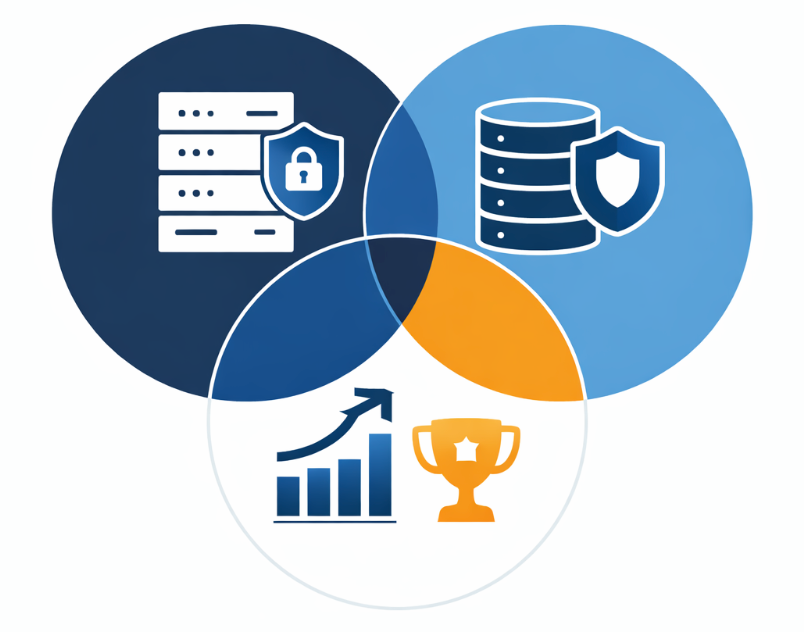
| Responsibility | CTO | CDO | CAIO |
|---|---|---|---|
| AI architecture & infrastructure | ✅ Lead | 🤝 Contributor | ℹ️ Informed |
| Model security & data sovereignty | ✅ Lead | 🤝 Contributor | ℹ️ Informed |
| Data quality & governance | ℹ️ Informed | ✅ Lead | 🤝 Contributor |
| EU AI Act / GDPR compliance | 🤝 Contributor | ✅ Lead | 🤝 Contributor |
| AI literacy & upskilling | ℹ️ Informed | 🤝 Contributor | ✅ Lead |
| Use case portfolio & prioritization | 🤝 Contributor | 🤝 Contributor | ✅ Lead |
| AI ROI & board reporting | ℹ️ Informed | 🤝 Contributor | ✅ Lead |
| Production-readiness & deployment | ✅ Lead | ℹ️ Informed | 🤝 Contributor |
| Strategic AI vendor relationships | 🤝 Contributor | 🤝 Contributor | ✅ Lead |
Legend: ✅ Lead = primary decision-maker | 🤝 Contributor = co-decision-maker | ℹ️ Informed = consulted
What happens when roles overlap without clarity
Here are the three most common friction scenarios, and how to resolve them.
Friction 1 — "Who owns the production agent?"
The CTO thinks they own it because it runs on their infrastructure. The CDO thinks they own it because it consumes their data. The CAIO thinks they own it because they initiated the use case.
Resolution: create a transverse "AI Product Owner" role, reporting to the CAIO, with an explicit mandate on delivery and ROI for each production agent.
Friction 2 — "Who approves a new model for go-live?"
Without a clear process, every go-live becomes a three-way negotiation between security (CTO), data quality (CDO), and business urgency (CAIO).
Resolution: define an "AI Release Gate" with objective criteria shared across all three functions — architecture, data, business value — and a weekly or bi-monthly validation committee.
Friction 3 — "Who presents AI to the board?"
If all three roles present AI topics to the Comex separately, the board receives three versions of the organization's AI maturity — often inconsistent.
Resolution: the CAIO presents the consolidated AI performance report to the board. The CTO and CDO feed the slides, but don't carry the business narrative.
FAQ — Common questions about these roles
Does my organization need to create a CAIO? Not necessarily. If your CTO and CDO work in synergy and have the capacity to jointly pilot the AI portfolio, a CAIO may be redundant. The CAIO is relevant when AI represents a strategic growth lever that exceeds the scope of both other roles — and when the organization has the means to make it work with a real budget and a clear mandate.
Should the CAIO have a technical or business profile? Both, but with a business dominant. The CAIO must understand technical constraints without directly managing them. Their superpower is speaking fluently the language of both business units and AI simultaneously.
What if all three roles already exist but operate in silos? Create an "AI Governance Council" bringing together CTO, CDO, and CAIO bi-monthly with a strict agenda: portfolio review, budget arbitrations, escalations. Without a formal governance instance, silos persist.
Can the CDO absorb the CAIO role? In mid-size organizations (under 5,000 employees), often yes — provided the CDO is repositioned as a CDO/CAIO with an explicit business mandate. In large organizations, both roles have scopes too broad to be carried by a single person.
The bottom line: the AI governance triangle
Enterprise AI transformation doesn't succeed with a single role — it succeeds with a clear governance triangle.
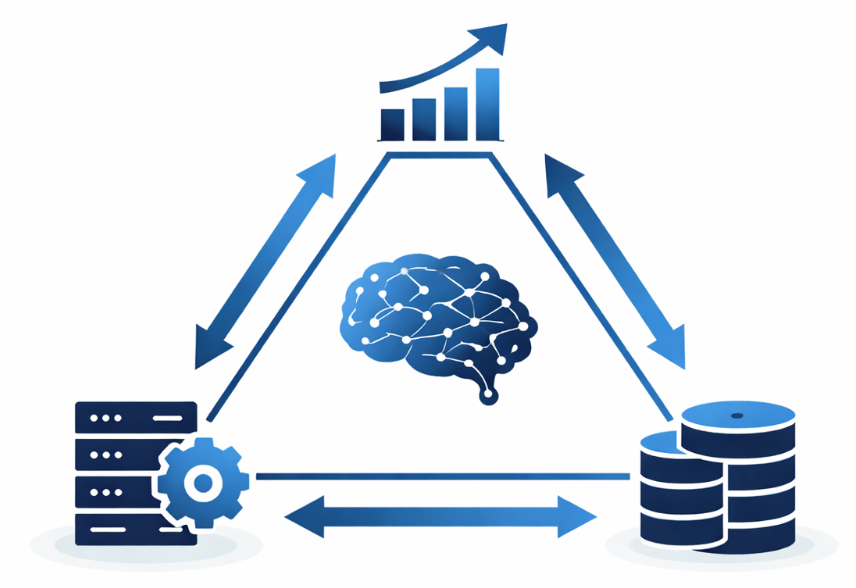
- The CTO ensures AI is reliable, secure, and scalable.
- The CDO ensures AI is fed with quality data and compliant with the rules.
- The CAIO ensures AI delivers measurable business value and that the board understands where the organization is headed.
These three roles are not competitors. They are complementary — provided that responsibilities are defined with precision before projects begin, not once they're already in crisis.
The real question for your organization isn't "which role do I need?" — it's "what is my AI decision matrix, and who owns it?"
Leading an AI transformation in enterprise? Subscribe to my newsletter for weekly insights from what I apply in production at large-scale retail organizations.
Sources
Secondary — Data & AI Leadership Exchange 2026 Executive Benchmark Survey — squarespace.com — 2026-01 — https://static1.squarespace.com/...Secondary — CDO Insights 2026: Data governance and the trust paradox — Informatica / Salesforce — 2026-01-27 — https://www.informatica.com/blogs/cdo-insights-2026Secondary — The CTO's New Mandate in Technology Services — Egon Zehnder — 2026-02 — https://www.egonzehnder.com/functions/technology-officers/chief-technology-officers/insights/the-cto-s-new-mandateSecondary — How Chief AI Officers Deliver AI ROI — IBM Institute for Business Value — 2025 — https://www.ibm.com/thought-leadership/institute-business-value/en-us/report/chief-ai-officerSecondary — Chief Data Officer Priorities for 2026 — OvalEdge — 2025-12 — https://www.ovaledge.com/blog/chief-data-officer-priorities-2024



Comments ()